
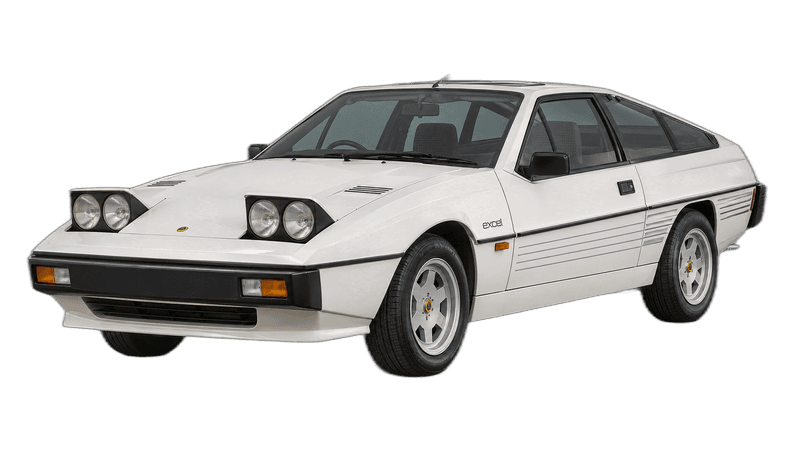
Lotus Excel
160bhp
Power
209km/h
Top Speed
The Lotus Excel is a 2-door coupé by Lotus, with 160 bhp, 217 Nm of torque and a top speed of 209 km/h.
Dream Car Garage Editorial · Last updated 3 November 2026
Overview
We have not driven this car. This review is based on published specifications and the sources listed below.
Scope of this guide
This guide is scoped to the Lotus Excel, the standard 160 bhp car sold from October 1982 to 1992. It is a two-door 2+2 coupé with a front-engine, rear-wheel drive layout, a galvanised steel backbone chassis, a glass-fibre body styled by Oliver Winterbottom and a 2.2 litre Lotus type 912 slant-four engine. It is the last front-engined, rear-wheel drive four-seat grand tourer Lotus built, according to the SELOC technical wiki. We say below how the later SE and SA versions differ, but we do not treat them as the subject of the page, and this is not a guide to the Esprit.
We have not driven this model for this article. We are an editorial desk that reads sources, and everything below comes from pages we opened: Wikipedia, the Lotus Cars heritage page for the Excel, the SELOC technical wiki, two Motor Sport magazine archive articles (a September 1983 road test of the Excel and a September 1986 report on the SE), The Drive, a Bonhams Cars Online auction listing carried on The Market, and three specification sites (Ultimatespecs, Automoli and Cararac). We have not inspected, owned or tested a car. This page is research, not a buying recommendation, and it cannot replace an inspection by a Lotus specialist.
The figures at a glance
- Engine: 2.2L naturally aspirated inline-four, the all-aluminium Lotus type 912 of 2,174 cc with two overhead camshafts and four valves per cylinder, mounted at the front and tilted over in the slant-four manner, fed by two twin-choke 45 mm Dellorto carburettors.
- Layout: front-engine, rear-wheel drive, with a Toyota five-speed manual gearbox, differential and driveshafts. A ZF four-speed automatic was added on the SA.
- Power: 160 bhp for the standard car. Wikipedia prints 160 hp (119 kW; 162 PS). Converting 162 PS at 0.98632 gives about 159.8 bhp and converting 119 kW at 1.34102 gives about 159.6 bhp, so we use 160 bhp throughout. The Motor Sport road test of 1983 also states 160 bhp.
- Torque: 217 Nm. The Motor Sport SE report gives the standard car as 160 lb ft, and 160 lb ft multiplied by 1.35582 is 216.9 Nm, which we round to 217 Nm. Ultimatespecs independently prints 217 Nm for the standard car.
- Top speed: 209 km/h. The Motor Sport road test of 1983 measured 130 mph, and 130 mph multiplied by 1.60934 is 209.2 km/h. Maker and spec-site claims run higher, explained below.
- 0-100 km/h: no figure shown. Sources give 0-60 mph times, which are not a 0-100 km/h time, and we do not relabel them.
- Weight: 1,125 kg in the Motor Sport road test and on the Lotus page, and 1,168 kg on Wikipedia.
- Years: 1982 to 1992.
- Production: sources disagree and we show no single count (see the production section).
Which power figure we use, and why
Two outputs were offered over the life of the car. The original Excel, called the Éclat Excel for the 1982 and 1983 model years, was rated at 160 bhp. The SE, introduced in October 1985, was rated at 180 bhp. We describe the standard car, so every performance number in this guide that is not marked as an SE number belongs to the 160 bhp engine.
The SE rating appears as 180 bhp in the Motor Sport report of September 1986, on the Lotus heritage page, on the SELOC wiki and on Wikipedia, where it is given as 180 hp (134 kW; 182 PS). Converting 182 PS at 0.98632 gives about 179.5 bhp and converting 134 kW at 1.34102 gives about 179.7 bhp, so the sources agree on 180 bhp. Automoli and Cararac instead print 184 hp for the SE and SA, which is a metric horsepower figure; 184 PS at 0.98632 is about 181.5 bhp. We treat that as a rounding of the same engine rather than a different one. Ultimatespecs gives 158 HP for the 160 PS standard car, which is the same output expressed in another unit.
Origins and design
The Excel was unveiled in October 1982 as the Éclat Excel, with Lotus type number 89, as an evolution of the Éclat, itself a development of Lotus's earlier 1970s wedge-shaped four-seater. Wikipedia credits Oliver Winterbottom as designer. The Lotus page says every body panel was redesigned for a more aerodynamic shape, that the car got a new gearbox and drivetrain, and that the chassis kept its essential layout but was galvanised. It also says the drag coefficient improved from 0.34 on the Éclat to 0.32.
The Toyota connection matters for the character of the car. The SELOC wiki says the Excel used Toyota Celica Supra components, including the transmission and brakes, and that these improved reliability over the Éclat. The Motor Sport road test describes the gearbox as a Toyota five-speed with a Toyota differential and driveshafts, and the brakes as ventilated discs front and rear made in Japan, with a servo. The rear suspension used an Esprit-style top link and lower wishbone in place of the Chapman strut used on earlier cars.
Wikipedia gives the dimensions as a wheelbase of 2,483 mm, a length of 4,398 mm, a width of 1,816 mm and a height of 1,207 mm. It says the body is vacuum-injected resin made in upper and lower halves joined together, and describes the front suspension as a single transverse lower arm with an anti-roll bar and a wishbone above, with coil springs and dampers throughout.
What the 1983 road test found
Motor Sport tested the Excel in September 1983 under the headline of an excellent car, and recorded the following.
- 0-60 mph in 7.2 seconds and 0-100 mph in 21 seconds.
- A top speed of 130 mph, reached in fifth gear at 6,150 rpm, which is the 209 km/h figure we use.
- Fuel consumption of 20.6 mpg overall from a 67 litre tank.
- A kerb weight of 1,125 kg, about 70 kg less than the 163 bhp Porsche 944 the magazine compared it with.
- Handling described as extremely neutral and secure, a ride firmer than earlier Éclats with more road feel, and nicely weighted power steering.
- A price of 14,273 pounds, or about 16,000 pounds as tested with options including leather at 773 pounds and power steering at 650 pounds.
The reviewers found the seats flat with limited thigh support, the rear seats adequate for headroom but short on legroom, and luggage space for two suitcases and soft bags with a full-size spare wheel in the floor. Those are impressions from a 1983 test, not our own.
Top speed claims against the measured figure
This is where the sources disagree most.
- Motor Sport measured 130 mph (209 km/h) on the standard car in 1983.
- Ultimatespecs prints 216 km/h (134 mph) for the standard 160 PS car and Automoli prints 216 km/h for the 162 PS version.
- Automoli prints 217 km/h for the SE and SA, and the Motor Sport SE report says its measured 128.9 mph (about 207 km/h) was 5 mph below the Lotus claim.
- The Motor Sport SE report measured 7.2 seconds to 60 mph against a Lotus claim of 6.8 seconds. Automoli and Cararac print 6.8 seconds for the SE, which matches the maker's 0-60 mph claim rather than the magazine's measurement; Cararac labels it as a 0-100 km/h time, which we do not accept.
We use the measured 209 km/h because it is the one figure from a test of the standard car that we could read directly. Ultimatespecs also prints a 0-100 km/h time of 7.1 seconds, but it does not say where the figure comes from and it sits very close to the 0-60 mph times that magazines recorded, so we do not adopt it. For 0-100 km/h there is no figure shown on this page.
How the SE and SA differ
The Excel SE arrived in October 1985 and the automatic SA in October 1986, according to Wikipedia and the SELOC wiki. Lotus gives the SE as running to 1992.
- Engine: a higher-compression version of the 2.2 litre engine, with a compression ratio of 10.9:1, higher-lift inlet cams and larger porting. Power rose from 160 bhp to 180 bhp, and torque from 160 lb ft to 165 lb ft (224 Nm at 1.35582), which the Motor Sport report calls a marginal gain. The SE is recognised by red cam covers.
- Bodywork: Lotus describes restyled, more aerodynamic bodywork with wheel-arch blisters, bonnet vents, a slightly larger rear spoiler and nine-spoke 15 inch alloy wheels. The SE report mentions a stepped front air dam and a revised rear wing.
- Cabin: a tilting steering column borrowed from the Toyota Supra, improved switchgear and walnut veneer.
- Weight: 1,135 kg for the SE on the Motor Sport report and Wikipedia.
- Price: Motor Sport says the SE cost about 1,000 pounds more than the standard car. Its text gives 18,500 pounds and its table gives 17,980 pounds, so the magazine disagrees with itself.
- SA: the same SE engine with a ZF four-speed automatic, cruise control and central locking. No page we read gives a separate SA power or performance figure.
Changes over the run
The sources give a model-year timeline. Wikipedia and the SELOC wiki agree on most of it.
- 1984 model year: the Éclat name is dropped, with body-coloured bumpers, a louvred bonnet, a boot spoiler and an optional eight-spoke wheel.
- 1985 model year: flared front wheel arches, a larger boot opening, front fog lamps, VDO instruments and an optional 15 inch wheel.
- 1987 and 1988: the SELOC wiki records a cross-drilled crankshaft, new engine mounts and bell housing in March 1987, and a revised undertray, rear body mounts, boot floor brace and fuel system in July 1987.
- 1989 model year: restyled bonnet, new front and rear spoilers, updated wheels and interior trim and air intake temperature control.
- Late editions: a Hethel 25th Anniversary edition in metallic green, introduced in November 1990 according to Lotus, of which Wikipedia says 40 were built, and a 1991 Aquascutum edition in midnight blue.
Production numbers
We cannot reconcile the production total from the pages we read.
- Wikipedia and The Drive give 2,075 built from 1982 to 1992.
- The SELOC wiki says reported production runs from 1,485 to 2,500 cars and adds that the count is uncertain. It also notes that the DVLA never recognised the Excel as a separate model, so UK registrations all read as Éclat Excel.
- The Lotus page gives about 870 for the Éclat Excel and Excel of 1982 to 1985, and about 1,410 for the SE from 1985 to 1992, which adds up to about 2,280.
Because the maker's page and the reference pages disagree, we show no single production count. The SELOC wiki says the Excel was not officially exported to the United States, although one US-specification car has been reported. On survivors, Wikipedia reports 413 on the UK register in 2024, 304 of them off the road, while the SELOC wiki estimates about 270 on the road and about 250 off the road at the time it was written.
What to check before buying
The pages we read give limited specifics, and none is a full buyer's guide, so treat this as a short list of clues rather than a checklist.
- Structure: the Bonhams Cars Online listing for a 1987 SE records sub-frame corrosion and slight corrosion to the brake hose ferrules as MoT advisories. The Drive notes underbody corrosion on a 1990 SE offered at auction in 2025.
- Engine history: the same Bonhams listing records a full engine rebuild in November 2018 at 7,494.52 pounds, a new cam belt and tensioner in 2017 and a new radiator and fan kit in 2018. The listing shows what a documented history looks like; it does not tell us how often these jobs come up.
- Steering feel: the SELOC wiki says the front wheels have no Ackermann steering effect, which causes judder or dragging at low-speed cornering and a tendency to jump on gravel. The wiki describes this as a design feature that helps high-speed handling, so it is not necessarily a fault.
- Trim and glass: the Bonhams listing mentions slight delamination of the windscreen, worn interior and worn bonnet sound deadening. The Drive judged the paint chips, wheel scratches and interior wear on its 1990 car as not excessive for its age.
- Unused cars: the Bonhams car had stood for about 15 months and the seller said it might need recommissioning.
- Commitment: The Drive says ownership takes real commitment to keep the car running, whatever the purchase price.
Values and sale results
These are prices exactly as the pages print them, not a current valuation.
- Bonhams Cars Online, sold on 15 March 2023: a 1987 Excel SE with about 86,500 miles sold for 10,000 pounds including buyer's fees after 49 bids, against a pre-sale estimate of 6,000 to 10,000 pounds.
- The Drive, April 2025: a 1990 Excel SE on the Cars and Bids site with 89,428 miles stood at just over 5,000 dollars about 17 hours before the end, and the author called the top bid of 5,100 dollars below market. The article quotes a Hagerty valuation of 5,000 pounds for a base car in fair condition and 5,500 pounds for an SE, which we know only as it is reported there.
- Motor Sport, 1983 and 1986: new prices of 14,273 pounds for the standard car and around 18,000 pounds for the SE. These are historic figures.
The Drive also repeats Hagerty's view that the Excel is a genuine alternative to a Porsche 924 or 944. The gap between about 5,000 dollars and 10,000 pounds shows that condition, history and the buyer's route to market move the price a long way.
What we could not find
- A classic car magazine buying guide returned a refusal when we tried to open it, and we did not work around the block. We found no full model-specific buyer's guide that we could open and cite, so the buying section above has thinner specifics than we would like.
- A Brightwells auction page returned a refusal, so we did not use it.
- No page we opened prints a 0-100 km/h time we trust, so that figure is no figure shown. The SELOC wiki and the Wikipedia article print no torque, 0-60 mph or top speed for the standard car.
- We found no single agreed production total and no recall or safety campaign for the Excel in anything we read, and we do not claim there was none.
- Cararac lists the SE and SA as all-wheel drive and the 162 hp version as front-wheel drive. Every other page, including the Motor Sport road test, says rear-wheel drive, so we treat that as an error.
About the photograph
The page uses the catalogue photograph for this model, and its credit is listed on the credits page.
Verdict
The Excel is a quiet success: a carefully developed Lotus four-seater with Toyota running gear, a galvanised chassis and a 160 bhp 2.2 litre engine that gave it about 209 km/h in a 1983 test and a 0-60 mph time of 7.2 seconds. The 180 bhp SE added a modest amount of power and torque and new trim, and the sources show Lotus claims running ahead of what magazines measured. Production totals, weight and several performance numbers differ between sources, so treat any single number with care. This page is a research aid built from published pages, and it cannot replace a specialist inspection of a specific car.
Sources
- Wikipedia: Lotus Excel
- Lotus Cars: Excel heritage page
- SELOC technical wiki: Excel (Type 89)
- Motor Sport, September 1983: Road test, the excellent Lotus Excel
- Motor Sport, September 1986: New cars, Lotus Excel SE
- The Drive: Lotus Excel for sale (April 2025)
- The Market: 1987 Lotus Excel SE, Bonhams Cars Online (March 2023)
- Ultimatespecs: Lotus Excel 2.2 (1982-1992)
- Automoli: Lotus Excel specifications
- Cararac: Lotus Excel 1983-1986 coupé specifications
Specifications
Engine
2.2L naturally aspirated inline-four
Displacement
2.2L
Power
160 bhp
Torque
217 Nm
Top Speed
209 km/h
Drivetrain
RWD
Country
United Kingdom
Body Style
2-door coupé
Years
1982–1992
Specifications are manufacturer-published figures.
More from Lotus
Frequently Asked Questions
What are the specifications of the Lotus Excel?
The Lotus Excel is a 2-door coupé by Lotus, with 160 bhp, 217 Nm of torque and a top speed of 209 km/h.
What drivetrain does the Lotus Excel use?
The Lotus Excel is configured with rear-wheel drive.
What type of car is the Lotus Excel?
The Lotus Excel is a sports cars manufactured by Lotus in United Kingdom. Production ran from 1982 to 1992.