
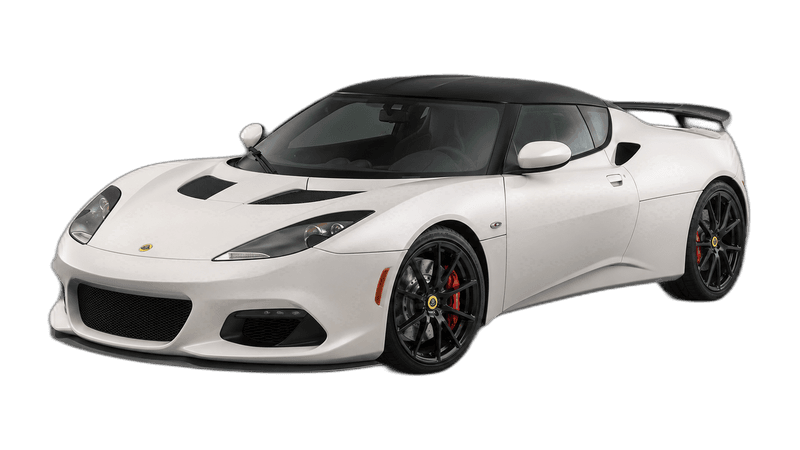
Lotus Evora 400
£55,000
usedIndicative market price, updated periodically.
400bhp
Power
4.2s
0-100 km/h
300km/h
Top Speed
£55,000
Price Used
How hard it pulls.
Peak g-force the instant you bury the throttle, estimated from the car's 0–100 time and drivetrain.
Lotus Evora 400Estimated peak launch g from the 0–100 time and drivetrain: an honest approximation, not a measured figure.
The Lotus Evora 400 is a coupe by Lotus, with 400 bhp, 410 Nm of torque, a 0-100 km/h time of 4.2 seconds and a top speed of 300 km/h. Indicative used value: approximately £55,000. Actual values vary with specification, condition and history.
Dream Car Garage Editorial · Last updated 2 November 2026
Overview
We have not driven this car. This review is based on published specifications and the sources listed below.
A 400 bhp supercharged V6 from Lotus
The Lotus Evora 400 is a mid-engined, rear-wheel-drive sports coupe built at Hethel. Our catalogue lists it from 2015 with a 3.5L supercharged V6 petrol engine producing 400 bhp and 410 Nm, with 0 to 100 km/h in 4.2 seconds and a top speed of 300 km/h. This guide is scoped to the 400 bhp car as launched in 2015. It is not about the later Evora Sport 410 or the GT430, which were different cars with more power, and we explain below how they differ so that you do not mix up an advert.
We have not driven this model for this article. This is a desk-researched ownership guide built from two sources we could read in full: the official Lotus Cars Evora model history page and the PistonHeads Evora 400 used buying guide by Tony Middlehurst, published on 28 March 2021. We could not find Lotus's original 2015 press release online. For the launch figures we also read a reproduction of Lotus's 18 February 2015 announcement on the website of SELOC, an owners club that says it is independent of Lotus, and reprints of Lotus's 3 September 2015 release. Anything that comes only from those copies is secondhand, and we say so where it matters. We did not consult the government recall check for this article, and you should use it yourself.
Checking the figures
Power is where units and sources differ. The Lotus history page says output rose from 345 bhp to 400 bhp at 7,000 rpm. The SELOC copy of the launch announcement gives 400 hp, which it converts to 406 PS, against 345 hp or 350 PS for the Evora S it replaced. Metric horsepower is about 1.4 percent bigger than mechanical horsepower, so 400 bhp and 406 PS describe the same car. An advert quoting 406 is probably using the PS figure, and one quoting 400 bhp is using ours. PistonHeads agrees on 400 hp and a 55 hp rise.
Torque is 410 Nm in the Lotus text, available between 3,500 and 6,500 rpm. PistonHeads gives 302 lb ft at the same range, which converts to about the same figure. The SELOC copy lists the Evora S at 400 Nm, so the 400 added only a little torque and most of its gain was in power.
Acceleration and top speed come from outside the Lotus history page, which gives neither for this model. The launch announcement as reproduced by SELOC and in the September reprints says 0 to 60 mph in 4.1 seconds and 0 to 100 km/h in 4.2 seconds, with 186 mph or 300 km/h. PistonHeads gives 4.2 seconds to 62 mph and 186 mph. 186 mph is about 299 km/h, so these are the same claim rounded differently. They are manufacturer claims, not tests we have done, and the PistonHeads author says weight and power data are approximate and should be treated as relative.
Weight is the figure on which the sources disagree most. The SELOC copy of the February announcement gives 1,415 kg for the manual and 1,419 kg for the automatic, 22 kg and 23 kg lighter than the old Evora. The September release reprints say 1,395 kg and 42 kg lighter than the Evora S. The official Lotus page says the 400 is 42 kg lighter than the previous model, but its spec table shows 1,248 kg for the whole 400 range, which does not fit that claim and which looks like a figure for a later, lighter variant. The PistonHeads table gives 1,415 kg. An evo report from May 2015 says only that it was 15 kg lighter than the Evora S. Treat any single kerb weight in an advert with caution, and ask what it refers to.
Dates and numbers built are also loose. Lotus announced the car in February 2015 ahead of the Geneva show, and the first customer and dealer cars left Hethel in early September 2015. The Lotus page gives 2015 to 2021 for the Evora 400 range, with about 1,420 units for all models, a count that appears to cover every Evora variant listed in that table rather than only the 400. PistonHeads estimates around 700 Evoras on British roads, and calls that an estimate. We give no production count for the 400 alone.
Engine and gearbox
The engine is a supercharged, charge-cooled 3.5-litre V6, which evo says is supplied by Toyota and PistonHeads describes as Toyota-sourced. According to the SELOC announcement the 400 changed the exhaust, induction, supercharger and engine management to reach its output. PistonHeads says the V6 is regarded as reliable, but reports odd supercharger failures on 400s. It says the blowers were made by Edelbrock rather than Lotus, that most cases seemed to involve early US cars, and that one two-year-old UK car was also affected. It does not say how many cars were involved, so ask the seller whether the supercharger has ever been replaced, who did the work and what warranty came with it.
PistonHeads also says some 400s went flat after a week or more unused, and that a trickle charger needs the boot open, so the boot light stays on while charging. A missing boot light may mean a previous owner removed it, which could point to a battery that was neglected. Spark plugs are on a 54,000 mile schedule according to PistonHeads, and it says an independent can source them from Toyota for less than Lotus charges. It also reports that Lotus cut first-service costs by about 37 percent across the Evora, Elise and Exige in March 2020. We have left out its pound figures because they are dated.
The manual is a six-speed. The SELOC announcement lists a new clutch disc and a low-inertia flywheel, and a standard limited-slip differential on the manual car. PistonHeads says early manuals felt a bit baggy and that tighter cabling on the 400 and 410 improved the shift considerably, although the clutch is heavy. The automatic is where sources disagree. The Lotus table says a four-speed automatic was available, while PistonHeads describes the older IPS automatic as an Aisin six-speed. We do not know which description applies to the 400 automatic, so check the gearbox on the car you are shown. PistonHeads adds that the IPS has no limited-slip differential and weighs 54 kg more, that the paddles give manual mode for ten seconds in D or indefinitely in Sport, and that sensors stop it changing gear mid-corner. Try both modes on a test drive and listen for hesitation or harsh shifts.
Chassis, brakes and wheels
The 400 uses a revised bonded and extruded aluminium chassis. SELOC reports sills 43 mm narrower and 56 mm lower on each side than before, for easier entry, and a torsional stiffness of 27,000 Nm per degree. Lotus says over two thirds of the car was new, which is a manufacturer claim we cannot check. Evo describes standard double-wishbone suspension with revised spring rates, and PistonHeads says the 400 has Sport and Race modes but that the normal mode is still very entertaining. The fully adjustable Ohlins and Eibach set-up it mentions belongs to the later GT430, not to the 400.
The brakes are two-piece, cross-drilled and ventilated, 370 by 32 mm at the front and 350 by 30 mm at the rear according to SELOC, with AP Racing discs mentioned in the September release. Ask for brake invoices, because we found no source with disc or pad wear data. Wheels are 19 inch at the front and 20 inch at the rear, on Michelin Pilot Super Sport tyres in 235/35 ZR19 and 285/30 ZR20 sizes. PistonHeads warns that lightweight suspension components can lose their geometry after a modest knock, with uneven tyre wear as a warning sign, so check the tyres across their width and ask for an alignment printout. It also says lacquer peeling affected some Evora alloy wheels, which the factory has generally dealt with. Inspect all four wheels for peeling or corrosion.
Body, interior and electronics
PistonHeads says the composite panels and separate front and rear sections make repairs easier, and that panel gaps are a good place to look for accident history. It lists known weak points: fragile door handle components on earlier cars, dents in the tailgate from the rubber stops when it is shut too hard, light boot lids that do not always respond to the dash release button, fuel caps that sometimes fail to relatch, failing window motors, and central locking faults, although it says the last is not unique to the Evora. It also mentions blocked air-conditioning drains that let water into the cabin, which it thinks most cars have had sorted by now. Check the footwells for damp.
Inside, the SELOC announcement lists a new dashboard layout, a revised climate control system, a start-stop button, a simplified instrument cluster and optional rear seats that are wider than before. Evo adds a new leather supplier and new seats. PistonHeads says the Alpine head unit can be temperamental, that early reversing cameras were not fully reliable, and that the dashtop airbag cover can bubble in warm weather or lift at one corner, with a repair that means removing large parts of the dash. Parking sensors and a reversing camera were standard, which it credits. It says the rear seats suit child seats, and it quotes a 160-litre boot that takes a golf bag. Early air-conditioning condensers could be punctured by stones, although it has not heard of this on 400s, perhaps because owners fitted mesh guards.
Recalls and history
Neither the Lotus history page nor the PistonHeads guide mentions any recall for the Evora 400, and PistonHeads says nothing about open campaigns. That does not mean none exist, only that our sources do not say. We do not state recall numbers or dates. Enter the registration into the government recall check, which we did not consult, and ask a Lotus dealer or specialist for open campaigns and software updates against the car's VIN.
Ask for the full service history, evidence of any supercharger work, accident repair records, and invoices for tyres, brakes and battery. The Hethel Edition, launched in 2016 to mark 50 years at Hethel according to PistonHeads, adds forged alloys and contrasting brake calipers, so confirm the specification from the car's paperwork and not from the badge or the advert.
Buying decision
The PistonHeads verdict is that the Evora is a left-field alternative to more obvious exotics and a good introduction to Lotus ownership, and that many people considered the 400 as good to drive as a Porsche Cayman GT4. It also says build quality is better, if not perfect, and that the old reputation is a bit old hat. Prices are dated, so compare current adverts and leave our sources' numbers aside.
Keep the variants straight. The Evora Sport 410 was revealed at Geneva in 2016 and, according to PistonHeads, it drops the audio, navigation and air conditioning by default, adds Alcantara and carbon fibre, and is about 70 kg lighter with a 10 hp remap. The GT430 followed in 2017 with 430 bhp and a titanium exhaust, and the Lotus page describes it as the most powerful road car Lotus had made at that time. PistonHeads also uses the names GT410 and GT410 Sport for later cars without explaining the naming. The Lotus table's 406 to 430 bhp range spans the whole family, so do not assume the figures in this guide apply to anything but a 400 bhp car.
Prefer a car with a clean government recall check, documented supercharger history, a healthy battery and a trickle charger left with it, even tyre wear, working electrics and windows, a dry cabin, and written confirmation of the exact model, gearbox and output.
Specifications
Engine
3.5L supercharged V6 petrol
Displacement
3.5L
Power
400 bhp
Torque
410 Nm
0-100 km/h
4.2s
Top Speed
300 km/h
Drivetrain
RWD
Country
UK
Body Style
coupe
Years
2015–present
Price Used
£55,000
Specifications are manufacturer-published figures.
More from Lotus
Frequently Asked Questions
What are the specifications of the Lotus Evora 400?
The Lotus Evora 400 is a coupe by Lotus, with 400 bhp, 410 Nm of torque, a 0-100 km/h time of 4.2 seconds and a top speed of 300 km/h. Indicative used value: approximately £55,000. Actual values vary with specification, condition and history.
How much does a Lotus Evora 400 cost?
Indicative used value: approximately £55,000. Actual values vary with specification, condition and history.
What drivetrain does the Lotus Evora 400 use?
The Lotus Evora 400 is configured with rear-wheel drive.
What type of car is the Lotus Evora 400?
The Lotus Evora 400 is a sports cars manufactured by Lotus in UK. Production started in 2015.