
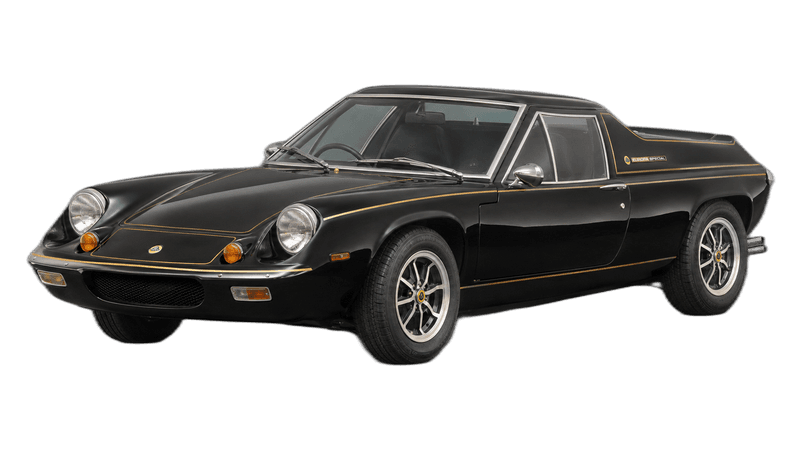
Lotus Europa Special
126bhp
Power
198km/h
Top Speed
The Lotus Europa Special is a 2-door coupé by Lotus, with 126 bhp, 153 Nm of torque and a top speed of 198 km/h.
Dream Car Garage Editorial · Last updated 3 November 2026
Overview
We have not driven this car. This review is based on published specifications and the sources listed below.
Scope of this guide
This guide is scoped to the Lotus Europa Special, the Type 74 Europa with the Lotus-Ford twin-cam engine in big-valve form, built from 1972 to 1975. It is a two-seat, mid-engine coupe with rear-wheel drive, a fibreglass body over a steel structure (supercars.net describes fibreglass over a steel tub), and the 1.6 litre four-cylinder sitting behind the seats. The Special is the last and strongest version of the original Europa, so the figures here describe the standard European-market big-valve car with the five-speed gearbox. They do not describe the earlier Renault-engined Series 1 and Series 2 cars, the first Twin Cam that preceded the Special, or the detuned United States Federal cars, which Wikipedia rates at 113 hp rather than the European figure.
We have not driven this model for this article. We are an editorial desk that reads sources, and everything below comes from pages we opened: Wikipedia, the Lane Motor Museum, a Total Kit Car history of the Europa, a supercars.net page on the John Player Special edition, a Sports Car Market profile of a 1974 car, a Classic Car Garage archive entry and a Fantasy Junction listing for 1974 cars, a Zeperfs data sheet, Autozine and a Trade Classics sold listing. Most of these are reference pages and dealer write-ups, not owner reports. This page is for research, not a buying recommendation, and a guide cannot replace an inspection by a specialist who knows these cars.
The figures at a glance
- Engine: 1.6L naturally aspirated inline-four, the 1,558 cc Lotus-Ford twin-cam with big-valve cylinder head. Zeperfs and Wikipedia agree on 1,558 cc, while the Lane Motor Museum prints 1557 cc and a dealer listing rounds to 1600 cc.
- Layout: mid-engine, rear-wheel drive, longitudinal engine, as Zeperfs and the Lane Motor Museum both describe it.
- Power: 126 bhp. Wikipedia, the Lane Motor Museum, Sports Car Market, supercars.net and Total Kit Car all print 126 bhp or 126 hp for the European big-valve engine. A Classic Car Garage archive gives 126 bhp at 6,500 rpm. Zeperfs prints 126 PS, which at the PS conversion of 0.98632 would be about 124 bhp, and it also mentions 124 brake horsepower. We use 126 bhp everywhere because most sources print that number directly.
- Torque: 153 Nm. Zeperfs and a Classic Car Garage archive (quoting Carfolio) print 153 Nm, the latter at 5,500 rpm, and Zeperfs and Autozine print 113 lb ft. Converting 113 lb ft at 1.35582 gives 153.2 Nm, so the sources agree.
- Top speed: 198 km/h. Wikipedia reports 123 mph (198 km/h) recorded by Motor magazine on a UK Special, and the Lane Motor Museum and Autozine also print 123 mph. Converting 123 mph at 1.60934 gives 197.9 km/h. Other pages disagree, which we cover below.
- 0-100 km/h: no figure shown. Every performance time we found is a 0-60 mph time, around 6.6 seconds, and we have not relabelled it as a 0-100 km/h time.
- Weight: 740 kg in Wikipedia, supercars.net and Autozine, 712 kg claimed kerb weight in Zeperfs and 711 kg in a technical data block quoted on one dealer page.
- Gearbox: Renault five-speed manual, front disc and rear drum brakes according to the Classic Car Garage archive.
- Production: 3,130 cars badged as Specials, per Wikipedia and Sports Car Market, with a lower-confidence alternative below.
Which Europa Special this guide describes
This page covers 1972 to 1975, 1,558 cc and 126 bhp. That matches a European-specification big-valve Special. The date range is slightly generous, because several sources say the Special itself was built only until 1974, while the wider Europa line ended in 1975. We keep 1972 to 1975 because Wikipedia titles the Special as 1972 to 1975 and because the Lane Motor Museum lists the Europa line as built from 1966 to 1975. Where a source says otherwise we say so in the history section.
Power is the one figure that has to be handled with care for old cars. The European big-valve engine is quoted at 126 bhp, but the American Federal cars used Stromberg carburettors and, according to Wikipedia, were rated at 113 hp. Wikipedia says the big-valve version sold outside North America used a Dell'Orto carburettor setup, while Sports Car Market describes a Weber setup on the 1974 car it profiled and the Classic Car Garage archive describes two twin-choke Weber carburettors. Carburettor brand therefore varies between sources and probably between cars. If you are reading a listing for a car, check whether the engine and carburettors are original before treating 126 bhp as a given.
History and what changed over the run
The Europa was Lotus's first mid-engined road car, built with Renault parts. A Classic Car Garage archive says the Series 1 ran from 1967 to 1969, the Series 2 from 1969 to 1971, and the Twin Cam followed in 1972 with a 105 bhp Lotus-Ford engine. The Lane Motor Museum says the Series 1 and 2 used 85 bhp Renault engines and that the Series 3 brought the twin-cam engine and the nickname Twink.
The Special was the next step. Total Kit Car says the big-valve engine was developed under Tony Rudd, then Lotus chief engineer and an ex-BRM man. According to that article the changes were spikier camshafts, larger inlet valves, compression raised from 9.5 to 1 up to 10.3 to 1, and smoothed and polished ports. supercars.net gives the same 10.3 to 1 compression and a bore and stroke of 82.6 mm by 72.6 mm. Total Kit Car also says the result was 126 bhp, the same as the Elan Sprint engine, although the same article at another point refers to a 160 bhp big-valve version. We treat the 160 bhp mention as an internal inconsistency in that article, since everything else we read says 126 bhp.
The Special also brought a five-speed gearbox. Total Kit Car says it came from the Renault 16TX and gives the type as 365, while Wikipedia also says a Renault five-speed of type 365 was offered in Europe and other markets and became standard on the Special in the United States in 1974. A Trade Classics listing calls it a closely spaced five-speed from Renault's Gordini range. Wikipedia says the first 100 John Player Special cars all had the five-speed, and the text of supercars.net says all cars had a five-speed even though its own spec table lists a four-speed, so that page contradicts itself. We treat the five-speed as the defining Special gearbox, but it is worth checking an individual car rather than assuming.
Total Kit Car lists chassis changes as repositioned front suspension mounts, rear arches moved back, GKN Kent alloy wheels as standard, lowered floors and wider footwells. Autozine says the iron-block engine was much heavier, so Lotus lengthened the wheelbase to keep the balance.
Launch dates disagree
Launch timing is not consistent across sources. supercars.net says the John Player Special edition was introduced in September 1972, Total Kit Car says late 1972, and Trade Classics says the Twin Cam Special was launched in 1972. A Classic Car Garage archive says the Twin-Cam Special followed in 1973 and a Fantasy Junction listing says the big-valve engine and five-speed arrived in 1974. We read this as a rolling introduction, with the big-valve car appearing in late 1972 and some markets receiving the five-speed later, but we cannot confirm that from the pages we have.
John Player Special colours
Several sources describe the black and gold look. The Lane Motor Museum says the first 100 big-valve Twin-Cam Specials were black with gold pinstripes and John Player Special dash badges. supercars.net says the first 100 big-valve cars carried a numbered dash badge and that the name was meant to be dropped after the first two hundred cars but stayed until Europa production ended. Total Kit Car says most Specials were black with gold pinstriping, recalling the John Player Special livery of the 1972 championship-winning Lotus 72.
Performance and how the sources disagree
The performance picture is consistent in character but inconsistent in detail. The 0-60 mph time is 6.6 seconds in Wikipedia, Total Kit Car, Autozine's table and a Fantasy Junction listing. Autozine's text says the Special got there in less than seven seconds, supercars.net prints about 7.0 seconds, and Sports Car Market says six to seven seconds. Wikipedia also gives a quarter mile of 14.9 seconds. One dealer archive prints 0-60 km/h in 6.6 seconds, which is almost certainly a mislabelled 0-60 mph time, and we ignore it.
Top speed is less settled. Total Kit Car says 125 mph and a Classic Car Garage archive prints 204 km/h (127 mph), while Zeperfs gives 195 km/h as the manufacturer claim and 205 km/h as a measured maximum. We chose 198 km/h because it is a measured figure that Wikipedia attributes to a named magazine test, and because the Lane Motor Museum and Autozine give the same 123 mph. Treat any single top speed as a rough guide for a car of this age.
Road & Track's 1973 test, quoted by the Lane Motor Museum, called the Europa the best handling non-Ferrari road car the magazine had tested. That is a quote from a museum page about a period test, not something we have verified ourselves.
Production numbers
Production figures depend on what is being counted. Wikipedia says 4,710 Type 74 cars were built, 3,130 of them badged as Specials, and that Lotus shipped 1,580 cars as Twin Cam before switching to the 126 hp big-valve engine. Sports Car Market also says 3,130 Specials were built between 1972 and 1974. We use 3,130 because two sources agree. The Lane Motor Museum instead gives 4,257 for the Type 74 and 9,887 for all Europas, while Total Kit Car says approximately 3,500 Specials were made and Autozine lists 9,320 for the whole Europa range. A Fantasy Junction listing says 9,300 Europas were sold over nine years. None of these is an official Lotus figure that we have seen, so use them as an order of magnitude.
Prices and market notes
Sources give a few dated numbers. Total Kit Car quotes a launch price of 2,471 pounds sterling fully built or 2,044 pounds sterling in kit form, though the article places this in the context of the early 1970s without a precise date. The Lane Motor Museum gives an original cost of 7,019 dollars, and Sports Car Market gives an original list price of 7,292 dollars for a 1974 car.
For the market, Sports Car Market in January 2016 gave a valuation range of 20,000 to 35,000 dollars for the 1974 Twin Cam Special and an investment grade of B. It reported a sale at 33,000 dollars including buyer's premium at the Auction America Santa Monica sale on 17 July 2015, and called that slightly well sold. A Trade Classics listing shows a sold price of 25,441 pounds sterling for a restored car, though the part of the page we read does not give a sale date. These are single data points from several years ago, not a current price guide, and we have no current valuation to offer.
What to check before buying
Our sources give limited specifics, so this list is short and we would rather say so than pad it.
- Crash protection is poor. Sports Car Market says the fibreglass body offers little protection and describes the cars as little better than pinatas on wheels in accidents. That is a safety point for anyone planning regular road use.
- Engine access. Total Kit Car says refitting the engine after removal is difficult, so a past engine-out job is worth asking about.
- Consumables are inexpensive. Sports Car Market says a tune-up costs two to three hundred dollars and distributor caps are 25 dollars, as of its January 2016 profile.
- Originality. Check carburettors, gearbox type and engine against the specification above, since the sources show mixed carburettor and gearbox descriptions.
- Paperwork. A Fantasy Junction listing for one 1974 car mentions a dealer service costing 6,700 dollars in 2008 and a file of service records, and a Trade Classics listing mentions a restoration bill of about 39,000 pounds sterling in 2010. These are single-car examples, but they show that documented history matters on these cars.
- Body and chassis condition. Total Kit Car says the original Series 1 bonded body was costly to repair, though it does not say the same for the Special. None of the pages we opened gave chassis corrosion or body-off inspection details for the Special.
What we could not find
- 0-100 km/h: no figure shown in any source. The times we found are 0-60 mph times and we have not converted them.
- An official Lotus production total for the Special, an official power curve, and a complete torque rpm figure. Torque rpm appears on only one page we read (5,500 rpm, in a Classic Car Garage archive quoting Carfolio).
- Chassis rust, suspension wear and other typical faults. Sports Car Market, Total Kit Car and the listings gave only the general points above.
- Several pages were blocked or unavailable when we tried them, including Car and Classic, which returned a service error, and a Classic Driver listing and the Encycarpedia page, which refused access. We did not work around those blocks and do not cite them.
- A current market price. Nothing we read is newer than January 2016 for valuation.
About the photograph
This page uses the catalogue photograph, and its credit is listed on the credits page.
Verdict
The Europa Special is the strongest of the original Europas. On paper it has a 1.6L naturally aspirated inline-four with 126 bhp, a five-speed gearbox, a low kerb weight around 740 kg and a mid-engine layout that earned praise for handling. The figures are less certain than they look: top speed ranges from about 195 to 205 km/h depending on the source, production counts differ by hundreds of cars, launch dates differ by up to two years, and the one thing we cannot give is a 0-100 km/h time. Treat the 126 bhp, 153 Nm and 198 km/h figures here as the best-supported numbers from the pages we read, not as certified data. For a real car, hire a Lotus specialist to inspect it, because this guide is research and not a buying recommendation.
Sources
- Wikipedia: Lotus Europa
- Lane Motor Museum: Lotus Europa Special Type 74
- Total Kit Car: The Lotus Europa story
- supercars.net: Lotus Europa John Player Special
- Sports Car Market: 1974 Lotus Europa Twin Cam Special
- Classic Car Garage: Lotus Europa Special TC, 1974
- Fantasy Junction: 1974 Lotus Europa Special
- Zeperfs: Lotus Europa Special technical data
- Autozine: Lotus Europa
- Trade Classics: Lotus Europa Twin Cam Special listing
Specifications
Engine
1.6L naturally aspirated inline-four
Displacement
1.6L
Power
126 bhp
Torque
153 Nm
Top Speed
198 km/h
Drivetrain
RWD
Country
United Kingdom
Body Style
2-door coupé
Years
1972–1975
Production
3,130
Specifications are manufacturer-published figures.
More from Lotus
Frequently Asked Questions
What are the specifications of the Lotus Europa Special?
The Lotus Europa Special is a 2-door coupé by Lotus, with 126 bhp, 153 Nm of torque and a top speed of 198 km/h.
How many Lotus Europa Special were made?
Lotus produced 3,130 units of the Lotus Europa Special.
What drivetrain does the Lotus Europa Special use?
The Lotus Europa Special is configured with rear-wheel drive.
What type of car is the Lotus Europa Special?
The Lotus Europa Special is a sports cars manufactured by Lotus in United Kingdom. Production ran from 1972 to 1975.