
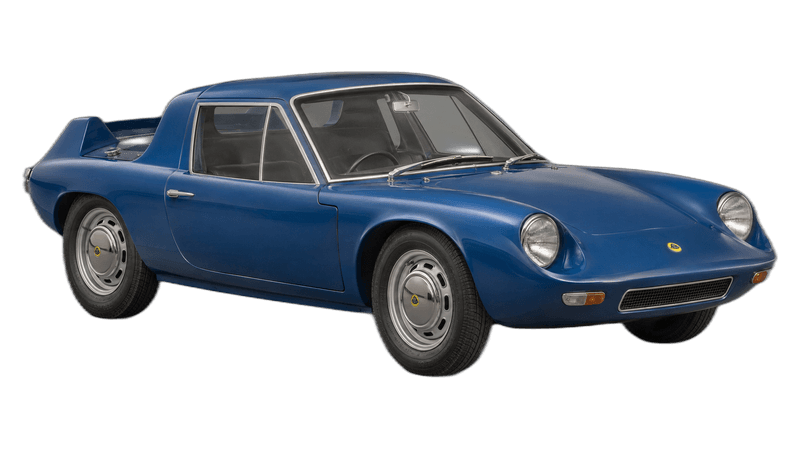
Lotus Europa S1
82bhp
Power
195km/h
Top Speed
The Lotus Europa S1 is a 2-door coupé by Lotus, with 82 bhp and a top speed of 195 km/h.
Dream Car Garage Editorial · Last updated 3 November 2026
Overview
We have not driven this car. This review is based on published specifications and the sources listed below.
Scope of this guide
This guide is scoped to the Lotus Europa S1, the first series of the small Lotus coupe, also called the Type 46 and sold from 1966 to 1968. It is a two-door, two-seat, mid-engine car with rear-wheel drive, powered by a 1,470 cc four-cylinder engine taken from the Renault 16 and mounted behind the driver. It is not a guide to the later Europa Series 2, the Twin Cam or the Special, which used different engines, different bodies and a different fixing method for the shell, although we mention them for contrast.
We have not driven this model for this article. We are an editorial desk that reads sources, and everything below comes from pages we opened: Wikipedia, the Lotus company's own Europa history page, Sports Car Market, Conceptcarz, the sportscar2 profile of the Series 1, the Autozine classic car archive, the French magazine guide on automobile-sportive.com and a British Car Forum thread of buying advice. Like most pages about a car of this age, they are reference pages and owner discussion, not test reports we could check. This page is for research, not a buying recommendation, and a guide cannot replace an inspection by a specialist who knows these cars.
The figures at a glance
- Engine: 1.5L naturally aspirated inline-four, the 1,470 cc pushrod Renault 16 unit with an aluminium block, retuned by Lotus, according to Wikipedia, sportscar2 and Autozine. Bore and stroke are given as 76 by 81 mm by automobile-sportive.com, with a single double-barrel Solex carburettor.
- Layout: mid-engine, rear-wheel drive, with a four-speed Renault transaxle and a steel backbone chassis.
- Power: 82 bhp. Wikipedia prints 82 hp (61 kW), sportscar2 prints 82 bhp and Autozine prints 82 hp, which makes 82 the majority figure among the pages we read. Two other pages disagree, which we explain below.
- Torque: no figure shown. The sources that give one disagree with each other, as described below.
- 0-100 km/h: no figure shown. The sources we read give 0-60 mph times, and a 0-60 mph time is not a 0-100 km/h time, so we have not converted or relabelled it.
- Top speed: 195 km/h. Wikipedia prints 121 mph (195 km/h) from an Autocar test, and sportscar2 also prints 121 mph. As a conversion check, 121 mph at 1.60934 is 194.7 km/h, which rounds to 195 km/h.
- Weight: about 610 kg. Wikipedia gives 610 kg (1,345 lb), the Lotus page gives 612 kg, Autozine gives 613 kg and automobile-sportive.com gives 620 kg.
- Production: 296 cars with chassis numbers 460001 to 460296, per Wikipedia and sportscar2.
History and what the car was for
The sources agree on the broad story. Lotus announced the Europa for European sale on 20 December 1966, and Wikipedia and automobile-sportive.com say the first cars reached France in February 1967. The Lotus company page calls it Britain's first mid-engined sports car and says the engine sat behind the driver compartment on a light but rigid structure. Sports Car Market adds that the first two years of production were sold in Europe, and sportscar2 says the marketing under the Renault agreement was aimed at continental Europe for the first few years.
The reason for the Renault engine is practical. Autozine says the car was aimed at mainland Europe, so a Renault powertrain meant easier servicing there. Sports Car Market notes that thousands of Renault 16 cars were sold in Europe, which is why mechanical parts for the engine and transaxle are not hard to find. Sportscar2 also says the choice reduced Lotus's reliance on Ford engines. Wikipedia notes that Volkswagen held the Europa name in Germany, so cars sold there were badged Europe.
The shape and the cabin
The Series 1 is the most uncompromising version of the car. Sports Car Market describes a breadvan-like profile and says the rear window offered poor visibility, and sportscar2 says rear vision was limited to a narrow slot behind the driver's head. Wikipedia lists the early cars as having fixed side windows, fixed seats with pedals that could only be adjusted with tools, no door handles, no internal door covers and an aluminium dashboard. Sports Car Market says the fixed windows made the car feel claustrophobic and that the interior trim was generally poor, so original interiors are rare. Automobile-sportive.com adds that owners criticised the cabin ventilation. Conceptcarz, by contrast, says the page lists adjustable steering and pedals, which does not match Wikipedia, and we have not resolved that difference.
Chassis and body
Wikipedia, sportscar2 and Sports Car Market agree that the glass-fibre body was bonded to the steel backbone chassis. The upside, according to sportscar2, is that the lightweight body and steel backbone kept weight down. The downside, according to all three, is that repairs are complicated. Autozine praises the balance, roadholding and steering, and also says the car was underpowered and slower than the Elan. Wikipedia quotes Car magazine for lateral acceleration in excess of 0.9 g on period road tyres, which is a period magazine measurement we cannot check.
Variants over the run
The Series 1 did not stay unchanged. Automobile-sportive.com says that in October 1967 it became the S1A, with removable side windows and keyed bonnet latches. Wikipedia describes the S1A as having removable side windows, a wooden dashboard and internal door panel covers, and the S1B as having a redesigned rear panel with rectangular light clusters, and says both took on some later Series 2 changes. The Series 2 arrived in April 1968. Sportscar2 gives 296 Series 1 cars and 348 of the 1A and 1B, for a family total of 644, and Wikipedia gives the same 296 and 644 with the 1A and 1B described as about 350 together. Because this guide covers the original S1, we use 296.
Where the sources disagree
We say so where sources disagree instead of choosing silently.
- Power. Wikipedia, sportscar2 and Autozine give 82. The Lotus company page gives 78 bhp, and automobile-sportive.com gives 78 ch at 6,000 rpm, which at 0.98632 converts to about 77 bhp. None of the pages we read states which rating basis (gross, net, DIN or other) their number uses. We chose 82 bhp because three of the pages agree on it, and we use that figure throughout. Anyone comparing it with 78 should expect a difference of this kind.
- The standard Renault engine. Wikipedia says the unretuned unit made 63 hp, while sportscar2 says 52 bhp. We cannot tell which basis each uses, so we do not rely on a gain figure.
- Torque. Sportscar2 gives 75 lb ft and Autozine gives 79 lb ft. Converting 75 lb ft at 1.35582 gives about 102 Nm, and 79 lb ft gives about 107 Nm. Wikipedia and the French guide give no torque for the Series 1. Because the two pages that do give a figure disagree and neither is a primary source, there is no figure shown for torque.
- Top speed. Wikipedia and sportscar2 give 121 mph (Autocar), Autozine says about 115 mph. Automobile-sportive.com gives 180 km/h, which would suit its 78 ch figure. We use 195 km/h because it is the one tied to a named magazine test in the pages we read, but it is a single test of one car, and the other pages suggest real cars were slower.
- 0-60 mph. Autocar is quoted at 9.3 seconds by Wikipedia and sportscar2 (sportscar2's own table says 9.2), while Autozine, citing Motor, gives 9.5 seconds. These are 0-60 mph times, and we do not show a 0-100 km/h figure.
- Weight. The range is 610 to 620 kg across four pages, so treat about 610 kg as approximate.
- Windows. Most pages say the Series 1 had fixed side windows, with removable ones arriving on the S1A in late 1967. We therefore describe that as the dividing line, though the exact date comes from one page only.
- Production. Conceptcarz lists 296 for the Series 1 but also says about 650 Series 1 cars were built, without reconciling them. That is consistent with the 644 family total, which includes the 1A and 1B, so the larger number does not contradict 296 for the original S1.
- Years. Conceptcarz gives 1966 to 1968, while Sports Car Market says the car was introduced in 1967 and sportscar2's table lists 1967 to 1968. We use 1966 to 1968 because the announcement was in December 1966.
What to check before buying
Several sources give specifics. None is a Series 1 inspection manual, so treat this as a list of points to raise with a specialist.
- Chassis rust. Sports Car Market and the British Car Forum thread both say the steel backbone is rust-prone, and the forum thread names the area where the hammerhead section meets the backbone, the lower wishbone pivot areas and the front uprights. Enclosed box sections with weep holes can trap dirt and moisture.
- Water in the body-to-frame joint. The forum thread says water soaking into the horsehair mat between body and frame can rust the top of the backbone. Sports Car Market advises leaving a Series 1 with chassis problems alone and preferring a car that is completely done to one that is completely done-in.
- Accident damage. The forum thread says the frames are light and hard to straighten, and that the factory recommended replacement after serious shunts.
- Body cracks and doors. Sports Car Market says the fibreglass quality was decent but stress cracks can occur, and the forum thread says door sag is common as worn washers let hinge pins slip. That thread is mainly about the Twin Cam, so some of its engine points do not apply to the Renault car.
- Head gasket. Sports Car Market says oil and coolant mixing signals a likely head gasket failure, which it calls common on Europas.
- Transaxle and rear hubs. The forum thread says rear wheel bearings and axles are a known weak point on the Europa, and that some weeping at the transaxle output seals is normal. It also says leaks where the shift mechanism enters are common and that the tubular shift linkage can take in water and seize.
- Identity. Match the car to its chassis number in the 460001 to 460296 range the sources describe, and ask a specialist how to confirm whether it is an S1, S1A or S1B.
Market and value notes
Price information is thin and old. Sportscar2 lists a 1967-68 Series 1 in good condition at roughly 12,000 to 15,000 pounds (19,000 to 24,000 dollars), but the page is undated, so we cannot say when. Conceptcarz lists an original price of 3,790 dollars for a 1967 Europa, and its auction averages for the Series 1 years are far higher, but the rows mix in the racing Type 47, so we do not quote them. Sports Car Market says collectors pay little attention to Lotus road cars and that Europa values were low, with little appreciation expected. We do not know what any car costs today.
What we could not find
- A primary Series 1 torque figure and any 0-100 km/h time: no figure shown for either.
- A source that states what rating basis the 82 bhp figure uses.
- Several sites refused or failed our requests, including a Hagerty valuation page that redirected to a login, Encycarpedia, Car and Classic and Classic.com (403), Old Classic Car (429) and a Lotus Drivers Guide page (404). We did not work around any of them and cite none of them.
- Dated, verified sale prices for the Series 1 specifically.
- Recall or safety campaign information. None of the pages we read give any.
- Insurance and running-cost data. We make no claims about them.
About the photograph
The page uses the catalogue photograph, and its credit is listed on the credits page.
Verdict
The Lotus Europa S1 is a small, mid-engine, rear-wheel drive coupe from the first, European-market years of the Europa, with a 1.5L naturally aspirated inline-four of 82 bhp in our chosen reading, a top speed of 195 km/h in the Autocar test that Wikipedia quotes, and 296 cars built. It is a light car, around 610 kg, whose character comes from its backbone chassis, bonded body and cramped, closed-in cabin rather than from its engine. The sources we read warn mainly about rust in the chassis and about how hard the bonded body is to repair. They disagree on power, torque, top speed and the dates of the window change, so treat every number here as approximate. Anyone seriously considering one should find the exact series and history of a specific car and have it inspected by a Lotus specialist. This page is for research only.
Specifications
Engine
1.5L naturally aspirated inline-four
Displacement
1.5L
Power
82 bhp
Top Speed
195 km/h
Drivetrain
RWD
Country
United Kingdom
Body Style
2-door coupé
Years
1966–1968
Production
296
Specifications are manufacturer-published figures.
More from Lotus
Frequently Asked Questions
What are the specifications of the Lotus Europa S1?
The Lotus Europa S1 is a 2-door coupé by Lotus, with 82 bhp and a top speed of 195 km/h.
How many Lotus Europa S1 were made?
Lotus produced 296 units of the Lotus Europa S1.
What drivetrain does the Lotus Europa S1 use?
The Lotus Europa S1 is configured with rear-wheel drive.
What type of car is the Lotus Europa S1?
The Lotus Europa S1 is a sports cars manufactured by Lotus in United Kingdom. Production ran from 1966 to 1968.