
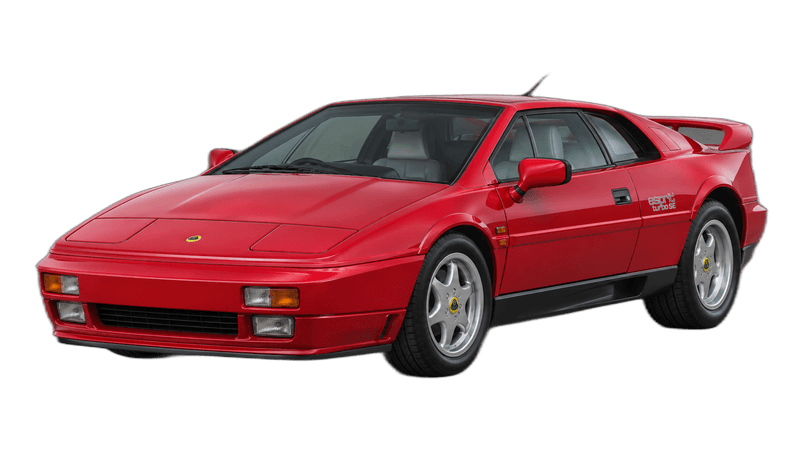
Lotus Esprit Turbo SE
264bhp
Power
265km/h
Top Speed
The Lotus Esprit Turbo SE is a 2-door coupé by Lotus, with 264 bhp, 354 Nm of torque and a top speed of 265 km/h.
Dream Car Garage Editorial · Last updated 3 November 2026
Overview
We have not driven this car. This review is based on published specifications and the sources listed below.
Scope of this guide
This guide is scoped to the Lotus Esprit Turbo SE, the charge-cooled flagship of the restyled X180 Esprit that Lotus introduced in May 1989 and built until 1993. It is a mid-engine, rear-wheel drive two-door coupe with a 2.2-litre turbocharged four-cylinder engine and a five-speed manual gearbox. It is not a guide to the carburettor-fed Esprit or the 228 bhp Esprit S that sat below it in the range, nor to the later S4, S4s and Sport 300, which we mention only for context.
We have not driven this model for this article. We are an editorial desk that reads sources, and everything below comes from pages we opened: the Lotus Esprit World model page, the Motor Sport magazine first-impressions piece from June 1989, a Fastlane road test from July 1989 reproduced on Lotus Esprit World, the Lotus Esprit Turbo site, the PistonHeads used buying guide, a Supercar Nostalgia article, and Wikipedia. Several of these are enthusiast or second-hand reproductions of period material, so treat them as research and not as maker documents. A guide cannot replace an inspection by a Lotus specialist, and this page is for research, not a buying recommendation.
The figures at a glance
- Engine: 2.2L turbocharged inline-four, the Lotus Type 910S according to Wikipedia, with a displacement of 2,174 cc as printed by PistonHeads. It has a water-cooled Garrett turbocharger and, on the SE, a liquid-cooled intercooler that Lotus called the Chargecooler.
- Power: 264 bhp at 6,500 rpm. Lotus Esprit World prints 264 bhp (197 kW) to the DIN 70020 standard, and Motor Sport prints the same constant rating. Wikipedia prints 268 PS, which it also gives as 264 hp. We converted 268 PS at 0.98632 and got about 264 bhp, so the sources agree. Several also quote a transient figure of about 280 bhp on overboost.
- Torque: 354 Nm at 3,900 rpm. Lotus Esprit World prints 261 lb ft and 354 Nm, and Motor Sport prints 261 lb ft. The 261 lb ft converts to about 354 Nm at 1.3558. Wikipedia, Fastlane, Supercar Nostalgia and the Lotus Esprit Turbo site give no torque figure.
- 0-100 km/h: no figure shown. The sources give 0-60 mph times (4.6, 4.7 and 4.9 seconds in different places) and one gives 0-62 mph, but none gives 0-100 km/h, and a mph time is not the same measurement, so we do not relabel any of them.
- Top speed: 265 km/h. Lotus Esprit World prints 165 mph and 265 km/h in its performance table, and Supercar Nostalgia prints 165 mph. This was a later claim, as discussed below. At launch the figure was lower.
- Drive: rear-wheel drive through a five-speed manual gearbox, with the engine mounted behind the cabin.
- Weight: Motor Sport says 1,270 kg-plus, and Wikipedia gives 1,270 kg for the X180 generation as a whole.
- Price when new: 42,500 pounds at the May 1989 launch, according to Lotus Esprit World, Motor Sport and Fastlane. Lotus Esprit World says this later rose to 46,300 pounds, and the Lotus Esprit Turbo site says the price reached 48,260 pounds by autumn 1991.
Where the sources disagree
Top speed is the widest spread. Motor Sport reports that the car breaks the 160 mph barrier and cites 163 mph, though it calls its own passage unclear. PistonHeads gives 159 mph. The Fastlane test recorded a genuine 160 mph average at Millbrook, with no official figure. Wikipedia says over 257 km/h (160 mph). The Lotus Esprit Turbo site says 159 mph at launch and that Lotus later claimed no less than 165 mph after the autumn 1991 styling changes. Lotus Esprit World gives 165 mph in its table and 160 mph in its introduction. We use 265 km/h because it is the one figure given in km/h by a source, but a launch-era car is better described by the lower figures of about 159 to 163 mph.
Acceleration also varies. Fastlane measured 4.6 seconds to 60 mph, Motor Sport and Lotus Esprit World say 4.7, Wikipedia says 4.7 seconds to 97 km/h, and PistonHeads says 4.9. Motor Sport adds 11.9 seconds to 100 mph, while Fastlane says under 12 seconds. These are different methods and years of report, and we do not average them.
Production is the weakest number. Lotus Esprit World says 563 were built in the debut year and that over one thousand six hundred were built before the S4 replaced it. Supercar Nostalgia says 560 were completed. Wikipedia's production table lists 1,608 Turbo SE cars but labels the range 1987-1993, which conflicts with its own 1989 start date elsewhere. The totals are close to each other, but because the definitions differ we hold no single production count for the catalogue. Lotus Esprit World also says the 1993 model year US-only run was limited to 62 cars.
What the SE changed
The SE sat at the top of the Esprit range at launch. The standard cars had 172 bhp naturally aspirated and 215 bhp turbocharged, according to Supercar Nostalgia, and Motor Sport says the carburettor models continued at 215 turbo bhp. The SE brought a Lotus-developed injection system using Delco and Rochester parts, plus the Chargecooler. Fastlane explains that cooling the intake charge from about 140 degrees Celsius toward 60 allows more power without detonation. Lotus Esprit World describes an engine-mounted chargecooler with its own mechanically driven liquid circuit and a front-mounted heat exchanger.
The claims we checked
- More boost: partly supported. Motor Sport gives 12.4 psi on the SE and Fastlane gives 12.5 psi as optimum boost. PistonHeads gives 0.65 bar for the ordinary Turbo, which is about 9.4 psi at 14.5 psi per bar. No single source states the SE boost as an increase, so this is our comparison across sources.
- Larger rear spoiler: supported with a date caveat. PistonHeads says chargecooler cars have a larger rear wing. Motor Sport describes an aerofoil-section rear wing at launch. The Lotus Esprit Turbo site says the 1989 SE had a small tail spoiler and that a larger free-standing aerofoil on pylons arrived in autumn 1991, while Lotus Esprit World dates a high wing to 1992. The sources differ by about a year on this.
- Body-colour bumpers: not supported. Lotus Esprit World says the bumpers are made from RRIM, a moulded material that resists minor knocks, but it does not say they were painted in body colour, and none of the other pages mention it. We make no such claim.
- Most powerful Esprit of its generation: not supported. At launch the SE was the most powerful Esprit on sale, with 264 bhp against 228 bhp for the Esprit S and 215 bhp for the carburettor car, per the Lotus Esprit Turbo site. Wikipedia then lists the S4 at 264 hp, the S4s at 301 hp and the Sport 300 at 302 hp, and calls the Sport 300 the fastest of the four-cylinder Esprits. So the SE was the most powerful Esprit only for its first years.
How the car changed over its run
Autumn 1990 added three-channel anti-lock brakes. Autumn 1991 brought a reworked cabin with more space and a three-year unlimited-mileage warranty, along with the styling package, the larger rear aerofoil and an extra rubber lip under the front spoiler, according to the Lotus Esprit Turbo site. Power steering was not fitted: PistonHeads says it became standard in 1994 and is a useful option on earlier cars. The interior, per Supercar Nostalgia, had a burr walnut dash, full leather, a glass sunroof and air conditioning as standard.
What to check before buying
The PistonHeads guide is a general Esprit Turbo guide that includes the SE, and it carries no date we could see. Treat its costs as indicative only.
- Cambelt: due every 24,000 miles or two years, according to PistonHeads. Lotus later raised the interval to 32,000 miles, but specialists advise the shorter one.
- Oil: change every 6,000 miles and use the correct Lotus filter with a non-return valve to protect the big-end bearings.
- Chargecooler: the guide says the elements can fail with age and puts a repair at around 150 pounds.
- Wastegate: a seized wastegate is a known fault, and a flutter on lifting off the throttle is the warning sign.
- Exhaust manifolds: they crack. The guide quotes 545 pounds for a new one and a day and a half of labour.
- Cooling: overheating is usually a failed fan or blocked radiator and can lead to a blown head gasket. Any water pump leak means replacement.
- Engine mounts: the one nearest the exhaust fails most often, and movement can damage pipework and manifolds.
- Misfires: often oil in the plug cavities from a warped cam cover.
- Gearbox: the Renault-sourced unit is described as tough, though a slipping clutch is a job of about 11 hours' labour.
- Bodywork: the glassfibre body does not rust, but check for stone chips, star cracks, mismatched paint and poor repairs. The guide does not cover chassis corrosion, and we found no source that does, so ask a specialist.
- Electrics: pop-up headlights that stay down are often water in the motors, and window faults can be a cheap switch or an expensive motor.
Running costs and known issues
We found no source giving fuel economy, insurance or a full service schedule for the SE, so we give none. The costs above come only from PistonHeads, and they are individual part or job figures, not an annual cost. Fastlane describes the driving character of a new car: very high grip with noticeable understeer, a tight and heavy gearchange with play, brakes that are powerful but grumble, and a reviewer's view that the SE loses some of the original's involvement. That is a 1989 opinion of a new car.
Recalls and safety
We found no recall notice for the SE in any page we read, but we did not search a recall database, so that is not a clean bill of health. Lotus Esprit World says the 1993.5 model year US transition car added a passenger airbag among other changes, which is the only safety equipment detail we found. We found no crash-test data. A fibreglass-bodied mid-engine car of this age has no modern crash structure, so ask a specialist about brakes and fuel lines.
Market and value notes
PistonHeads puts well-cared-for cars with good history from 20,000 pounds, up to 40,000 pounds for perfect examples, but the guide has no date we could see and the market may have moved. Supercar Nostalgia features a 1991 Oxford Blue car with about 70,000 km listed by Classic Throttle Shop in North Sydney, with no asking price shown. We tried an Iconic Auctioneers lot page, which returned no content, a Hagerty valuation page that redirected to a login, and a Car and Classic listing that returned 403 Forbidden, and we did not work around any of them. We therefore have no sold prices to quote.
What we could not find
We found no maker document from Lotus Cars itself. The figures come from enthusiast sites, period press reproductions, PistonHeads and Wikipedia. We found no 0-100 km/h time, so there is no figure shown for it, and no settled production count. We found no direct statement of the boost increase, no source for body-colour bumpers, and no support for the most-powerful claim beyond the early years. We found no running costs beyond the PistonHeads job costs, no recall data, no crash data and no auction results. We could not confirm the slant-four description often applied to this engine: the pages we read call it a 2.2-litre inline-four, and Wikipedia never mentions a slant layout.
About the photograph
This page uses the catalogue photograph for the car. Its credit is listed on the credits page.
Verdict
The Esprit Turbo SE is a mid-engine, rear-wheel drive coupe with a 2.2L turbocharged inline-four making 264 bhp and 354 Nm, a quoted 265 km/h that is best read as a late claim, and a 0-60 mph time between 4.6 and 4.9 seconds depending on the source. The headline claims are mixed: the chargecooler is clearly confirmed, the larger wing came later in the run, and the body-colour bumper and most-powerful-Esprit claims did not survive our reading. What you are buying is a glassfibre car whose main risks, from the sources we read, are cambelt neglect, cooling, manifolds, wastegate and mounts, and a sound history matters more than the badge. We have not driven it, so use the sources, the seller's records and an independent specialist inspection to decide.
Sources
- Lotus Esprit World: Esprit Turbo SE model page
- Motor Sport magazine: New cars, Lotus Esprit Turbo SE (June 1989)
- Lotus Esprit World: Fastlane road test of the Esprit Turbo SE (July 1989)
- Lotus Esprit Turbo: Lotus Esprit SE history
- PistonHeads: Lotus Esprit Turbo used buying guide
- Supercar Nostalgia: 1991 Lotus Esprit Turbo SE
- Wikipedia: Lotus Esprit
Specifications
Engine
2.2L turbocharged inline-four
Displacement
2.2L
Power
264 bhp
Torque
354 Nm
Top Speed
265 km/h
Drivetrain
RWD
Country
United Kingdom
Body Style
2-door coupé
Years
1989–1993
Specifications are manufacturer-published figures.
More from Lotus
Frequently Asked Questions
What are the specifications of the Lotus Esprit Turbo SE?
The Lotus Esprit Turbo SE is a 2-door coupé by Lotus, with 264 bhp, 354 Nm of torque and a top speed of 265 km/h.
What drivetrain does the Lotus Esprit Turbo SE use?
The Lotus Esprit Turbo SE is configured with rear-wheel drive.
What type of car is the Lotus Esprit Turbo SE?
The Lotus Esprit Turbo SE is a sports cars manufactured by Lotus in United Kingdom. Production ran from 1989 to 1993.