
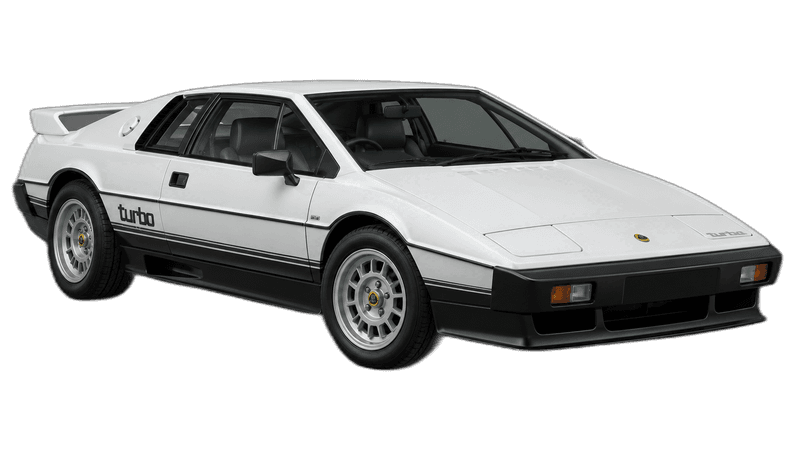
Lotus Esprit Turbo
210bhp
Power
241km/h
Top Speed
The Lotus Esprit Turbo is a 2-door coupé by Lotus, with 210 bhp, 271 Nm of torque and a top speed of 241 km/h.
Dream Car Garage Editorial · Last updated 3 November 2026
Overview
We have not driven this car. This review is based on published specifications and the sources listed below.
Scope of this guide
This guide is scoped to the Lotus Esprit Turbo, the original turbocharged Esprit that Lotus built from 1980 until 1987 in the Giugiaro-styled shape. It is a two-seat, mid-engine car with rear-wheel drive, a longitudinal four-cylinder engine behind the cabin and a five-speed manual gearbox. The run includes the limited Essex Turbo Esprit of February 1980 to April 1981, the cheaper production Turbo that followed, and the Turbo HC of the final year. It does not cover the Esprit Turbo SE of 1989 onward, which has its own guide, nor the naturally aspirated Series 3 or the later Stevens-shaped cars.
We have not driven this model for this article. We are an editorial desk that reads sources, and everything below comes from pages we opened: Wikipedia's Lotus Esprit article, a Motor Sport road test from September 1981, a supercars.net page on the Essex car, the model pages and an Autocar buyer's guide reproduced on lotusespritturbo.com, two guides reproduced on lotusespritworld.com (an early-Esprit buying guide and a Classic and Sports Car guide from March 2000), a sportscar2 history page and a Supercar Nostalgia sale listing. These are reference pages and period road tests, not our own inspection. This page is for research, not a buying recommendation, and a guide cannot replace an inspection by a specialist who knows these cars.
The figures at a glance
- Engine: 2.2L turbocharged inline-four, 2,174 cc, the Lotus Type 910 with dry-sump lubrication in the first cars and the 910S wet-sump version later, according to Wikipedia. Motor Sport and supercars.net describe a Garrett T3 turbocharger feeding two twin-choke Dellorto DHLA 40 carburettors, with boost limited to 8 psi by a wastegate and a compression ratio of 7.5:1.
- Layout: mid-engine, rear-wheel drive, five-speed manual gearbox derived from the Citroen SM transaxle (Motor Sport and Wikipedia).
- Power: 210 bhp. Motor Sport, supercars.net, sportscar2, lotusespritworld.com and the Autocar guide all print 210 bhp, and Wikipedia prints 213 PS (157 kW; 210 hp). Converting 213 PS at 0.98632 gives about 210.1 bhp, and converting 157 kW at 1.34102 gives about 210.5 bhp, so the figures agree.
- Torque: 271 Nm. The sources print two hundred lb ft, and Wikipedia prints 271 N m. Converting two hundred lb ft at 1.35582 gives 271.2 Nm.
- Top speed: 241 km/h. Wikipedia prints 241 km/h (150 mph), and supercars.net, lotusespritworld.com and the Classic and Sports Car guide give about 150 mph. Converting 150 mph at 1.60934 gives 241.4 km/h.
- 0-100 km/h: no figure shown. Every performance time we found is a 0-60 mph time, and we do not relabel a 0-60 mph time as a 0-100 km/h time.
- Kerb weight: 1,148 kg on supercars.net and the Supercar Nostalgia listing, 1,067 kg on Wikipedia for the Series 3 and Turbo, and 2,673 lb unladen (Autocar, December 1984). The sources do not agree.
- Production: no single figure we trust. See the production section below.
Which power figure we use
The catalogue lists 210 bhp, and that is the figure we use throughout. It is the rating quoted for the Essex car and the standard production Turbo, which cover most of the run. The Turbo HC that arrived late in the run is rated higher: Wikipedia gives 218 PS (160 kW; 215 hp) and 298 N m (220 lb ft), the Autocar guide and lotusespritworld.com give 215 bhp at 6,000 rpm and 220 lb ft at 4,250 rpm, and the Classic and Sports Car guide says the HC has compression raised from 7.5:1 to 8:1, Mahle forged pistons and new exhaust manifolds. The sources also differ on the engine speeds at which the 210 bhp is reached. Most give 6,250 rpm, Motor Sport gives 6,000 rpm, and the Autocar guide gives 6,500 rpm. We cannot resolve that from what we read, so we quote the 210 bhp figure alone and mention the spread here.
History and what changed over the run
Wikipedia says the Essex Turbo Esprit was the first factory turbocharged Esprit. Supercars.net and sportscar2 describe it as unveiled at a party at London's Royal Albert Hall hosted by the Formula One sponsor Essex Petroleum, and sold at first only in the sponsor's blue, red and silver livery. Production began in February 1980 at about ten cars a week and ended in April 1981 according to those pages. Supercars.net adds that Giugiaro's Italdesign reworked the styling and that the car used a new chassis. Wikipedia says the chassis and rear suspension were redesigned, with an upper link added at the rear, and that the brakes were improved. Supercar Nostalgia, in a sale listing, says the turbo Esprit was launched at the Geneva Motor Show in March 1980.
In April 1981 the car was renamed. Sportscar2 calls it the Turbo Esprit Type 82, with a wider range of colours, a lower selling price, and air conditioning and leather as options. The lotusespritworld.com model page describes it as a cheaper production version with reduced trim and BBS wheels. Wikipedia says it kept the Essex aero body kit and Turbo Esprit decals, with interior changes that added headroom and a larger footwell.
Sources differ on lubrication. The lotusespritworld.com model page says the production Turbo used wet-sump lubrication except on the earliest cars, while the early-Esprit buying guide says Essex cars were dry-sump and that from 1983 Turbos were wet-sump. Wikipedia says the wet-sump engine had the same power and torque as the dry-sump engine before it. We note the disagreement without choosing a date.
Autocar's guide says the Triumph-based front suspension was replaced by Toyota-sourced parts in 1985, and Wikipedia mentions minor bodywork and front-suspension changes for the 1985 model year. The HC dates are also uncertain: the Classic and Sports Car guide gives October 1986 to October 1987, Wikipedia says April 1986, and the Autocar guide says February 1987 for the S3 version, with an Autocar test of the Turbo HC dated 8 April 1987. We describe the HC loosely as the final year or so of the run. Wikipedia also describes a fuel-injected HCi with a catalytic converter for stricter emissions markets, with the same peak power at higher rpm and torque of 274 N m (202 lb ft); the other sources we read do not mention it.
What the contemporary tests said
Motor Sport's September 1981 road test timed 0-60 mph in 6 seconds with a passenger and a full tank, and estimated the top speed as over 140 mph and possibly over 150 mph. It quotes 210 bhp at 6,000 rpm and two hundred lb ft at 4,000 rpm, with over 140 lb ft available from 2,500 rpm. The writer praised the handling and road holding, reported very little roll even in fast corners and a firm but comfortable ride, and said he could not lock a wheel under braking at 70 or 100 mph in the dry. Complaints were about wiring, rattles and some switchgear carried over from BL models, and the writer felt the gear change needed improving. Fuel consumption was 20.2 mpg over the test, with a 19-gallon tank giving roughly 350 miles between stops.
Other 0-60 mph times vary by source. Wikipedia prints 6.1 seconds for the Essex car, lotusespritworld.com quotes 5.6 seconds from Motor, supercars.net notes that Autocar's 1980 figures gave 5.55 seconds, and sportscar2 prints 5.5 seconds. The Autocar guide's own test table, dating from December 1984, gives the standard Turbo 6.1 seconds to 60 mph and a top speed of 138 mph, and the Turbo HC of April 1987 5.6 seconds and 141 mph. We chose 150 mph as the top speed because Wikipedia, supercars.net and the Classic and Sports Car guide agree on it, but a tested car could be slower than the maker's claim, and the 1984 Autocar test is the clearest example of that.
Production numbers
Production figures vary widely. For the Essex cars alone, Wikipedia and sportscar2 give 45 Essex-liveried cars. The lotusespritworld.com model page gives 34 plus 11 development cars, sportscar2 adds 59 dry-sump Turbos in other colours, and the Classic and Sports Car guide says about 100. Supercars.net lists 45 in its header but refers in the same text to the first 100 cars in the commemorative livery.
For the later production Turbo, Wikipedia lists 2,909 for the Turbo from 1981 to 1987, the lotusespritworld.com model page lists 1,845 or 2,274 including the HC, sportscar2 gives 2,274 for the car from April 1981, and the Classic and Sports Car guide gives 1,608 from April 1981 to October 1986. An early buying guide on the same site gives 378 built at the time it was written, which was evidently before the run finished. The Autocar guide adds that Lotus built 243 Turbos in 1983 and 323 in 1985. Because the sources conflict and do not use the same date ranges, we do not give a single production total for this model.
Prices then and later
Contemporary prices are well documented. Motor Sport in September 1981 gave 16,982 pounds for the basic Turbo Esprit, just under 19,500 pounds for the test car with a radio cassette, air conditioning and leather trim, and 20,900 pounds for the Essex Turbo Esprit. Autocar's guide gives 20,950 pounds for the 1980 Turbo in Essex livery, 16,982 pounds in April 1981, 21,270 pounds in October 1984 and 24,980 pounds in October 1986. The small gap between 20,900 and 20,950 pounds for the Essex car is a reminder that these pages disagree in detail.
Used prices in our sources are old. The Autocar guide, which quotes prices for cars up to 1988 and so appears to date from around that time, listed an early Turbo at 7,000 to 8,000 pounds, often with 70,000 to 80,000 miles, and a 1983 Turbo at about 10,000 pounds. The Classic and Sports Car guide, with prices quoted in March 2000, said a Giugiaro-shape Turbo peaked at about 10,000 pounds for a non-HC car and 13,500 pounds for an HC, and an Essex Turbo at up to 16,000 pounds. Sportscar2 gives an undated estimate of about 14,000 pounds (22,000 dollars) for a good Essex car. Supercar Nostalgia describes a 1983 car with just under 21,000 miles and a family of former Lotus main dealers as owners, consigned to a Bonhams sale at the Goodwood Festival of Speed, but gives no price or estimate. We found no current market data, so none of these figures tells you what a car is worth today.
What to check before buying
Our sources give real specifics, though most are decades old. Treat the list as a set of questions to ask a specialist, not a checklist you can complete yourself.
Chassis and body
- The chassis. The early-Esprit buying guide says early frames can corrode and that the front cross member deserves close inspection, and that later galvanised frames should last for many years. The Classic and Sports Car guide says post-1981 cars have galvanised chassis, advises tapping the chassis with a hammer and listening for a crisp sound, and says to inspect it on a ramp. It quotes a replacement at about 3,500 to 4,000 pounds all in, in March 2000 money. The Autocar guide warns that a chassis can look sound on the surface while needing detailed work.
- The body. Autocar says the glass-fibre shell cannot rust, that Lotus kept many obsolete moulds so panels are generally available, and that a very cheap car is not worth rebuilding. The Classic and Sports Car guide lists star-shaped cracks on the nearside rear wing, faded paint (especially red) and window-frame corrosion.
- Water leaks. The early-Esprit guide warns about leaks around the windscreen and rear window and into the front compartment and boot, and the Classic and Sports Car guide notes that window motors corrode when water gets past the door glass seals.
Engine and turbo
- The wastegate. The Classic and Sports Car guide says pre-HC Turbos have an external wastegate that can stick: shut, it can break a piston, and open, it makes the engine feel sluggish. The HC wastegate is built into the turbo and is more reliable, it says.
- Manifolds and cooling. The same guide says exhaust manifolds can crack around the wastegate area, and warns about overheating, head gasket failure and a warped head, plus a low-mounted radiator that is easily damaged.
- Cold start and oil. It advises a cold start with minimal revs, notes that some big-end noise at start-up is normal while heavy rattling is a warning, and gives oil pressure of 35 psi when warm at 3,500 rpm.
- Cam belt and tappets. The Classic and Sports Car guide gives belt changes about every 24,000 miles for pre-HC engines and about 36,000 miles for the HC. The early-Esprit guide says 25,000 miles and calls the job not cheap, with tappet adjustments every 10,000 miles.
- Servicing. The early-Esprit guide says the 16-valve engine should be serviced only by a qualified Lotus dealer, while also calling the Turbo's engine and transmission reliability good.
Gearbox, suspension and running costs
- Gearbox. The early-Esprit guide says a noise that sounds like a clutch release bearing may be a worn input shaft, and warns about oil leaks at the selector cross shaft bushes and sloppy linkage from worn bushes. Autocar says the gearchange should feel heavy but precise.
- Suspension. Dampers often fail before 30,000 miles on the early cars, according to the early-Esprit guide, which recommends Konis, and Autocar warns that rebushing and alignment can be costly.
- Running costs. Autocar says major services fall every 24,000 miles and take at least 15 hours, that parts are expensive, that rear tyres rarely last beyond about 8,000 miles on fast-driven Turbos, that a replacement exhaust can cost well over 500 pounds, and that insurance was Group 9. These were prices from the 1980s.
- Resale. The early-Esprit guide recommends a plain-colour Turbo over an Essex car for better resale value, while the Classic and Sports Car guide's price table shows the Essex car at the top of the range in 2000. Those two statements come from different eras, and we cannot tell you which holds today.
What we could not find
- 0-100 km/h: no figure shown. Every time we found is a 0-60 mph time, and we do not relabel it.
- A single agreed production total for the Turbo, or an agreed count of Essex cars. The sources above disagree.
- A current price guide, auction result or recall information. None of the pages we read give recent values or a safety recall for this model, so we make no claims about them.
- A clear date for the change from dry-sump to wet-sump lubrication, or for the start of the Turbo HC.
- Torque rpm and power rpm are inconsistent between sources, so we give the peak figures only.
About the photograph
The page uses the catalogue photograph, and its credit is listed on the credits page.
Verdict
The early Lotus Esprit Turbo is a mid-engine, rear-wheel drive two-seater with a 2.2L turbocharged inline-four, 210 bhp, 271 Nm and a claimed top speed of 241 km/h. Our sources agree on those numbers and on the car's reputation for handling, but not on its 0-60 mph time, which ranges from 5.5 to 6.1 seconds depending on who measured it, nor on production totals, and we found no 0-100 km/h time. The buying advice we found is consistent in one respect: check the chassis, the wastegate and the cam belt history, and use a specialist who knows the car. The advice is also old, and prices have certainly moved since it was written. For a buyer, the sensible next step is to establish exactly which version a car is, Essex, standard or HC, and to get it inspected before anything else. This page is for research only.
Sources
- Wikipedia: Lotus Esprit
- Motor Sport Magazine: Lotus Turbo Esprit road test, September 1981
- Supercars.net: Lotus Essex Turbo Esprit
- Lotus Esprit Turbo site: Lotus Esprit models
- Lotus Esprit Turbo site: Autocar buyer's guide
- Lotus Esprit World: buying guide to early Esprits, 1976-82
- Lotus Esprit World: Classic and Sports Car Esprit guide, March 2000
- Sportscar2: Lotus Essex Turbo Esprit
- Supercar Nostalgia: One to Buy, 1983 Lotus Esprit Turbo
Specifications
Engine
2.2L turbocharged inline-four
Displacement
2.2L
Power
210 bhp
Torque
271 Nm
Top Speed
241 km/h
Drivetrain
RWD
Country
United Kingdom
Body Style
2-door coupé
Years
1980–1987
Specifications are manufacturer-published figures.
More from Lotus
Frequently Asked Questions
What are the specifications of the Lotus Esprit Turbo?
The Lotus Esprit Turbo is a 2-door coupé by Lotus, with 210 bhp, 271 Nm of torque and a top speed of 241 km/h.
What drivetrain does the Lotus Esprit Turbo use?
The Lotus Esprit Turbo is configured with rear-wheel drive.
What type of car is the Lotus Esprit Turbo?
The Lotus Esprit Turbo is a sports cars manufactured by Lotus in United Kingdom. Production ran from 1980 to 1987.