
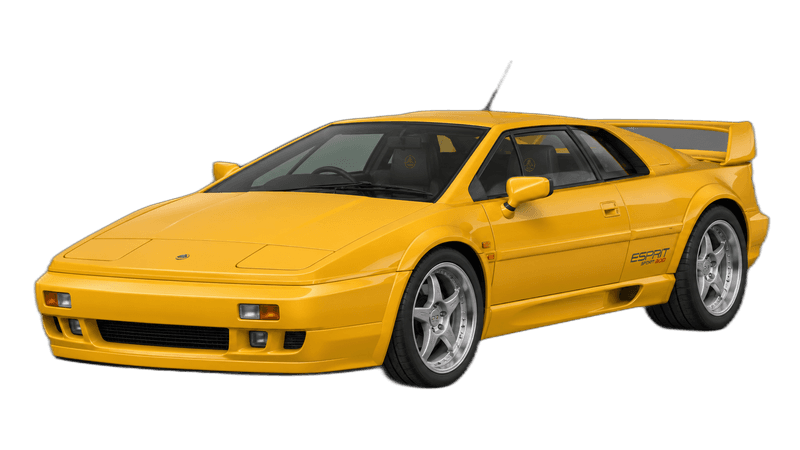
Lotus Esprit Sport 300
302bhp
Power
270km/h
Top Speed
The Lotus Esprit Sport 300 is a 2-door coupé by Lotus, with 302 bhp, 389 Nm of torque and a top speed of 270 km/h.
Dream Car Garage Editorial · Last updated 3 November 2026
Overview
We have not driven this car. This review is based on published specifications and the sources listed below.
Scope of this guide
This guide is scoped to the Lotus Esprit Sport 300, the limited, road-going derivative of the Esprit X180R racer that Lotus unveiled at the Birmingham Motor Show in October 1992 and sold in 1993 and 1994. It is a two-seat, mid-engine car with rear-wheel drive, a turbocharged four-cylinder engine behind the seats and a five-speed manual gearbox. It is built on the Esprit S4 and Turbo SE basis, with a lighter and stiffer body, wider wheels and tyres, a limited-slip differential and a more powerful engine. It is not a guide to the standard Esprit S4, to the Esprit S4 Sport that followed it, or to the V8 Esprit.
We have not driven this model for this article. We are an editorial desk that reads sources, and everything below comes from pages we opened: Wikipedia, a Motor Sport magazine review from May 1993, an Autocar road test from August 1993 as reproduced by Lotus Esprit World, the Sport 300 pages on SportsCar2 and Supercars.net, a Jalopnik feature from January 2019, a Supercar Nostalgia listing for a 1994 car, Conceptcarz, a Lotus Esprit World page about one Australian competition car, and two More-Cars pages. Most of these are reference or magazine pages, not owner reports. This is a very rare car, so this page is for research, not a buying recommendation, and a guide cannot replace an inspection by a specialist who knows these cars.
The figures at a glance
- Engine: 2.2L turbocharged inline-four, 2,174 cc, 16-valve, twin overhead cam, with a compression ratio of 8.0:1 according to SportsCar2. The factory engine code in the Supercars.net specification table is S910.
- Layout: mid-engine, rear-wheel drive, five-speed manual. Autocar describes the engine as mid-mounted and the drive as to the rear wheels.
- Power: 302 bhp at 6400 rpm. Autocar prints 302 bhp at 6400 rpm, SportsCar2 prints the same, and Wikipedia prints 306 PS (225 kW; 302 hp) at 6400 rpm. Converting 306 PS at 0.98632 gives about 301.8 bhp, which rounds to 302 bhp. Lotus itself called it a 300 bhp car, and we explain that choice in the section on where the sources disagree.
- Torque: 389 Nm at 4400 rpm. Autocar and SportsCar2 print 287 lb ft at 4400 rpm, and converting 287 lb ft at 1.35582 gives about 389.1 Nm. Wikipedia prints 389 N m (287 lb ft) at 4400 rpm, so the sources agree.
- 0-100 km/h: no figure shown. The sources we read give 4.7 seconds for 0-60 mph and 11.7 seconds for 0-100 mph, and one data site gives a 0-100 figure without a unit. A 0-60 mph time is not a 0-100 km/h time, and we do not relabel it.
- Top speed: 270 km/h, which is the 168 mph that Lotus quoted. Converting 168 mph at 1.60934 gives about 270.4 km/h. Autocar measured 161 mph at Millbrook, which is about 259.1 km/h.
- Weight: 1,243 kg (2,738 lb) in Autocar's test, giving 243 bhp per tonne, a figure that matches the 302 bhp rating.
- Production: 64 cars, according to Wikipedia, SportsCar2, Supercars.net, Jalopnik quoting the author Richard Catchpole, and Supercar Nostalgia.
- Launch price: 64,995 pounds in the UK, per Motor Sport in May 1993 and Autocar in August 1993.
What the Sport 300 is
Wikipedia calls the Sport 300 an extensively modified derivative of the X180R, and Supercar Nostalgia describes it as a road-going version of the X180R that won the 1992 IMSA Supercar Championship. The same Supercar Nostalgia page says it also served as the homologation special for a GT-class Esprit that debuted at the 1993 Le Mans 24 Hours. Conceptcarz adds that two Sport 300s ran at Le Mans in 1993 without finishing in the placings, which the page calls Lotus's first works-supported entry in more than thirty years, and that Thorkild Thyrring won the British National GT series in a Sport 300 in 1994. Jalopnik puts the same lineage plainly: the road car came from the racer that competed in the SCCA and IMSA supercar series.
For the road, Wikipedia says the engine gained a Garrett T4 turbocharger, an improved Chargecooler and larger inlet valves, which lifted it by about 38 PS over the 268 PS of the S4 and Turbo SE. Motor Sport called it a reworked cylinder head on the 2.2-litre twin-cam turbo. Supercar Nostalgia calls it the most powerful turbocharged engine ever fitted to an Esprit up to that time.
Chassis, brakes and body
The shell is the point of the car. Motor Sport said the body was the lightest and strongest yet on an Esprit, with added bracing, and ready to accept an FIA roll cage. SportsCar2 describes a four-point braced frame, extensive composite materials, stiffer coil springs and dampers, and a wider front and rear track. Supercar Nostalgia says the car was 80 kg lighter than a standard Turbo SE, thanks to a simplified interior and a lighter, stiffer bodyshell built with extensive composites. Motor Sport also says the limited-slip differential, which it describes as Lotus's patented design, appeared on a public road car for the first time as standard.
Autocar lists three-piece OZ wheels, 8.5x16 in at the front with 245/45 ZR16 tyres and 10.5x17 in at the rear with 315/35 ZR17 tyres. Brakes are 327 mm ventilated front discs and 280 mm rear discs with four-piston AP Racing calipers and Delco ABS. Autocar calls the brakes unservoed and the reviewer found them tireless. The dimensions in the same test are 4,391 mm long, 1,900 mm wide, 1,175 mm high on a 2,438 mm wheelbase, with a 73 litre fuel tank. SportsCar2 also mentions a front airdam with brake-cooling ducts, widened wheelarches and a large rear wing, Supercar Nostalgia mentions a custom aero kit and wheelarch extensions, and Motor Sport refers to Sport 300/IMSA front aerodynamics.
Autocar notes that the steering is power-assisted at 3.1 turns lock to lock, carried over from the S4. Motor Sport's earlier prototype had no power steering and its reviewer found it heavy at low speed, with understeer that gave way to sudden oversteer on the test track. Production cars were said to have power steering.
How it drove, according to the road testers
We did not drive it, so this is only what the testers wrote. Autocar praised the feedback through the steering wheel and said the ride avoided the rock-hard character that caught out the Porsche Carrera RS Lightweight. It found the engine delivery peaky, with boost building from about 3,000 rpm and coming on strongly at 5,000 rpm, so the driver has to keep the revs in the right range. The measured figures were 4.7 seconds for 0-60 mph, 11.7 seconds for 0-100 mph, 13.4 seconds for the standing quarter-mile and 24.3 seconds for the standing kilometre. The magazine said these were not the big wow you might have expected and put that down to slight fuel starvation, which Lotus believed an uprated fuel pump would fix.
Motor Sport reported about four seconds for 0-60 mph from a prototype, found the car demanding but rewarding, compared it with a Porsche 911 RS with better ride quality, and said road noise was high even by Esprit standards. Autocar also notes that some cabin features were removed to save weight, including the tunnel-top console and map pockets.
Years, price and production
Supercar Nostalgia says the car was unveiled in October 1992. Motor Sport reviewed a prototype in May 1993 and reported that five orders had been placed with deposits of 6,500 pounds, while Autocar's August 1993 test said 25 cars were already sold. SportsCar2 gives the years 1993-1994 and says 64 units were built over a two-year production period. We therefore describe the car as a 1993-1994 model, with the show launch in 1992. Wikipedia's type table prints 1992-1995 and Supercars.net prints the same, which look like launch-to-end-of-availability dates, not build dates.
At launch the price was 64,995 pounds, the top of the Esprit range according to Motor Sport. Autocar lists air conditioning at 1,495 pounds, a CD player at 820 pounds and Yellow Pearl paint at 1,995 pounds. Jalopnik gives the same launch price and converts it to roughly 83,695 dollars at the exchange rate of the time. Supercars.net notes an optional LotusSport package with a roll cage, harness and fire extinguisher.
Where the sources disagree
- Power. Lotus rated the car at 300 bhp, which is how Motor Sport and the Supercars.net specification table (300 bhp at 6,500 rpm) describe it. Autocar and SportsCar2 print 302 bhp at 6400 rpm, Wikipedia prints 306 PS, and More-Cars prints 305 PS (305 PS at 0.98632 is about 300.8 bhp). We use 302 bhp everywhere because it is the figure two independent pages print with an rpm figure, and Wikipedia's conversion agrees. The 300 in the name is a round number.
- Top speed. Lotus quoted 168 mph (270 km/h), the figure on Wikipedia and More-Cars. Autocar measured 161 mph, and SportsCar2 and the Supercars.net table list that lower figure. We use 270 km/h as the maker's figure and give the measured figure beside it.
- 0-100 km/h. More-Cars lists 4.4 for 0-100 with no unit given. That is quicker than every other 0-60 mph time we read and conflicts with Autocar's 4.7 seconds, so we do not use it. We give no figure shown for 0-100 km/h.
- Production. Wikipedia, SportsCar2, Supercars.net, Jalopnik and Supercar Nostalgia say 64. Autocar says 50 were planned, and More-Cars lists 50. Motor Sport said 50 per year. We use 64 as the number built, and 50 as the plan.
- Weight. Autocar prints 1,243 kg and says the car is about 80 kg lighter than an S4. Supercar Nostalgia gives 80 kg against a Turbo SE. Motor Sport says 242 lb less than the S4, which is about 110 kg at 0.45359 kg per lb. The two numbers printed on the Autocar page also imply a larger gap than 80 kg, so treat the comparison as approximate.
- Years. See the section above. We use 1993-1994.
- Torque. Torque is consistent at 287 lb ft or 389 Nm. Conceptcarz prints 290 lb ft in the context of the later S4 Sport, which we do not use here.
- Competition cars. The Lotus Esprit World page about an Australian competition car quotes an owner's hub dyno figure of 444 bhp. That car is a modified racer built to Le Mans specification, so the figure says nothing about the road car and we do not use it.
What to check and what the rarity means
The sources give limited, practical hints, not a technical checklist. We found no owner-written buying guide specific to the Sport 300, and no source we read lists known faults, repair costs or recalls, so we do not invent any.
- Confirm that it is a genuine Sport 300 and not a standard Esprit with cosmetic parts. The wide arches, rear wing, OZ wheels and bracing are the identifying features, and with only 64 built, history matters.
- Ask for the documentation. The Supercar Nostalgia listing of a 1994 car in Camel Yellow, with 102,000 km from new, makes a point of a fully documented service history. We did not see a price or a date on that page.
- Look for signs of competition use. The car was built to accept a roll cage and harnesses, and the Australian page shows how a competition car can differ from the road car, with swapped panels and very thin carbon fibre parts.
- Remember the fuel supply. Autocar reported slight fuel starvation on its test car, and said Lotus planned an uprated pump. Ask how that was resolved on any individual car.
- Check import status. Supercar Nostalgia says the car was originally banned from sale in the USA, and that the 25-year import rule now lets such cars in once they are old enough.
- Do not rely on any price from this page. We read no sold price for a Sport 300, and the only prices we can report are the 1993 launch prices above.
What we could not find
- Production years from the maker: sources give three different spans.
- 0-100 km/h: no figure shown in any source that labelled its units. Only 0-60 mph and 0-100 mph times were given.
- Reliability data, running costs, service intervals or a list of common faults specific to this model.
- Any sold price or valuation for a Sport 300. The Conceptcarz page gives only a general 1993 Esprit price range with no Sport 300 sales.
- A road test from the 1990s other than Autocar and Motor Sport.
- Several pages blocked our requests with errors and we did not work around them: Car and Classic returned 403, Classic Driver returned 403, the Express and Star auction story returned 403, and Parkers returned 402. An Iconic Auctioneers lot page loaded with no readable content. None of them is cited here.
About the photograph
The page uses the catalogue photograph, and its credit is listed on the credits page.
Verdict
The Lotus Esprit Sport 300 is a mid-engine, rear-wheel drive, 64-car road version of the X180R racer, with a 2.2L turbocharged inline-four rated at 302 bhp and 389 Nm, a claimed top speed of 270 km/h and a body that is lighter, wider and stiffer than the Esprit it came from. Contemporary testers praised its steering feel and its ride, and criticised its peaky delivery and noise. The performance Autocar measured was good but not dramatic, and no source we read gives a 0-100 km/h time. For a researcher, the main lesson is that the name, the years and the top speed all depend on which source you read. For a buyer, the next step is to find the paperwork and the build history of one specific car and to have it checked by a Lotus specialist. This page is for research only.
Sources
- Wikipedia: Lotus Esprit
- Motor Sport Magazine: The pleasure principle (May 1993)
- Lotus Esprit World: Autocar road test of the Sport 300 (August 1993)
- SportsCar2: Lotus Esprit Sport 300
- Supercars.net: 1993 Lotus Esprit Sport 300
- Jalopnik: Your 90s supercar knowledge is not complete until you meet the best Lotus Esprit
- Supercar Nostalgia: Lotus Esprit Sport 300 for sale in the USA
- Conceptcarz: 1993 Lotus Esprit
- Lotus Esprit World: Esprit Sport 300 competition car, Australia
- More-Cars: Lotus Esprit Sport 300 fact sheet
- More-Cars: Lotus Esprit Sport 300 (X180R)
Specifications
Engine
2.2L turbocharged inline-four
Displacement
2.2L
Power
302 bhp
Torque
389 Nm
Top Speed
270 km/h
Drivetrain
RWD
Country
United Kingdom
Body Style
2-door coupé
Years
1993–1994
Production
64
Specifications are manufacturer-published figures.
More from Lotus
Frequently Asked Questions
What are the specifications of the Lotus Esprit Sport 300?
The Lotus Esprit Sport 300 is a 2-door coupé by Lotus, with 302 bhp, 389 Nm of torque and a top speed of 270 km/h.
How many Lotus Esprit Sport 300 were made?
Lotus produced 64 units of the Lotus Esprit Sport 300.
What drivetrain does the Lotus Esprit Sport 300 use?
The Lotus Esprit Sport 300 is configured with rear-wheel drive.
What type of car is the Lotus Esprit Sport 300?
The Lotus Esprit Sport 300 is a sports cars manufactured by Lotus in United Kingdom. Production ran from 1993 to 1994.