
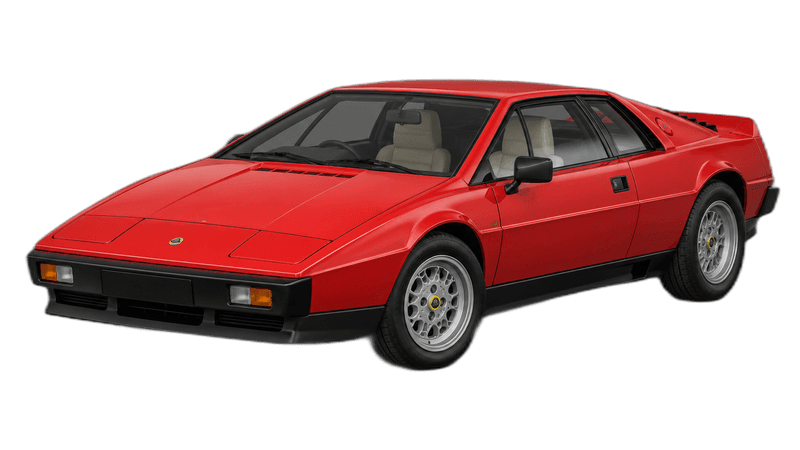
Lotus Esprit S3
160bhp
Power
217km/h
Top Speed
The Lotus Esprit S3 is a 2-door coupé by Lotus, with 160 bhp, 217 Nm of torque and a top speed of 217 km/h.
Dream Car Garage Editorial · Last updated 3 November 2026
Overview
We have not driven this car. This review is based on published specifications and the sources listed below.
Scope of this guide
This guide is scoped to the Lotus Esprit S3, the naturally aspirated Series 3 Esprit that Lotus launched in April 1981 and built until 1987. It is a two-seat, mid-engine coupe with rear-wheel drive, a glassfibre body on a steel backbone chassis, and the 2.2-litre Type 912 four-cylinder engine mounted behind the seats. It is not a guide to the Turbo Esprit, which was sold at the same time with a turbocharged engine and a separate model entry, and it is not a guide to the earlier S2 (2.0-litre) or the short-run S2.2. Where a source blends those cars together we say so.
We have not driven this model for this article. We are an editorial desk that reads sources, and everything below comes from pages we opened: Wikipedia's Lotus Esprit article, the Lotus Drivers Guide Esprit genealogy table, the Lotus Esprit World S3 model page, a CAR magazine road test from June 1981 as reproduced on Lotus Esprit World, a ClassicCar buying guide from September 2001 (also reproduced on Lotus Esprit World), a Practical Classics buyer's brief dated 3 June 2025 and a Hagerty UK article dated 14 February 2023. This page is for research, not a buying recommendation, and a guide cannot replace an inspection by a Lotus specialist who knows these cars.
The figures at a glance
- Engine: 2.2L naturally aspirated inline-four. The sources name it the Lotus Type 912, 2,174 cc, twin overhead cams, 16 valves, with two Dellorto side-draught carburettors and an aluminium alloy block and head (Lotus Esprit World).
- Layout: mid-engine, rear-wheel drive, five-speed manual gearbox.
- Power: 160 bhp at 6,500 rpm. CAR magazine in 1981 and Lotus Esprit World both print 160 bhp at 6,500 rpm, and the Lotus Drivers Guide table lists 160 bhp for the S3. No conversion was needed because the figure is already given in bhp.
- Torque: 217 Nm. The 1981 CAR test and Lotus Esprit World give 160 lb ft at 5,000 rpm. We convert at 1.35582 Nm per lb ft, which gives 216.9 Nm, rounded to 217 Nm. No source we read prints a metric torque figure for the original S3.
- 0-100 km/h: no figure shown. The only acceleration times we found are 0-60 mph figures: 6.7 seconds in the 1981 CAR test and 6.5 seconds on Lotus Esprit World. A 0-60 mph time is not a 0-100 km/h time and we do not relabel it.
- Top speed: 217 km/h. Lotus Esprit World gives 135 mph, and 135 mph at 1.60934 km/h per mph is 217.3 km/h. CAR describes the standard S3 as a 138 mph car, which would be about 222 km/h, but it did not print a measured top speed. See the disagreement section below.
- Weight: Lotus Esprit World gives a kerb weight of 1,220 kg with a 41.2 to 58.8 front-to-rear split and a 67 litre fuel tank.
- Production: 732 cars, from the Lotus Drivers Guide table and the type table in Wikipedia. Lotus Esprit World says 767. See below.
History and what the S3 changed
The Series 3 was officially launched on 22 April 1981, according to Lotus Esprit World. It kept the Giugiaro wedge shape of the original Esprit but brought together the 2.2-litre engine and a substantially revised chassis and running gear. Wikipedia says the S3 and the Turbo Esprit debuted together in April 1981 and shared a chassis and body moulds. Lotus Esprit World says the chassis and running gear came from the February 1980 Essex Turbo Esprit and delivered large gains in torsional rigidity.
The engine is the 2.2-litre Type 912 that had already appeared in the short-run S2.2. Wikipedia notes that the S2 used a 2.0-litre Type 907, and that the S2.2 did not receive the revised chassis structure that arrived with the S3. The Lotus Drivers Guide table lists the S2.2 as 88 cars from 1980 to 1981 at 160 bhp, which tells you how brief that car was.
Exterior and wheels
Wikipedia says the S3 has larger bumpers than the S2.2 but keeps a simpler sill line and glazed rear hatch than the Turbo, and does not carry the Turbo's Essex-style body kit. Lotus Esprit World lists a colour-coded front spoiler, side sills, air scoops and Turbo-style bumpers. Wikipedia gives 15-inch BBS alloy wheels in place of the S2's 14-inch Speedline wheels. Lotus Esprit World gives 7J front and 8J rear rims, both 15-inch, with Goodyear Grand Prix tyres in 195/60 VR15 front and 235/60 VR15 rear sizes. Wikipedia adds that bodywork and front suspension were revised for the 1985 model year.
Interior
Lotus Esprit World lists new seats, a new steering wheel, instruments derived from the Turbo (without a boost gauge) and greater sound insulation that it says reduces interior noise by half. CAR in June 1981 repeated the 50 percent noise figure and called the cabin genuinely plush and impressive, with improved seat support, comfort and headroom, a smaller leather-bound steering wheel and better instrument lighting. Wikipedia says the revised trim gave more headroom and a larger footwell, and notes that there was no standard cigarette lighter, with ashtrays built into the door sills.
Dimensions
Wikipedia gives a wheelbase of 2,440 mm, a length of 4,320 mm, a width of 1,860 mm and a height of 1,110 to 1,120 mm for the Esprit range covered in its infobox. It gives a kerb weight of 1,067 kg, which does not agree with the 1,220 kg on Lotus Esprit World, and we cannot tell from the article whether the lighter number is a dry weight or applies to a different variant. We quote the Lotus Esprit World number for the S3 and flag the gap.
How it drove, according to a 1981 road test
CAR magazine's June 1981 newcomer report by Mel Nichols and Colin Curwood is the closest thing we found to a contemporary verdict. It called the S3 delightful to handle, said grip was outstanding and that it took real effort to break traction. It reported softer spring and damper settings than the Turbo, a more absorbent ride and slightly less roadholding. It printed 0-60 mph in 6.7 seconds, a launch price of 13,461 pounds, and in-gear speeds of 40, 60, 88, 120 and 138 mph, which are speeds reached in each gear rather than timed runs. Fuel consumption was given as mid to high 20s with no units. Lotus Esprit World's model page gives 23.2 mpg, a 0-60 mph time of 6.5 seconds and 135 mph.
Those are testers' impressions from over four decades ago. We have no modern independent test of a standard S3 to compare them with.
Where the sources disagree
- Top speed. Lotus Esprit World prints 135 mph. CAR calls the S3 a 138 mph car without printing a test result. We chose 135 mph, or 217 km/h, because it is a stated figure rather than a description, and because it matches the figure already in our catalogue entry. The two numbers differ by about 5 km/h.
- 0-60 mph. CAR measured 6.7 seconds and Lotus Esprit World prints 6.5 seconds. Neither is a 0-100 km/h figure, so the 0-100 km/h entry stays as no figure shown.
- Production. The Lotus Drivers Guide table and Wikipedia's type table both give 732 S3s. Lotus Esprit World says 767 were sold between 1981 and 1987. Wikipedia's infobox also gives a combined 3,041 for the S3 and Turbo built from 1982 to 1988, which does not agree with its own type table, and the Lotus Drivers Guide lists the Turbo Esprit alone as 3,155. We use 732 because two pages agree on it, but the totals in this area are not settled.
- Years. Wikipedia's infobox says 1982 to 1988 for the combined S3 and Turbo, while its type table, the Lotus Drivers Guide and Lotus Esprit World all point to 1981 to 1987 for the S3. We use 1981 to 1987.
- Late-run power. Wikipedia lists a 1986 update to the naturally aspirated engine at 172 PS (170 hp) and 160 lb ft. Converting 172 PS at 0.98632 gives about 169.6 bhp. No other page we read mentions this change, and it is unclear whether it applies to the S3 or only to the HC-era cars generally, so we keep 160 bhp as the single power figure for the S3 throughout this page.
- Galvanised chassis. ClassicCar (2001) says all Esprits from the S2.2 onwards have a galvanised chassis, Practical Classics says S2.2 chassis were galvanised and that the stiffened Turbo chassis went into every version from the S3, and Hagerty describes the S3 chassis as galvanised steel. Wikipedia, however, says the S2.2 did not get the revised chassis structure. The galvanising and the stiffening may therefore be two different changes, and the sources do not fully reconcile them.
What to check before buying, according to the buying guides we read
Only the buying guides give specifics, and they are older or are short summaries. We repeat what they say and no more. Treat them as a checklist of questions for a specialist.
- Chassis. ClassicCar (September 2001) says some earlier cars have since been fitted with a galvanised chassis, so look for evidence. It priced a replacement chassis at about 1,500 pounds at that time, with bushes, steering rack and brake pipes roughly doubling the cost and specialist fitting adding about 1,000 pounds. Practical Classics (June 2025) says felt between chassis and body traps water, and recommends inspecting the car on a ramp.
- Cambelt. Both ClassicCar and Practical Classics say the cambelt should be changed every 24,000 miles or two years. Hagerty warns that on a neglected car a belt failure could mean a five-figure rebuild.
- Engine. Both guides say the engine can reach about 100,000 miles between rebuilds with six-monthly or 6,000-mile servicing. Practical Classics lists misfires from oil in the spark plug recesses caused by a leaking cam cover gasket, blown head gaskets and fractured manifolds. ClassicCar adds cracked exhaust manifolds, a low-slung radiator that can leak without obvious signs, an oil pressure guide of about 35 psi at 3,500 rpm when warm, and a recommendation to use a lead substitute because of the valve seat inserts.
- Gearbox. Both guides say the five-speed box is shared with the Citroen SM and parts are increasingly hard to find. An ungreased spigot bearing can fail and damage the crankshaft. ClassicCar says S3 and later cars have a more durable rear drive design than the S1 and S2.
- Body. The glassfibre shell is strong but heavy. Both guides mention star-shaped cracks on the nearside rear wing from loose boot cargo, stone damage on the nose and poor accident repairs.
- Steering and suspension. Practical Classics says racks wear faster on S3s and later because of the wider wheels and tyres, and may last about 48,000 miles, or half that if driven hard. It put a replacement rack at about two hundred pounds plus labour, while ClassicCar's parts list shows 232 pounds for an S3 front rack in 2001.
- Electrics. Window motors can seize from corrosion, the glovebox fuse box can be knocked by luggage, and the headlamp relays often fail first. ClassicCar says the Esprit's electrics are less unreliable than many glassfibre cars.
- Fuel tanks. Hagerty says the two steel fuel tanks are known to rot, with alloy replacements costing 300 pounds each at the time of writing. ClassicCar does not cover tanks.
Market and value notes
All prices below are dated and come from the pages named. They are not a valuation.
- ClassicCar, September 2001: a value band of 8,000 pounds for the best S3s and S2.2s, and a listed 1981 S3 in white with 91,000 miles at 5,000 pounds.
- Hagerty UK, 14 February 2023: the Hagerty Price Guide average for a condition 4 S3 was twelve thousand eight hundred pounds, and a 1982 S3 needing recommissioning had an auction estimate of 14,000 to 18,000 pounds. The author warned that a proper respray could leave little change from 20,000 pounds, and called buying one a Lotus lottery.
- Practical Classics, 3 June 2025: project cars at 15,000 to 25,000 pounds, average cars at 25,000 to 35,000 pounds and excellent cars at 35,000 to 65,000 pounds, with an average S3 listed at 27,000 pounds. It says the S3 has traditionally offered the best value of the early cars.
The two newer pieces were written about two years apart and do not describe the same sales. We cannot tell from them whether the market moved or whether the cars compared were different. Neither does the data say anything about what a particular car should cost.
What we could not find
- Torque in newton metres, 0-100 km/h and a measured top speed from a period road test. The torque figure above is converted from lb ft, the 0-100 km/h entry is no figure shown, and the top speed is a manufacturer-style figure repeated by Lotus Esprit World.
- A single agreed production count and a clear statement of how the 1986 engine update applied to the S3.
- Recalls, safety campaigns, service schedules from the maker, or running-cost data beyond the dated parts prices above.
- Pages from encyCARpedia and Classics World returned a 403 error when we tried to open them, and a Honest John Classics link redirected to a different site. We did not work around any of that and none of them is cited.
About the photograph
The page uses the catalogue photograph, and its credit is listed on the credits page.
Verdict
The Lotus Esprit S3 is a mid-engine, rear-wheel drive coupe whose 2.2L naturally aspirated inline-four makes 160 bhp and about 217 Nm, with 217 km/h as the best-supported top speed and no figure shown for 0-100 km/h. It was built from 1981 to 1987, 732 times by the figures we trust most, and it combined the Turbo's stiffer chassis and quieter, plusher cabin with the less demanding naturally aspirated engine. The buying guides agree on the points to inspect: chassis condition, a documented cambelt history, gearbox spigot bearing, fuel tanks, body repairs and electrics. For a reader, the practical next step is to find an individual car with documented history and have a Lotus specialist inspect it. This page is for research only.
Sources
- Wikipedia: Lotus Esprit
- Lotus Drivers Guide: Esprit genealogy
- Lotus Esprit World: Esprit S3
- CAR magazine, June 1981: Lotus Esprit S3 (via Lotus Esprit World)
- ClassicCar, September 2001: Lotus Esprit buying guide (via Lotus Esprit World)
- Practical Classics: Buyer's brief, Lotus Esprit S1-S3
- Hagerty UK: I bought a bargain Lotus Esprit S3
Specifications
Engine
2.2L naturally aspirated inline-four
Displacement
2.2L
Power
160 bhp
Torque
217 Nm
Top Speed
217 km/h
Drivetrain
RWD
Country
United Kingdom
Body Style
2-door coupé
Years
1981–1987
Production
732
Specifications are manufacturer-published figures.
More from Lotus
Frequently Asked Questions
What are the specifications of the Lotus Esprit S3?
The Lotus Esprit S3 is a 2-door coupé by Lotus, with 160 bhp, 217 Nm of torque and a top speed of 217 km/h.
How many Lotus Esprit S3 were made?
Lotus produced 732 units of the Lotus Esprit S3.
What drivetrain does the Lotus Esprit S3 use?
The Lotus Esprit S3 is configured with rear-wheel drive.
What type of car is the Lotus Esprit S3?
The Lotus Esprit S3 is a sports cars manufactured by Lotus in United Kingdom. Production ran from 1981 to 1987.