
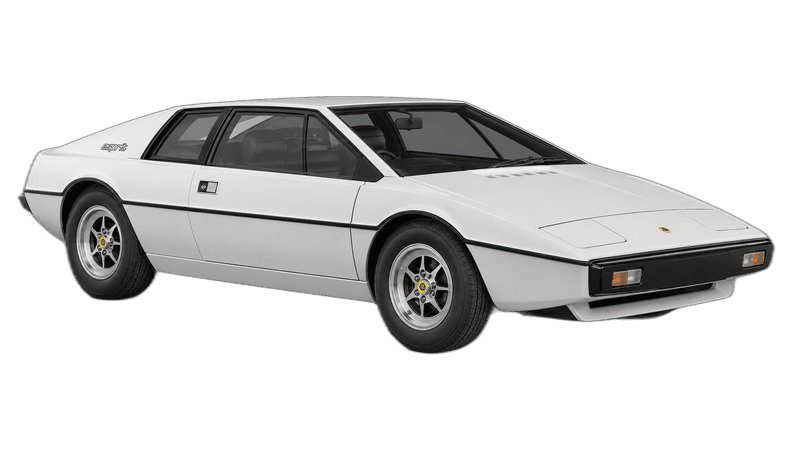
Lotus Esprit S1
160bhp
Power
214km/h
Top Speed
The Lotus Esprit S1 is a 2-door coupé by Lotus, with 160 bhp, 190 Nm of torque and a top speed of 214 km/h.
Dream Car Garage Editorial · Last updated 3 November 2026
Overview
We have not driven this car. This review is based on published specifications and the sources listed below.
Scope of this guide
This guide is scoped to the Lotus Esprit S1, the first production Esprit, built from June 1976 and replaced by the S2 in 1978. It is a two-seat, mid-engine, rear-wheel drive coupé with a Giorgetto Giugiaro wedge body, a steel backbone chassis and a naturally aspirated 2.0 litre four-cylinder engine mounted behind the seats. It is not a guide to the S2, the S3, the turbocharged Esprits that followed from 1980, or the V8 cars of the 1990s.
We have not driven this model for this article. We are an editorial desk that reads sources, and everything below comes from pages we opened: Wikipedia, the Lotus Cars heritage page for the Esprit, the supercars.net entry for the S1, a reproduction of a Classic Car buying guide from September 2001 on the Lotus Esprit World site, an undated Practical Classics buyer's brief, the conceptcarz page for a 1977 Esprit, The Classic Valuer, and three auction lot pages (Gooding and Company, and two from RM Sotheby's). We have not inspected, owned or tested a car. Please treat this page as research, not as a buying recommendation, and do not use it in place of an inspection by a Lotus specialist.
The figures at a glance
- Engine: 2.0L naturally aspirated inline-four, the all-aluminium 16-valve Lotus type 907 of 1,973 cc, mounted longitudinally behind the seats.
- Layout: mid-engine, rear-wheel drive, five-speed manual transaxle of Citroen origin.
- Power: 160 bhp in European trim. Wikipedia prints 160 hp (119 kW; 162 PS). Converting 162 PS at 0.98632 gives about 159.8 bhp and converting 119 kW at 1.34102 gives about 159.6 bhp, so the sources agree on 160 bhp. US cars were rated at 140 bhp.
- Torque: 190 Nm. The Classic Car buying guide spec box and supercars.net both print 140 lb ft, and 140 lb ft multiplied by 1.35582 is 189.8 Nm, which we round to 190 Nm. No torque figure for the US-trim cars is shown in anything we read.
- Top speed: 214 km/h, which is the 133 mph road-test figure that Wikipedia gives as about 214 km/h (133 mph multiplied by 1.60934 is 214.0 km/h). Lotus claimed 138 mph, about 222 km/h. Other sources give lower numbers, explained below.
- 0-100 km/h: no figure shown. Sources give 0-60 mph and 0-62 mph times, but none of the pages we read prints a 0-100 km/h time, and we do not relabel a mile-based time as a metric one.
- Weight: sources disagree, from 898 kg to 1,006 kg (see the performance section).
- Production: sources disagree, from 714 to 864 cars (see the production section), so no single figure is shown here.
- Years: 1976 to 1978.
Which power figure we use, and why
The Esprit S1 was sold with two outputs. European cars were rated at 160 bhp at 6200 rpm, which appears on Wikipedia, in the Classic Car spec box, on the supercars.net page, on the Lotus heritage page and in the conceptcarz article. US and Federal cars were rated at 140 bhp, which appears on Wikipedia, in the RM Sotheby's Monterey 2018 lot text ("140 hp in American-market form, versus 160 hp in European guise") and on the Gooding and Company Amelia Island 2012 lot page (140 bhp at 6200 rpm). We use 160 bhp throughout this guide because it is the maker's figure and the one printed on the largest number of pages. If you are looking at a US-market car, read every power and performance number below as optimistic for your car. Wikipedia describes the American cars as stifled by emission controls and considered underpowered.
One oddity is worth knowing about. The Practical Classics brief describes the S1 as having a "2-litre 130bhp Lotus engine" in its text but prints 160 bhp in its own specification box, and it does not say why. We treat the 130 bhp mention as a slip, because everything else we read says 160 bhp or 140 bhp.
The fuel system differs between the sources too. The Classic Car guide lists two Dell'Orto carburettors for the European car, while the Gooding lot page for a US West Coast car lists two Zenith-Stromberg carburettors. That is consistent with different carburation for the emissions-controlled market, though no page we read says so in as many words.
Origins and design
Lotus says Giugiaro's Ital Design showed a silver mid-engined concept at the Turin show in November 1972, based on a substantially modified Lotus Europa Twin-Cam chassis, and that the project was known internally as M70. The Lotus page says the final production design was remarkably close to the Ital Design concept. The conceptcarz article places Giugiaro in the group of designers who produced polygonal folded-paper shapes and notes that he ran Ital Design, which he founded in 1968.
The production car was shown at the 1975 Paris Motor Show according to Lotus, Wikipedia and conceptcarz, and conceptcarz says it was formally announced in October 1975. Production began in June 1976. The Classic Car guide says the car first appeared at the 1974 Paris salon, which conflicts with those three sources, and we have followed the majority and used 1975. Wikipedia and conceptcarz both say the S2 arrived in 1978, conceptcarz giving August 1978. The Classic Valuer says the S1 was produced between 1977 and 1978, which disagrees with the June 1976 start in the other sources. The Lotus page itself gives 1976 to 1977 for the Series 1. We use 1976 to 1978 because Wikipedia and conceptcarz put the start in mid-1976 and the S2 changeover in 1978.
How the car is built
Wikipedia describes a steel backbone chassis with a wedge-shaped fibreglass body. The front suspension uses upper A-arms, lower lateral links and an anti-roll bar. The rear uses tapering box-section trailing arms and lower lateral links, with coil-over dampers at all four corners, unassisted rack-and-pinion steering and disc brakes on all four wheels, the rears mounted inboard. The dimensions it gives are a wheelbase of 2,438 mm, a length of 4,260 mm, a width of 1,861 mm and a height of 1,111 mm.
The gearbox is a five-speed manual transaxle. Wikipedia calls it a Citroen C35 unit, and the Practical Classics brief says it is the same one used in the Citroen SM. The Classic Car guide makes a pointed comment about the layout: the engine was bolted directly to the chassis, so the driveshaft acted as a suspension arm, and it blames that arrangement for poor refinement.
The S1 is recognisable by its snow-shovel front air dam, its Fiat X1/9 tail lights, the absence of side ducts behind the rear quarter windows, Wolfrace alloy wheels and a one-piece instrument cluster with Veglia gauges. Wikipedia sets these against the S2, which has an integrated spoiler, Rover SD1 tail lights, side intake ducts, Lotus-designed Speedline wheels and individual Smiths gauges. It also reports the S2 as heavier, at 1,050 kg against 900 kg for the S1.
Performance claims against road tests
This is the area where sources disagree most, and none of them is a test we ran.
- Lotus claimed 0-60 mph in 6.8 seconds and a top speed of 138 mph (222 km/h), according to Wikipedia.
- Wikipedia and conceptcarz both say road tests found about 8 seconds to 60 mph and a top speed of about 133 mph (214 km/h). We use the 214 km/h figure.
- The supercars.net page gives 8.4 seconds in its header, about 8.1 seconds in its table, and a top speed of about 124 mph (199.6 km/h). It reports that Motor could not verify Lotus's 138 mph claim.
- The Classic Car spec box gives 124 mph and 0-62 mph in 8.6 seconds. The Practical Classics box gives 138 mph and 8.4 seconds to 60 mph.
- Weights: Wikipedia gives 900 kg, the Classic Car guide 898 kg (1,980 lb), supercars.net 953 kg, and the Lotus heritage page 1,006 kg.
You will sometimes see 8 seconds quoted as a 0-100 km/h time for this car. The nearest times in the sources are 0-60 mph (8 seconds from Wikipedia and conceptcarz) and 0-62 mph (8.6 seconds in the Classic Car spec box), and neither is a 0-100 km/h time, so for 0-100 km/h there is no figure shown on this page. Likewise a top speed of 210 km/h matches none of the sources, which cluster at 199.6, 214 and 222 km/h.
Production numbers
The sources give five different totals for the S1 and we cannot reconcile them:
- 714 built from 1975 through 1978 (conceptcarz), with 580 sold in 1977 described as a record that would never be topped.
- 718 built from June 1976 to 1978 (Wikipedia and supercars.net).
- 744 built, most exported (Classic Car buying guide, September 2001).
- 864 units, 1976 to 1977 (Lotus heritage page).
- 894, quoted by one dealer listing that we saw only as a search snippet and did not open, so we do not rely on it.
The RM Sotheby's Monterey 2018 lot text describes its car as the 27th of 459 examples distributed to the US market, which suggests that a majority of cars did go to the US, consistent with the Classic Car guide saying most were exported. Because the maker's page and the reference pages disagree, we show no single production count.
What to check before buying
Two buying guides give specifics, and both are old, so treat them as a checklist of known weak points rather than a current condition report. The Classic Car guide is dated September 2001 and the Practical Classics brief is undated.
- Chassis: both guides put corrosion first. A felt layer between the chassis and the bodyshell can trap water, and the top of the chassis cannot be seen. Practical Classics says the only way of making sure the chassis is not rotten is to put the car on a ramp, and both suggest tapping the metal, where a crisp clang is good and a dull thud suggests corrosion. The Classic Car guide says the S1 chassis was not galvanised, and that galvanising came from the S2.2 onward.
- Chassis cost in 2001: the Classic Car guide said a replacement chassis cost about 1,500 pounds, and that bushes, a steering rack and brake pipes roughly doubled the bill. That is a 2001 figure and should not be read as a current price.
- Engine: cam carrier and cover gaskets often leak oil onto the exhaust manifold, oil can collect in the spark plug recesses and cause misfiring, and over-tightening can strip threads. Exhaust manifolds crack from heat cycling. Belts are due every 24,000 miles or two years and services every six months or 6,000 miles. Practical Classics says a looked-after engine should cover about 100,000 miles between rebuilds.
- Gearbox and driveline: the gearbox is described as durable, but the spigot bearing must be greased or it can fail and damage the crankshaft. The rear suspension layout means universal joints and front wheel bearings wear quickly.
- Steering and suspension: the front trunnions need regular oiling, and very heavy steering may point to a seized steering column universal joint.
- Brakes: the handbrake can seize because it has no lubrication point, and on S1 and S2 cars the handbrake mounting can break away.
- Body and trim: bonded screens on S1 and S2 cars age poorly, leather cracks, and the side window frames are powder-coated but not well. Loose luggage in the boot can crack the nearside rear wing.
- Parts: the Classic Car guide says body panels and replacement chassis were available, while small trim parts were harder to find. Practical Classics says gearbox parts were getting hard to find.
The Classic Car guide ended with a blunt line of advice: buy the best you can afford, and do not buy an S1 just because it appeared in a Bond film. It also quotes an owner of a 1976 S1 who called the design and build of the S1 abysmal and still would not part with the car.
The Bond car
The white Esprit S1 that appeared in the 1977 film The Spy Who Loved Me, which transforms into a submarine in a chase sequence, is what most people remember about the model, according to Lotus. Lotus adds that Roger Moore drove the Esprit as 007 in two films. Conceptcarz says the film appearance helped sales. A Bond connection raises interest, but the Classic Car guide specifically warns against buying on that basis.
Values and auction results
We read three auction lot pages and one valuation page. Prices below are exactly as printed there and are not a current valuation.
- Gooding and Company, Amelia Island 2012: a 1977 car, described as a US West Coast car fresh from a major service, sold for 20,900 dollars against an estimate of 25,000 to 35,000 dollars.
- RM Sotheby's, Monterey 2018: a 1977 car showing just over 4,100 original miles, described as perhaps the finest all-original Series I extant, sold for one hundred and six thousand four hundred dollars.
- RM Sotheby's, Arizona 2019: a 1977 car showing just over 15,000 miles after a restoration of about 1,000 hours, titled as a 1978, sold for fifty thousand four hundred dollars.
- The Classic Valuer, as we read it on 3 November 2026: a median price of 28,528 pounds since 2020, from 33 sold cars with an 80 percent sell-through rate. It shows a highest price of 124,292 pounds for a 1977 car sold at Bring A Trailer on 6 December 2024. For the lowest price it gives 7,984 pounds in one place and 7,677 pounds in another and does not explain the difference.
- The Classic Car guide gave 2001 price bands of 6,000 pounds for the best S1s and S2s, 4,000 pounds for average ones and 2,000 pounds for project territory. Those are historic figures only.
The spread from about 20,900 dollars to over one hundred thousand dollars shows how far condition, mileage and originality move the price. The RM Sotheby's cars were presented as low-mileage or restored examples, and the Gooding car was sold well under its estimate.
What we could not find
- Hagerty's valuation article on the Series 1 returned a refusal when we tried to open it, so we did not use it and did not work around the block. A second review site we tried would not load for us.
- No page we opened prints a 0-100 km/h time, so that figure is no figure shown. We also found no torque figure for US-trim cars and no single agreed production total.
- We found no period road test text itself, only later pages that summarise road-test results.
- We did not find a recall or safety campaign for the S1 in anything we read, and we do not claim there was none.
About the photograph
The page uses the catalogue photograph for this model, and its credit is listed on the credits page.
Verdict
The Esprit S1 is a significant car for its shape more than its speed. Giugiaro's wedge on a Lotus backbone chassis looks far quicker than the 160 bhp European or 140 bhp US figures suggest, and the road-test numbers (about 8 seconds to 60 mph and about 214 km/h) were slower than Lotus claimed. Buyers' guides say to start with the chassis, the engine seals, the driveline and the brakes, and to be cautious about paying extra for the Bond association. The sources disagree on production totals and on weight, so treat any single number you see with care. This page is a research aid built from published pages, and it cannot replace a specialist inspection of a specific car.
Sources
- Wikipedia: Lotus Esprit
- Lotus Cars: Esprit heritage page
- Supercars.net: Lotus Esprit S1
- Lotus Esprit World: Classic Car buying guide, September 2001 (S1 1976-78)
- Practical Classics: Buyer's brief Lotus Esprit S1-S3
- Conceptcarz: 1977 Lotus Esprit (Series 1)
- The Classic Valuer: Lotus Esprit S1
- Gooding and Company: 1977 Lotus Esprit S1, Amelia Island 2012
- RM Sotheby's: 1977 Lotus Esprit Series I, Monterey 2018
- RM Sotheby's: 1977 Lotus Esprit Series 1, Arizona 2019
Specifications
Engine
2.0L naturally aspirated inline-four
Displacement
2.0L
Power
160 bhp
Torque
190 Nm
Top Speed
214 km/h
Drivetrain
RWD
Country
United Kingdom
Body Style
2-door coupé
Years
1976–1978
Specifications are manufacturer-published figures.
More from Lotus
Frequently Asked Questions
What are the specifications of the Lotus Esprit S1?
The Lotus Esprit S1 is a 2-door coupé by Lotus, with 160 bhp, 190 Nm of torque and a top speed of 214 km/h.
What drivetrain does the Lotus Esprit S1 use?
The Lotus Esprit S1 is configured with rear-wheel drive.
What type of car is the Lotus Esprit S1?
The Lotus Esprit S1 is a sports cars manufactured by Lotus in United Kingdom. Production ran from 1976 to 1978.