
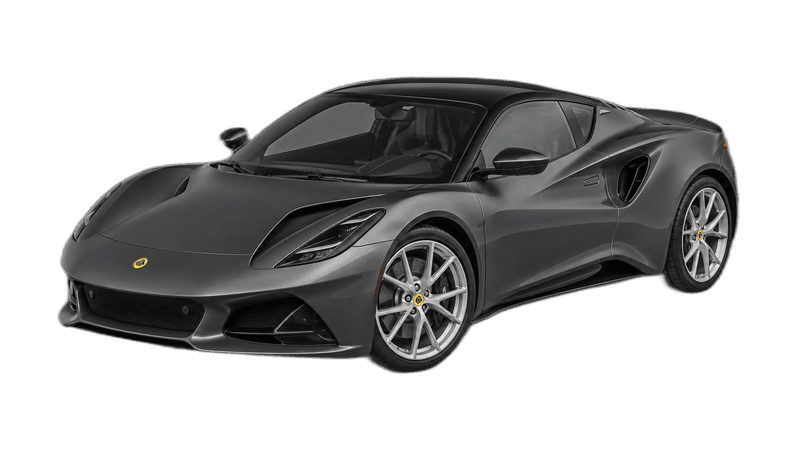
Lotus Emira i4
£60,000
usedIndicative market price, updated periodically.
360bhp
Power
4.4s
0-100 km/h
275km/h
Top Speed
£60,000
Price Used
How hard it pulls.
Peak g-force the instant you bury the throttle, estimated from the car's 0–100 time and drivetrain.
Lotus Emira i4Estimated peak launch g from the 0–100 time and drivetrain: an honest approximation, not a measured figure.
The Lotus Emira i4 is a coupe by Lotus, with 360 bhp, 430 Nm of torque, a 0-100 km/h time of 4.4 seconds and a top speed of 275 km/h. Indicative used value: approximately £60,000. Actual values vary with specification, condition and history.
Dream Car Garage Editorial · Last updated 2 November 2026
Overview
We have not driven this car. This review is based on published specifications and the sources listed below.
A 360 bhp AMG four-cylinder Lotus
The Lotus Emira is a mid-engined, rear-wheel-drive, two-seat sports coupe built at Hethel. Our catalogue lists this version from 2023 with a 2.0L turbocharged inline-4 petrol engine producing 360 bhp and 430 Nm, with 0 to 100 km/h in 4.4 seconds and a top speed of 275 km/h. The engine is a Mercedes-AMG four-cylinder, paired with an eight-speed dual-clutch gearbox. This guide is scoped to the 360 bhp Emira i4, sold first as the i4 First Edition and then simply as the Emira Turbo. It is not about the supercharged V6 Emira, the 400 bhp Turbo SE or the 416 bhp 420 Sport, and we explain below how they differ so that you do not mix up an advert.
We have not driven this model for this article. This is a desk-researched ownership guide built from sources we could read in full: the Lotus press page with the Emira Turbo and Turbo SE technical table, and the PistonHeads Emira used buying guide by Tony Middlehurst, published on 22 March 2025. That guide is written mainly about the V6 car, and we flag where its points may or may not carry across to the four-cylinder. We also read a PistonHeads launch report on the 2.0-litre car by Matt Bird from 13 July 2023, a reproduction of Lotus's July 2021 launch announcement on The Lotus Forums, and the ADAC German car catalogue entry for the i4 First Edition. The Lotus model pages and the government recall check were also opened. Anything that comes only from a copy of a release is secondhand, and we say so.
Checking the figures
Our catalogue row came in with 360 bhp, 430 Nm, 4.4 seconds, 290 km/h, rear-wheel drive and a 2022 start. Most of that holds. The top speed and the start year do not, and we corrected both.
Power is 360 bhp, or 269 kW, in the Lotus press table for the Emira Turbo. ADAC lists 268 kW and 365 PS for the First Edition. Metric horsepower is about 1.4 percent bigger than mechanical horsepower, so 365 PS and 360 bhp describe the same car. PistonHeads is slightly muddled: its 2023 headline says 360 hp, while the text says 365hp at 6,600 rpm. That is the metric figure, so adverts quoting either number can be correct.
Torque is 430 Nm. PistonHeads gives 317 lb ft from 3,000 to 5,000 rpm, which converts to about 430 Nm, ADAC gives 430 Nm, and Lotus's 2021 announcement said maximum torque would be 430 Nm across the range. The current Lotus press table has no torque row, so we rely on those secondary sources.
Acceleration is 4.4 seconds in the Lotus table, in ADAC, and in PistonHeads, which quotes 4.4 seconds to 62 mph with launch control. 62 mph is about 99.8 km/h, so these are one claim rounded two ways. They are manufacturer claims, not our tests.
Top speed is where the catalogue was wrong. The Lotus press table gives 171 mph or 275 km/h for the Turbo, and ADAC agrees on 275 km/h. The 290 km/h figure, 180 mph, comes from Lotus's 2021 announcement as a ceiling for the whole range and was repeated by PistonHeads in 2023. PistonHeads also gives 180 mph for the V6, so we treat 290 as an early range-wide claim and use 275 km/h. The Turbo SE is quoted at 181 mph or 291 km/h, so an advert saying 290 may be describing the wrong car.
Weight depends on definition. Lotus targeted 1,405 kg in its lightest form in 2021. PistonHeads gives 1,446 kg to DIN rules, with fluids and 90 percent fuel but no driver, and says that is 12 kg less than the V6. ADAC lists 1,521 kg as EU kerb weight. Do not compare these numbers across sources.
The start date needs care. The Emira was announced in 2021 and the V6 launched in 2022. The four-cylinder was shown in July 2023, and ADAC dates the First Edition from October 2023, so we use 2023 for this guide. We found no production count, so we give none.
Engine and gearbox
Lotus describes a 1,991cc turbocharged four-cylinder in-line petrol engine with four valves per cylinder, variable valve timing, a single twin-scroll turbocharger, and 200 bar piezo direct injection plus port fuel injection. PistonHeads calls it an all-aluminium turbocharged AMG four-cylinder. None of the sources we read reports a systemic engine fault on the 2.0, but the PistonHeads buying guide is V6 focused and says little about four-cylinder ownership, so the absence of reports is not evidence of reliability. Ask for the full service record, and check for oil seepage and coolant loss yourself.
The only gearbox on the four-cylinder is the eight-speed dual-clutch. Lotus's 2021 announcement mentions paddleshifts and driving modes, and PistonHeads mentions launch control. The V6's six-speed manual and torque-converter automatic are different hardware, so the guide's remarks about a notchy manual and a baulky reverse gear do not apply. On a test drive, try low-speed manoeuvres and parking, and listen for hesitation, judder or harsh shifts.
The buying guide lists a driveshaft-seal oil leak and loss of drive, which Lotus attributed to driveshafts not being fully locked in during assembly. It sits under the V6 gearbox heading, so we cannot say it affects the dual-clutch car. A central powertrain controller issue, where software updates did not fully install, is also listed. Ask a Lotus dealer whether the car has had every software update.
Chassis, brakes and wheels
The Emira uses Lotus's bonded aluminium chassis, with double wishbones front and rear. PistonHeads says the four-cylinder has an aluminium subframe, where the V6 has a steel one. According to the same launch report, the springs are by Eibach and the dampers by Bilstein, and the e-Diff, which brakes the rear wheels, replaces the limited-slip differential of the V6. Lotus offered two set-ups: the softer Tour chassis and the firmer Sport chassis. Ask which chassis the car has. They are set up differently, so confirm which one you are being shown.
Brakes are two-piece discs, 370 by 32 mm at the front and 350 by 32 mm at the rear, with AP Racing four-piston calipers and braided hoses, from the Lotus press table. Wheels are 20 inch, with 245/35 tyres at the front and 295/30 at the rear. PistonHeads reports Goodyear Eagle F1 Supersport on Tour cars and Michelin Pilot Sport Cup 2 on Sport cars, with Goodyear also offered on Sport. Check tread across the whole width and ask for invoices for discs and pads, because we found no wear data.
The V6 guide lists chassis faults that may also apply because the platform is shared. Low-speed creaking came from the undertray moving, fixed with extra rivets. Front scraping noises came from the damper spring seats, fixed with isolators added at the base of the front springs. Tyre pressure monitor problems were traced to water-based lubricant used when fitting valves at assembly. Dirt around the wheel speed sensors could trigger warnings, and Lotus added a cleaning step to the service schedule. Some power steering pumps leaked. Ask whether these fixes were carried out.
Body, interior and electronics
Lotus builds the car with composite panels. PistonHeads reports paint bubbling and blistering, which it believes is caused by moisture entering behind the panels. Some cars left the factory with no paint on the underside of the front bumper. Check every panel in bright light, along edges and around the door shuts.
The guide also lists windows that drop halfway when closed, water ingress, door mirrors that fail to retract, a headliner rattle at the top corner of the windscreen, and alarms that sound at random or about 2.5 minutes after locking. At least one car needed a full strip-down and rewiring after water got in. Check the footwells and boot for damp, and operate every window and both mirrors several times.
Inside, the guide says the cabin is more comfortable and better made than earlier Lotuses, with keyless start, adaptive cruise control and road sign recognition as standard. Its complaints include a 10.3-inch infotainment screen that lags, Apple CarPlay that can drop out, steering wheel touch buttons that are easy to press by accident, scratch-prone black trim, a popping from the subwoofer on some optional KEF systems, and side panels that can come off the seats. There are no ISOFIX points on the passenger seat. It reports 211 litres of space behind the seats and 151 litres in the rear boot, and no front boot.
On electrics, the guide says the battery must be well maintained or random faults appear. Some owners saw a low battery auto shutdown after a couple of minutes of audio with the engine off, and a limited telematics warning relates to a separate battery charged only by driving. Lithium replacements are lighter and more reliable but expensive. Ask what battery is fitted, whether a maintainer is included, and for software update history. The guide is unsure whether a climate-control fix affects only the 2.0 cars or every Emira, so ask the dealer.
Recalls and history
The PistonHeads guide says Lotus calls recalls manufacturer communications. It lists the driveshaft seal issue, a central powertrain controller software problem, and an HVAC shield added after some resistors failed from water ingress. It cannot say which apply to the four-cylinder. The government recall check, which we opened, takes the registration number of a car and shows unchecked or unfixed safety recalls, and it says the manufacturer tells owners about recalls for reasons other than safety, which it does not cover. A clean result is therefore not proof that no manufacturer communication is outstanding. We do not state recall numbers or dates.
Ask a Lotus dealer or specialist for open campaigns and software updates against the car's VIN. Ask for the full service history, accident repair records, and invoices for tyres, brakes and battery, and confirm the model from the paperwork and not from the badge. Early cars were badged First Edition; the buying guide says the V6 lost that branding in a later revision, and ADAC dates the i4 First Edition to the period from October 2023 to April 2025.
Buying decision
PistonHeads says the Emira was better than the Evora in key quality areas when new, with excellent steering and handling, an upmarket cabin and a compliant ride, but that complaints have accumulated and the owner forum's problem section runs to many pages. It says Lotus had sold around 10,000 Emiras and that used cars had become a buyer's market. Prices are dated, so compare current adverts and leave our sources' numbers aside.
Keep the variants straight. The V6 is a supercharged 3.5-litre Toyota-sourced engine with a manual or automatic. PistonHeads called it a sports car in search of an engine and said its 0 to 62 mph time and top speed were very close to the i4's. The Turbo SE has 400 bhp and 4.0 seconds, and the 420 Sport has 416 bhp and 3.9 seconds on the Lotus pages. The PistonHeads guide quotes the Turbo SE at 354 lb ft, which is about 480 Nm. Do not assume the figures in this guide apply to anything but a 360 bhp car.
Prefer a car with a clean recall check, documented software updates, a healthy battery and a maintainer left with it, dry carpets, working windows and mirrors, paint free of blisters, even tyre wear, and written confirmation of the model, chassis set-up and output.
Specifications
Engine
2.0L turbocharged inline-4 petrol
Displacement
2.0L
Power
360 bhp
Torque
430 Nm
0-100 km/h
4.4s
Top Speed
275 km/h
Drivetrain
RWD
Country
UK
Body Style
coupe
Years
2023–present
Price Used
£60,000
Specifications are manufacturer-published figures.
More from Lotus
Frequently Asked Questions
What are the specifications of the Lotus Emira i4?
The Lotus Emira i4 is a coupe by Lotus, with 360 bhp, 430 Nm of torque, a 0-100 km/h time of 4.4 seconds and a top speed of 275 km/h. Indicative used value: approximately £60,000. Actual values vary with specification, condition and history.
How much does a Lotus Emira i4 cost?
Indicative used value: approximately £60,000. Actual values vary with specification, condition and history.
What drivetrain does the Lotus Emira i4 use?
The Lotus Emira i4 is configured with rear-wheel drive.
What type of car is the Lotus Emira i4?
The Lotus Emira i4 is a sports cars manufactured by Lotus in UK. Production started in 2023.