
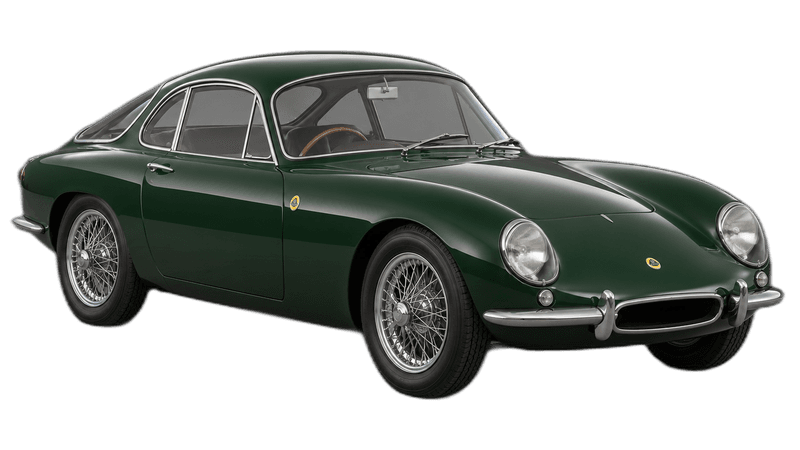
Lotus Elite Type 14
75bhp
Power
12.7s
0-100 km/h
180km/h
Top Speed
How hard it pulls.
Peak g-force the instant you bury the throttle, estimated from the car's 0–100 time and drivetrain.
Lotus Elite Type 14Estimated peak launch g from the 0–100 time and drivetrain: an honest approximation, not a measured figure.
The Lotus Elite Type 14 is a 2-door coupé by Lotus, with 75 bhp, 104 Nm of torque, a 0-100 km/h time of 12.7 seconds and a top speed of 180 km/h.
Dream Car Garage Editorial · Last updated 3 November 2026
Overview
We have not driven this car. This review is based on published specifications and the sources listed below.
Scope of this guide
This guide is scoped to the Lotus Elite Type 14, the two-seat fibreglass monocoque coupe that Lotus unveiled at the London (Earls Court) motor show in 1957 and built until 1963. It is a front-engine car with rear-wheel drive and a four-speed manual gearbox, powered by the 1.2 litre Coventry Climax FWE engine. It covers the standard cars and their main factory variants (Series 1, Series 2 and the SE), and it touches on the competition-only Super 95, Super 100 and Super 105 cars and on the one-off LX only to explain what the numbers mean. It is not a guide to any other Lotus.
We have not driven this model for this article. We are an editorial desk that reads sources, and everything below comes from pages we opened: Wikipedia, the Lane Motor Museum, supercars.net, Ultimatecarpage, ConceptCarz, a Supercar Nostalgia sale listing, the French owner-guide site automobile-sportive.com, a Sports Car Digest article and a Beverly Hills Car Club dealer page. This guide is for research, not a buying recommendation. Cars like this rarely come to market in anything like original condition, and a web page cannot replace an inspection by a specialist who knows the Type 14 and its fibreglass structure.
The figures at a glance
- Engine: 1.2L naturally aspirated inline-four. It is the Coventry Climax FWE, an all-aluminium single-overhead-cam unit of 1,216 cc. Ultimatecarpage prints it as naturally aspirated, with two SU H4 carburettors, a 10.1:1 compression ratio and a bore and stroke of 76.2 mm by 66.6 mm.
- Power: 75 bhp. Wikipedia, the Lane Motor Museum, ConceptCarz and the Beverly Hills Car Club all print 75 hp for the standard car, and Ultimatecarpage prints 75 bhp (56 kW) at 6,100 rpm. The French site prints 75 hp "metric" at 6,100 rpm, and 75 PS converts to about 74.0 bhp (PS multiplied by 0.98632), so the two ways of counting differ by less than one horsepower. The SE is a separate case, discussed below. We use 75 bhp everywhere in this guide.
- Torque: 104 Nm. Ultimatecarpage prints 104 Nm (77 lb-ft) at 3,750 rpm, and 77 lb-ft multiplied by 1.35582 gives 104.4 Nm. The French site prints 102 Nm at 4,750 rpm. Those two agree within two newton metres but disagree on the engine speed, and we do not know why. We use 104 Nm because it comes with a stated pound-feet figure we could convert.
- 0-100 km/h: 12.7 seconds. This comes from the spec table on automobile-sportive.com, whose text says "about 12 s". No other page we read prints a 0-100 km/h time. Wikipedia and the Lane Motor Museum quote a 1960 magazine road test with 0-60 mph in 11.4 seconds, and Ultimatecarpage gives 10.7 seconds for 0-60 mph. A 0-60 mph time is not a 0-100 km/h time, so we do not relabel those. The 12.7 seconds figure rests on one secondary source and should be read as indicative.
- Top speed: 180 km/h. Wikipedia reports 111.8 mph (179.9 km/h) from the 1960 road test, and 111.8 mph multiplied by 1.60934 is 179.9 km/h, which we round to 180 km/h. Other pages give higher claims: 115 mph (the Lane spec list, about 185 km/h), 185 km/h (the French table) and 120 mph or 193 km/h (Ultimatecarpage). We prefer the measured test figure over the unattributed claims.
- Drive: rear-wheel drive, front longitudinal engine, four-speed manual (BMC-sourced on early cars, ZF on the SE, per Ultimatecarpage, Wikipedia and ConceptCarz).
- Body: two-door coupe, fibreglass monocoque, drag coefficient 0.29 per the Lane Motor Museum, ConceptCarz and the Beverly Hills Car Club.
- Production: 1,030 cars. See the production section for why we chose it.
Where the sources disagree
Old-car sources disagree more than modern ones, and this model is no exception. We list the main splits here and keep the full discussion in the sections below.
- Power: 75 bhp for the standard car, 75 PS in the French table, 85 hp for the SE, and a range of 75 to 105 bhp that one ConceptCarz passage gives depending on tune.
- Top speed: 179.9 km/h measured, against claims of 185 and 193 km/h.
- Acceleration: 0-60 mph in 11.4 seconds (road test), 10.7 seconds (Ultimatecarpage) and "around twelve seconds" (ConceptCarz), with 12.7 seconds to 100 km/h in the French table.
- Weight: 503.5 kg on Wikipedia and supercars.net, 560 kg "manufacturer data" on the French site, 673 kg on Ultimatecarpage, about 1,300 lb on ConceptCarz, and 1,505 to 1,525 lb wet from a registry secretary quoted by Sports Car Digest. These cannot all be the same measurement, and none says clearly whether it is dry or wet, so we show no weight in the figures above.
- Production: 1,030, 1,047, 1,050, 1,015 and "a little over 1000" depending on the page.
- Start year: 1957 on most pages, 1958 on the French site and ConceptCarz in places, because the car was shown in 1957 but production began in 1958.
History and why the Type 14 matters
The Type 14 was Colin Chapman's first purpose-designed road coupe, following the open roadsters and sports racers that began with the 1954 Mk VIII, according to the Lane Motor Museum. The body was drawn by Peter Kirwan-Taylor, with aerodynamics by Frank Costin, and Ultimatecarpage also credits Chapman himself. Wikipedia says the car used glass-reinforced plastic for the entire load-bearing structure, replacing the separate chassis and body of earlier Lotus cars. The Lane Motor Museum adds that localised steel reinforcement was used, that the front subframe and suspension bolted to three box sections moulded into the shell, and that the rear Chapman struts were derived from the Lotus 12 Formula 2 car. Supercar Nostalgia calls it a light, stiff and advanced fibreglass monocoque, and Sports Car Digest says the design centred on weight and aerodynamics.
The car had independent suspension at all four corners, with wishbones at the front and Chapman struts at the rear, and Girling disc brakes of 9.5 inches (241 mm), which Wikipedia reports. The Beverly Hills Car Club page points out that the car had disc brakes on all four wheels when many rivals still used drums. Chapman's approach, the Lane Motor Museum says, was to add lightness rather than use bigger engines, and the 75 bhp engine fits that idea: modest power in a small, slippery shell.
The car competed as well as it sold. Wikipedia says the Elite won its class six times at the 24 Hours of Le Mans and took two Index of Thermal Efficiency wins, and ConceptCarz and Supercar Nostalgia repeat the six class wins. Wikipedia also records a one-off LX built for an outright win in 1960 with a 1,964 cc FPF engine, which reached 174 mph in testing but never raced because its lead driver left the night before. That car is outside this guide.
Variants and what changed over the run
- Series 1 (1958 to 1959 per the French site): bodies moulded by Maximar Mouldings at Pulborough, Sussex. Wikipedia says the first 250 or 280 bodies were made there, ConceptCarz says the first 250, and the French site says about 280 cars were sold before the Series 2 changes. The Beverly Hills Car Club says the Maximar shells are lighter.
- Series 2: production moved to the Bristol Aeroplane Company for the body. Wikipedia says Series 2 added triangulated trailing radius arms for better toe-in control, and the Lane Motor Museum describes an improved rear suspension and better body build. The French site gives the Series 2 as 1959 to 1963 with a richer interior, and counts 750 of them. Wikipedia also notes that the first 31 Series 2 cars still had Maximar bodies.
- SE (1960): twin SU carburettors, a cast alloy intake manifold, 85 hp (63 kW), ZF four-speed gearboxes in place of the MG units, Lucas PL700 headlamps and a silver roof, according to Wikipedia. The French site gives 85 hp at 6,500 rpm and 0-100 km/h in 10 seconds for the SE. These are the only SE figures we found, and they are not the figures used for the 75 bhp standard car above.
- Super 95: a 10.5:1 compression ratio and two sets of Weber 40DCOE carburettors, per Wikipedia.
- Super 100 and Super 105: limited racing cars with a five-bearing high-lift camshaft, steel timing gear and a ported head, per Wikipedia. We found no power figures for them in the pages we read, and ConceptCarz says only that the range ran as high as 105 bhp depending on tune.
Production and rarity
Wikipedia gives 1,030 cars built according to Ortenburger and notes that other sources say 1,047. The Lane Motor Museum gives about 1,030 and says production ended in September 1963. The French site also says about 1,030, and ConceptCarz says 1,030 as many as 1,047, while also quoting 1,015 and around 1,050 elsewhere on the page. Ultimatecarpage gives 1,050, Sports Car Digest says an estimated fewer than 1,050, and Supercar Nostalgia says only that a little over 1000 had been built. We use 1,030 because four pages give it directly and the others bracket it. No page we read breaks the total into exact Series 1, Series 2 and SE counts beyond the French site's rough split.
With around a thousand built, the Type 14 is a rare car. Supercar Nostalgia, in a teaser on a 2024 sale listing, says that while some contemporaries have ballooned in value over the last 20 years, the Type 14 still remains relatively accessible, but gives no figures. The same teaser says Lotus lost money on every Type 14 it sold between 1957 and 1963. Wikipedia agrees that the price was set too low, and calls selling the car as a kit perhaps the greatest mistake of all.
What to check before buying
Several sources give specifics, though none is a full inspection guide. Because the Type 14 has no metal chassis, problems in the shell can reach the mechanical parts directly.
- Fibreglass and suspension mounts. The Beverly Hills Car Club page warns that repairs of the fiberglass body and suspension pick-up points can be onerous, and recommends having a classic Lotus expert inspect the car. Wikipedia reports that rear suspension arm mounting points were observed to pull out of the fibreglass structure. The French site lists a fragile fibreglass body that needs specialist repair among the car's drawbacks.
- Engine vibration. Wikipedia reports a resonant vibration at about 4,000 rpm that was cured with a diaphragm clutch spring, and the French site notes a resonance peak around the same speed. Ask whether the fix has been made.
- Drive-train wear. Wikipedia says many drive-train parts were highly stressed and needed frequent re-greasing, so ask how the car was maintained.
- Which body and which series. Series 1 cars have Maximar shells and Series 2 cars have Bristol shells, and the SE and Super variants have different engines, gearboxes and carburettors. Check the chassis and engine numbers against the claimed specification, and be cautious of any car described as a Super 95, 100 or 105 without evidence, since those were limited competition builds.
- Originality. Supercar Nostalgia sells a car it calls totally unrestored with fewer than 30,000 miles from new, one owner since delivery in July 1963, and a documented history. That shows what a well-documented car looks like to a seller, but the page gives no price and we cannot say what such a car is worth.
- Specialist knowledge. One catalogue overview, found through a search, said the Type 14 needs more specialist knowledge to maintain, but we could not open that page, so we treat it as unconfirmed.
Running costs and known issues
We found no source giving servicing prices, parts prices, rebuild costs or failure rates for the Type 14, so we give none. The only running figure is fuel consumption of 40.5 mpg (imperial) in the 1960 road test, quoted by Wikipedia. The French site lists costly repairs and limited interior space among its negative points, but its list is a short summary and not a cost table.
Market and value notes
The pricing we found is thin and dated. Wikipedia reports that the 1960 test car cost 1,966 pounds including taxes. The Lane Motor Museum lists about 6,000 US dollars for the car and roughly 5,500 dollars with tax for a Series 1, both as original-era prices. For current values, the French site cites a Sport Auto valuation of about 40,000 euros (its 2007 guide, in an article dated 17 January 2008) and says optimised cars in excellent condition could reach about 60,000 euros in some countries, undated. Those figures are far out of date and we do not offer a current valuation. We did not open any auction result or price guide with current sales, so anyone using this page to price a car should look at recent verified sales and take specialist advice.
What we could not find
Several things were not available to us. The Car and Classic buyer guide returned a forbidden error and we did not work around it. A Unique Cars and Parts page returned not found. The Sports Car Digest article was cut off behind a subscription prompt, so we used only the visible part. We did not open a Lotus Cars heritage page, a period road test in full, or a registry's technical notes, so every figure above is a secondary report of a primary document. There is no figure shown for a standard-car power curve, no torque figure on the SE, no recalls or safety information, no crash-test data, and no consistent kerb weight. We found no reliable breakdown of production by series.
About the photograph
This page uses the catalogue photograph for the car. Its credit is listed on the credits page.
Verdict
The Type 14 is a front-engine, rear-wheel-drive, fibreglass-monocoque coupe with a 1.2L naturally aspirated inline-four, 75 bhp, 104 Nm, a measured 180 km/h and an indicated 12.7 seconds to 100 km/h, built in a run of about 1,030 cars between 1957 and 1963. Its interest comes from the construction and the weight-saving idea, not from the figures, and the sources disagree on weight, top speed, acceleration and production count. The same shell that made it light and stiff also makes repairs a specialist job, and the warnings about suspension mounts and body repair are the clearest practical guidance in the pages we read. We have not driven it, so use the sources, the seller's records and an independent specialist inspection to decide.
Sources
- Wikipedia: Lotus Elite
- Lane Motor Museum: Lotus Elite Type 14 Series 2 (1962)
- supercars.net: Lotus Elite
- Ultimatecarpage: Lotus 14 Elite (1957-1963) specifications
- ConceptCarz: Lotus Elite
- Supercar Nostalgia: One to Buy, 1963 Lotus Type 14 Elite
- automobile-sportive.com: Lotus Elite Type 14 owner guide (French)
- Sports Car Digest: Lotus Elite Type 14
- Beverly Hills Car Club: 1958 Lotus Elite
Specifications
Engine
1.2L naturally aspirated inline-four
Displacement
1.2L
Power
75 bhp
Torque
104 Nm
0-100 km/h
12.7s
Top Speed
180 km/h
Drivetrain
RWD
Country
United Kingdom
Body Style
2-door coupé
Years
1957–1963
Production
1,030
Specifications are manufacturer-published figures.
More from Lotus
Frequently Asked Questions
What are the specifications of the Lotus Elite Type 14?
The Lotus Elite Type 14 is a 2-door coupé by Lotus, with 75 bhp, 104 Nm of torque, a 0-100 km/h time of 12.7 seconds and a top speed of 180 km/h.
How many Lotus Elite Type 14 were made?
Lotus produced 1,030 units of the Lotus Elite Type 14.
What drivetrain does the Lotus Elite Type 14 use?
The Lotus Elite Type 14 is configured with rear-wheel drive.
What type of car is the Lotus Elite Type 14?
The Lotus Elite Type 14 is a sports cars manufactured by Lotus in United Kingdom. Production ran from 1957 to 1963.