
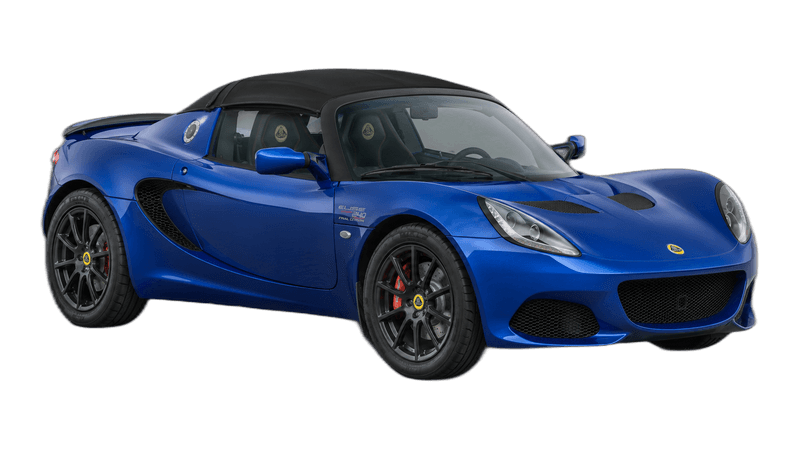
Lotus Elise Sport 240 Final Edition
240bhp
Power
4.5s
0-100 km/h
237km/h
Top Speed
How hard it pulls.
Peak g-force the instant you bury the throttle, estimated from the car's 0–100 time and drivetrain.
Lotus Elise Sport 240 Final EditionEstimated peak launch g from the 0–100 time and drivetrain: an honest approximation, not a measured figure.
The Lotus Elise Sport 240 Final Edition is a 2-door roadster by Lotus, with 240 bhp, 244 Nm of torque, a 0-100 km/h time of 4.5 seconds and a top speed of 237 km/h.
Dream Car Garage Editorial · Last updated 3 November 2026
Overview
We have not driven this car. This review is based on published specifications and the sources listed below.
Scope of this guide
This guide is scoped to the Lotus Elise Sport 240 Final Edition, the two-seat roadster that Lotus built at Hethel in Norfolk as the closing chapter of the Elise story in 2021. It is a mid-engine, rear-wheel drive car: the supercharged four-cylinder is mounted mid-car, as City AM describes it, and drives the rear wheels through a manual gearbox. The Final Edition range had two Elise models, the Sport 240 and the Cup 250, and this page covers only the Sport 240. The Cup 250 Final Edition is mentioned only to explain how the two differ.
We have not driven this model for this article. We are an editorial desk that reads sources, and everything below comes from pages we opened: the Australian specification database on CarExpert, Wikipedia, the Australian news site JustCars, the Irish site CompleteCar, PistonHeads, the City AM review, a Hagerty UK review, a CarExpert news report on the end of production, and the Lotus Cars road-car history page. This is a late, low-volume special edition that will rarely come to market in good order. A page like this cannot replace an inspection by a specialist who knows Elises, and it is for research, not a buying recommendation.
The figures at a glance
- Engine: 1.8L supercharged inline-four. It is the Toyota 2ZR-based engine, and the CarExpert specification page lists engine code 2ZR, a supercharger, and a displacement of 1,798 cc.
- Power: 240 bhp. Lotus and the press describe it as 240 hp, and Wikipedia prints 240 bhp (243 PS; 179 kW). The conversion is simple. 243 PS multiplied by 0.98632 is about 240 bhp, and 179 kW multiplied by 1.34102 is also about 240 bhp. The CarExpert specification page lists 179 kW and 243 PS. The model name carries the rounded 240 figure.
- Torque: 244 Nm. JustCars, Wikipedia, CompleteCar and CarExpert all print 244 Nm. City AM and Hagerty print 181 lb ft, which is the same figure in other units.
- 0-100 km/h: 4.5 seconds. Wikipedia, JustCars and the CarExpert specification page all give 4.5 seconds for 0-100 km/h. City AM and Hagerty give 4.5 seconds for 0-62 mph. We discuss the other published times in the next section.
- Top speed: 237 km/h. The CarExpert specification page prints 237 km/h, and City AM and Hagerty print 147 mph, which converts to about 237 km/h.
- Drive: rear-wheel drive, manual gearbox, two doors, two seats.
- Weight: 922 kg as listed by CarExpert, City AM, CompleteCar and Hagerty, and 898 kg with the lightweight options fitted. JustCars, CompleteCar, Wikipedia and Hagerty all give the 898 kg figure for the lightest specification.
- Price when new: PistonHeads, City AM and Hagerty give 45,500 pounds sterling in the United Kingdom, and JustCars gives 97,990 Australian dollars before on-road costs for the Australian market. These are launch list prices, not current values.
- Fuel and emissions: City AM prints 36.2 mpg and 177 g/km of CO2.
Where the sources disagree
The most useful thing we can do with a spec sheet is tell you where it is shaky.
On acceleration, the sources do not line up. Wikipedia, JustCars and CarExpert say 4.5 seconds for 0-100 km/h. City AM and Hagerty say 4.5 seconds for 0-62 mph, and they credit the figure to Lotus. CompleteCar says about 4.1 seconds and labels it 0-100 km/h. PistonHeads says Lotus claims the car reaches 60 mph in 4.1 seconds. A 0-60 mph time is not a 0-100 km/h time, and we have not relabelled one as the other. It is odd that one source gives 4.1 seconds to 60 mph while others give 4.5 seconds to 62 mph, because two extra miles per hour would not normally cost 0.4 seconds. We cannot resolve that from what we read. We use 4.5 seconds for 0-100 km/h because three sources print it against that label, and we treat the 4.1 second figures as unreconciled.
On power in kilowatts, Wikipedia and CarExpert's specification page give 179 kW, which is consistent with 240 bhp. A separate CarExpert news report on the end of production quotes 182 kW and 244 Nm for the Final Edition. 182 kW would be about 244 bhp, so we think that report may be describing a different variant. That is our reading, not something it states, and we use 240 bhp and 179 kW.
On weight, 922 kg is the standard figure and 898 kg is what the car weighs with every lightweight option fitted. City AM says 922 kg, and it adds that the original Elise launched at 723 kg, while Hagerty says 725 kg. Those two launch-weight figures differ by 2 kg, and we simply note it.
On wheels, CompleteCar describes 17-inch ten-spoke forged alloys, while the CarExpert page lists 16-inch front and 17-inch rear rims. We lean towards the CarExpert split because it gives front and rear separately, but it is a point to check on any car.
On the Cup 250 Final Edition, the Lotus Cars history page quotes a top speed of 241 km/h and 3.9 seconds, while Wikipedia and JustCars give 248 km/h and 4.3 seconds. Those are about the other car, but they show how easily numbers drift between pages. PistonHeads also gives its UK price as 50,900 pounds, whereas City AM gives 48,900 pounds.
The car in context
The Elise went on sale in 1996 and ran for 25 years. Wikipedia lists the final Series 3 powertrain as a 1.8L Toyota 2ZR-FE supercharged four-cylinder and says production of the Elise, Exige and Evora ended in 2021. The Sport 240 Final Edition replaced the Sport 220. JustCars and PistonHeads both describe it as gaining 23 hp from a revised calibration, taking output to 240 hp and 244 Nm.
CompleteCar says the Final Editions had limited build runs, and PistonHeads quotes Lotus saying the cars would be built in limited numbers. Neither gives a number. Hagerty calls it the very last of the line and expects it to be a model to watch in future years, which is opinion, not a market fact.
What changed over the run
The Final Edition changes were mostly about specification, not a new platform. The sources we read mention these items:
- A new TFT digital instrument display. PistonHeads, CompleteCar, Hagerty and City AM all mention it. CompleteCar describes a choice of two screens, one with conventional dials and one with a race-car-style speed readout and engine-speed bar. Hagerty notes that the display is modern while the gear linkage is not.
- New ten-spoke forged alloy wheels. JustCars says they are 500 grams lighter, and City AM says each wheel saves 0.5 kg. CompleteCar says they are fitted as standard and are finished in Anthracite.
- A lithium-ion battery as an option. JustCars lists it as available, and PistonHeads lists it among the extras. CompleteCar groups it with carbon-fibre panels and a polycarbonate rear window as the options that bring the weight down to 898 kg.
- Revised engine calibration for the extra 23 hp over the Sport 220.
The current catalogue description for this car also mentions commemorative detailing. None of the pages we read describes specific commemorative badges, plaques or trim, although the Final Edition name itself is commemorative, so we cannot confirm that claim and leave it out of the facts above.
The last Elise
CarExpert reported on 24 December 2021 that production of the Elise had ended, and that 35,124 Elise models had been produced since 1996 at Hethel. Its report says the final car was a Sport 240 Final Edition painted yellow. Wikipedia also says the last Elise built was a Sport 240, but describes it as painted gold, so the two sources disagree on the colour and we do not choose between them. Wikipedia's infobox gives a lifetime total of 35,124 for the Elise line, the same figure as CarExpert. This car is therefore not only a model in the range, it is the specification that closed the book.
What to check and what the rarity means
None of the sources we read gives owner-reported faults, recall data or maintenance prices for this particular car, so we are not going to invent any. What we can say from the sources is limited to the car's configuration and to general buying logic.
- Check which options are fitted. The 898 kg weight depends on lightweight options such as the lithium-ion battery, carbon-fibre panels and the polycarbonate rear window. A car without them is the 922 kg car. Ask for the original build specification and invoices.
- Check the wheels and tyres against the specification sheet. Because sources disagree on rim sizes, do not assume.
- Check the digital display works through all of its screens and modes. Hagerty and CompleteCar both describe it as a feature of this model.
- Check history from Lotus or a Lotus specialist. The car uses a Toyota-derived supercharged engine, but we have no source for servicing intervals, so ask a specialist.
- Check how the car has been stored and used. Hagerty's reviewer expects it to be a model to watch, so the age and mileage of any example, not just its condition, will affect what it is worth.
We found no auction results for this model in the pages we read. We therefore make no value claim. The launch prices above are the only prices we can give, and they are from the PistonHeads, City AM, Hagerty and JustCars pages.
Driving character, as reported
We have not driven it, so we only relay what the pages say. City AM describes a race car-style digital instrument cluster, a roof that comes off in about two minutes and stores in the small boot, a fixed rear window that helps in winter, and a car that you do not drive on auto-pilot. Its reviewer also says that this limits its appeal as a daily car for many buyers. Hagerty's reviewer praises the car and notes the contrast between the digital display and the old-fashioned gear linkage. These are opinions of the people who drove it, not our measurements.
What we could not find
- Production count: the catalogue row has no count and we found none. Sources say limited numbers or limited build runs, and give no figure. We therefore give no figure for how many Sport 240 Final Editions were built. The only totals we found are the lifetime Elise total of 35,124.
- Owner reports, recall notices, common faults and servicing costs for this model: none of our sources covers them.
- Current market or auction values: not found, so none are given.
- Sources we could not open: Autocar returned a payment-required response, Magneto Magazine and the Express and Star returned forbidden responses, and the Lotus media page redirected to a general press listing. We did not work around any of these.
- A single official Lotus specification sheet for the Sport 240 Final Edition with the 0-100 km/h time and top speed. The Lotus Cars history page we opened did not give them for this car, so those figures rest on the secondary sources named above.
About the photograph
This page uses the catalogue photograph for the car, and its credit is listed on the credits page.
Verdict
The Lotus Elise Sport 240 Final Edition is a well-documented farewell car with a clear set of facts: a 1.8L supercharged inline-four with 240 bhp, 244 Nm, a quoted 4.5 seconds from 0-100 km/h, a quoted 237 km/h top speed, a manual gearbox, rear-wheel drive and a weight of 922 kg, or 898 kg with the lightweight options. Its particular interest is that it closed a 25-year production run, and that a Sport 240 Final Edition was the last Elise built. The weak points in the record are the missing build count, the muddled acceleration figures and the lack of ownership data. A guide cannot replace a specialist inspection, and this page is for research, not a buying recommendation.
Sources
- CarExpert - Lotus Elise Sport 240 Final Edition (2021) features and specs
- Wikipedia - Lotus Elise
- JustCars - Lotus Elise Final Editions in detail
- CompleteCar - Lotus saves the best until last
- PistonHeads - Lotus announces Exige and Elise Final Editions
- City AM - Lotus Elise Sport 240 Final Edition review
- Hagerty UK - The light show is over: driving the final Lotus Elise
- CarExpert - Lotus Elise, Exige and Evora production ends
- Lotus Cars - Elise road car history
Specifications
Engine
1.8L supercharged inline-four
Displacement
1.8L
Power
240 bhp
Torque
244 Nm
0-100 km/h
4.5s
Top Speed
237 km/h
Drivetrain
RWD
Country
United Kingdom
Body Style
2-door roadster
Years
2021
Specifications are manufacturer-published figures.
More from Lotus
Frequently Asked Questions
What are the specifications of the Lotus Elise Sport 240 Final Edition?
The Lotus Elise Sport 240 Final Edition is a 2-door roadster by Lotus, with 240 bhp, 244 Nm of torque, a 0-100 km/h time of 4.5 seconds and a top speed of 237 km/h.
What drivetrain does the Lotus Elise Sport 240 Final Edition use?
The Lotus Elise Sport 240 Final Edition is configured with rear-wheel drive.
What type of car is the Lotus Elise Sport 240 Final Edition?
The Lotus Elise Sport 240 Final Edition is a sports cars manufactured by Lotus in United Kingdom. Production ran from 2021 to 2021.