
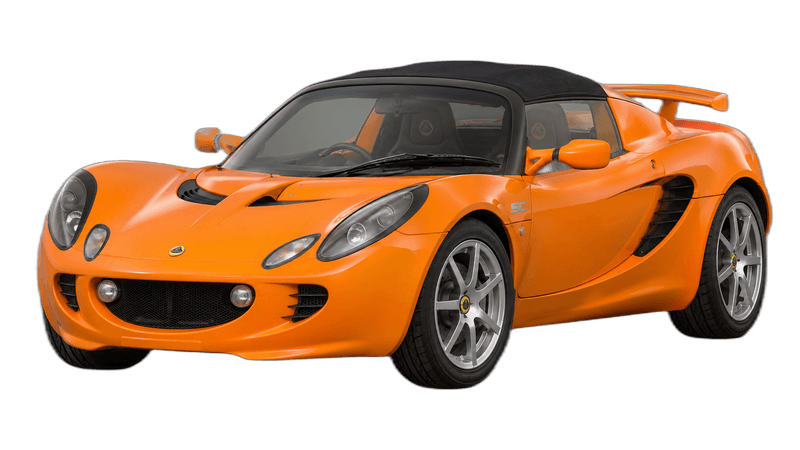
Lotus Elise SC
218bhp
Power
4.6s
0-100 km/h
240km/h
Top Speed
How hard it pulls.
Peak g-force the instant you bury the throttle, estimated from the car's 0–100 time and drivetrain.
Lotus Elise SCEstimated peak launch g from the 0–100 time and drivetrain: an honest approximation, not a measured figure.
The Lotus Elise SC is a 2-door roadster by Lotus, with 218 bhp, 212 Nm of torque, a 0-100 km/h time of 4.6 seconds and a top speed of 240 km/h.
Dream Car Garage Editorial · Last updated 3 November 2026
Overview
We have not driven this car. This review is based on published specifications and the sources listed below.
Scope of this guide
This guide is scoped to the Lotus Elise SC, the supercharged version of the Series 2 Elise that Lotus announced in October 2007 as part of the 2008 model year update. It is a two-seat roadster with a mid-engine layout, rear-wheel drive and a Toyota 2ZZ-GE engine, a 1.8L supercharged inline-four, driving the rear wheels through a six-speed manual gearbox. It is not a guide to the naturally aspirated Series 2 cars, to the Exige S that shares some of its hardware, or to the later Series 3 Elise range, which we mention only where a source helps us date the end of the SC.
We have not driven this model for this article. We are an editorial desk that reads sources, and everything below comes from pages we opened: Wikipedia's Lotus Elise article, the elises.co.uk model page, an Autoblog report from October 2007, a Just Cars launch report from July 2008, a PistonHeads used buying guide dated 27 July 2020, and a Classic Trader buying guide dated 28 May 2020. This guide is for research and is not a buying recommendation, and it cannot replace an inspection by a Lotus specialist who knows the Series 2 cars.
The figures at a glance
- Engine: 1.8L supercharged inline-four, the Toyota 2ZZ-GE with a 2-ZZ VVTL-i valve system. Lotus fitted a new, compact supercharger that has no intercooler. Just Cars says the unit was designed by Lotus and produced by Magnuson, with a smaller Eaton rotor pack than the Exige S, and that the engine is 8 kg lighter than the Exige S unit. We only read the displacement as 1.8 litres, so we do not print a cubic centimetre figure.
- Power: 218 bhp. This is a unit question as much as a disagreement. Wikipedia, PistonHeads and Classic Trader print 218 hp or 218 bhp. The elises.co.uk page gives 220 PS, and Just Cars gives 162 kW. Wikipedia's European-specification line reads 217 bhp (220 PS) at 8,000 rpm. Converting 220 PS at 0.98632 gives about 217 bhp, and 162 kW at 1.34102 gives about 217 bhp. We use 218 bhp because three of the pages we read print it, and we treat 217 bhp as the same output rounded the other way.
- Torque: 212 Nm at 5,000 rpm, which Wikipedia gives as 156 lb-ft (212 N.m) for the European specification. PistonHeads prints 158 lb-ft, which converts to about 214 Nm, so the sources differ by a couple of newton metres and we use the Wikipedia figure because it states the rpm and the unit conversion.
- 0-100 km/h: 4.6 seconds. This is the Lotus-claimed figure on the elises.co.uk page, which labels its performance numbers as estimated, and the Just Cars launch report prints the same 4.6 seconds. It is a manufacturer claim and not an independent test result.
- 0-60 mph: this is a different measurement and we do not relabel it. Autoblog and elises.co.uk print 4.4 seconds, PistonHeads prints a 4.4 second 0-60 time, and Wikipedia prints 4.3 seconds. A figure of 4.2 seconds is sometimes quoted elsewhere, but none of the pages we read gave it, so we do not use it.
- Top speed: 240 km/h. The elises.co.uk page gives 150 mph or 240 km/h, marked as estimated. Autoblog prints 150 mph, Wikipedia prints 150 mph (241 km/h), and Just Cars prints 241 km/h. 150 mph is about 241 km/h, so the sources agree and differ only in rounding. We keep the 240 km/h from the page that states both units.
- Other claimed performance: 0-100 mph in 10.7 seconds (Autoblog) and 0-160 km/h in 10.7 seconds (Just Cars), the same time under two labels. Both sit alongside the manufacturer's estimates.
- Drive: rear-wheel drive, mid-engine, six-speed manual. Wikipedia's infobox gives the layout as transverse mid-engine, rear-wheel drive.
- Weight: the sources do not agree. Wikipedia's text says a Lotus-claimed 1,987 lb (901 kg), its infobox lists 910 kg, and Just Cars prints 870 kg without saying what that figure includes. We give no single weight.
- Price when new in Australia: Just Cars listed the SC at 104,990 Australian dollars plus on-road costs in July 2008, with a Touring Pack adding 8,000 dollars and a Sport Pack adding 7,000 dollars.
Where the sources disagree
On power we use 218 bhp, as set out above. On torque, 212 Nm against about 214 Nm is a difference in rounding between two unit systems. On 0-60 mph, 4.3 and 4.4 seconds are both published, and the maker-style page gives 4.4. On weight the spread is 870 to 910 kg, and we cannot tell whether the lowest figure is a dry weight, so we say so rather than choose.
The dates also need care. Wikipedia says Series 2 production ran from 2001 to 2011 and that the 2011 model year SC kept a supercharged 2ZZ-GE making 218 hp, with the engine changed for model year 2012. A web search for the end of the Series 2 returned sources that list it as 2001-2010 and others as 2001-2011, and Classic Trader says the Series 3 replaced it in 2010 on one page and 2011 in its text. We therefore describe the SC run as 2008 to 2011, with the end year being the least certain part of that range.
History and what the SC changed
The SC was announced in October 2007 for the 2008 model year. Autoblog reported it on 23 October 2007 as a standard 1.8-litre engine with a new, compact, non-intercooled supercharger, and elises.co.uk calls it the most powerful production version of the Elise to that point. Classic Trader lists the lineage as 160 bhp for the 111S in 2001, 190 bhp for the Sport 190, 189 or 190 bhp for the Toyota-engined Elise R, and 218 bhp for the SC, which it says arrived in 2008 with a six-speed gearbox.
Outwardly, the sources say the SC was set apart by a new rear spoiler and new wheels. Autoblog mentions a new rear spoiler and model-exclusive wheels, Just Cars describes a bespoke alloy design with the rear width increased by half an inch to 8 inches, and Wikipedia says the spoiler matches the Type 72-D edition. Those are the changes that the page's production description mentions, and our sources support them.
The roof is the one claim we can only partly support. Wikipedia's infobox lists the body as a two-door, two-seat targa top roadster. PistonHeads mentions the price of a replacement roll-up soft top if one is missing, which is consistent with a removable roof, but none of the launch pages we read described the SC roof. Autoblog lists a new roof scoop only for the Exige S.
The supercharged engine is not a bolt-on of the Exige unit. Just Cars says the SC supercharger has a smaller rotor pack than the Exige S, is cast in one piece with a bespoke intake manifold plenum and has no intercooler. We cannot say from our sources how this affects hot-weather running, so we make no claim about it.
Variants and the end of the run
We found no list of SC sub-variants in the pages we read. Just Cars lists a Touring Pack and a Sport Pack as options on the Australian car. Wikipedia says the 2011 model year SC carried on with the 2ZZ and 218 hp, and that for the 2012 model year the 2ZZ was replaced by a supercharged 2ZR-FE. That puts the Toyota 2ZZ-GE SC in the 2008 to 2011 window, though we advise anyone buying to check the build date and engine on the individual car.
What to check before buying
Most of the following comes from the PistonHeads Series 2 guide dated 27 July 2020. It has no dedicated SC section, so treat these as Series 2 issues that the SC buyer should still ask about, not as SC failure rates.
- Gearbox synchros. PistonHeads says supercharged Toyotas can suffer worn synchros, usually heard as crunching on the 2-3 shift, and it mentions a Toyota recall covering shift mechanisms. Classic Trader says second and third synchros can wear and that Series 2 cars had revised gear linkages to reduce this.
- Accident damage. PistonHeads says a frame corner sitting even 2 mm out of line suggests a past accident, and that chassis repairs listed on an engineer's report should have been done by an approved Lotus operative.
- Corrosion. PistonHeads says the main risk is galvanic corrosion, where damaged paint on steel suspension inserts can turn the surrounding aluminium to powder, and that front wishbones and steel rear subframes corrode. Classic Trader says footwell floor corrosion was common in early Series 2 cars.
- Suspension and tracking. PistonHeads says rear toe-links can fail on hard-driven cars and that kerbing can knock the tracking out, so uneven tyre wear is a flag.
- Bodywork. PistonHeads says fibreglass clamshells crack, so look for spider-web cracks.
- Electrics and comfort. PistonHeads says electrical problems rise with age, especially if water got in. It also says air-conditioning pipes leak, particularly on 2006 and 2007 cars, and that throttle pedal bushes fail. Classic Trader says window winders often give trouble and that buyers should check the heater works.
- Recalls. Classic Trader tells buyers to check whether recalls were carried out. We did not search a recall database.
- Timing drive. PistonHeads describes the Toyota 2ZZ as chain-timed with a strong reputation for reliability, but that is a general point and not an SC-specific finding.
Running costs and known issues
The two buying guides give no SC-specific service costs. PistonHeads says clutch kits cost more for Toyota-engined cars than for K-series cars, but it prints no figure. The costs it does give, as of 27 July 2020, are 1,100 to 1,200 pounds for a used replacement clamshell plus likely fitting work, more than 500 pounds for a replacement roll-up soft top, and 500 pounds or more for an air-conditioning pipe repair. Its radiator and service figures apply to K-series cars only, so we leave them out. We have no insurance, tax or fuel cost data beyond Just Cars' estimate of 8.5 L/100km combined for the new car. Anyone quoting SC repair costs without a source is guessing.
Recalls and safety
We found no recall notice for the Elise SC in a page we could open, but that is not a clean bill of health. PistonHeads mentions a Toyota recall covering shift mechanisms, and Classic Trader says to check whether recalls were carried out. We found no crash-test data. The car is a lightweight roadster, and we have no safety rating to quote.
Market and value notes
Prices are patchy and a snapshot is not a valuation. PistonHeads, as of 27 July 2020, listed a 2008 first-year SC at 22,999 pounds, said supercharged Elises attract premium prices and put the Series 2 range as a whole at from 13,000 pounds. The Just Cars launch price of 104,990 Australian dollars was a new-car price in July 2008. We saw no auction results for the SC and give none. Both prices are many years old, so check current listings and condition before drawing any conclusion.
What we could not find
We found no production count for the SC, so there is no figure shown for it on this page and the catalogue gives none. We found no independent instrumented test of the 4.6 second 0-100 km/h claim: the pages we read give manufacturer figures, and several are marked estimated. We found no top speed from a test either. We found no SC-specific failure rates, service intervals, supercharger failure modes or recall list. Several pages blocked or failed on us: the Motor Authority launch report and the Drive Australia report returned access errors, the Magneto Magazine buying guide and the Encycarpedia specification page were refused, a Wikipedia page for the Series 2 returned not found, and an Autocar guide returned a server error. We did not work around any of them. Where a figure rests on one page, we have said so.
About the photograph
This page uses the catalogue photograph for the car. Its credit is listed on the credits page.
Verdict
The Elise SC is a mid-engine, rear-wheel-drive roadster with a 1.8L supercharged inline-four making 218 bhp and 212 Nm, a claimed 4.6 seconds to 100 km/h and a claimed 240 km/h. Its appeal, on the evidence we read, is a light car with a non-intercooled supercharged Toyota engine and a six-speed gearbox, with the usual Series 2 questions around the frame, corrosion, synchros and bodywork. We found no production count and no SC-specific reliability data. We have not driven it, so use the sources, the seller's records and a specialist inspection to decide.
Sources
- Wikipedia: Lotus Elise
- elises.co.uk: 2008 Elise SC model page
- Autoblog: Lotus powers up Elise and Exige for 2008 (23 October 2007)
- Just Cars: Supercharged Elise SC blows them away (July 2008)
- PistonHeads: Lotus Elise S2 used buying guide (27 July 2020)
- Classic Trader: Lotus Elise buying guide (28 May 2020)
Specifications
Engine
1.8L supercharged inline-four
Displacement
1.8L
Power
218 bhp
Torque
212 Nm
0-100 km/h
4.6s
Top Speed
240 km/h
Drivetrain
RWD
Country
United Kingdom
Body Style
2-door roadster
Years
2008–2011
Specifications are manufacturer-published figures.
More from Lotus
Frequently Asked Questions
What are the specifications of the Lotus Elise SC?
The Lotus Elise SC is a 2-door roadster by Lotus, with 218 bhp, 212 Nm of torque, a 0-100 km/h time of 4.6 seconds and a top speed of 240 km/h.
What drivetrain does the Lotus Elise SC use?
The Lotus Elise SC is configured with rear-wheel drive.
What type of car is the Lotus Elise SC?
The Lotus Elise SC is a sports cars manufactured by Lotus in United Kingdom. Production ran from 2008 to 2011.