
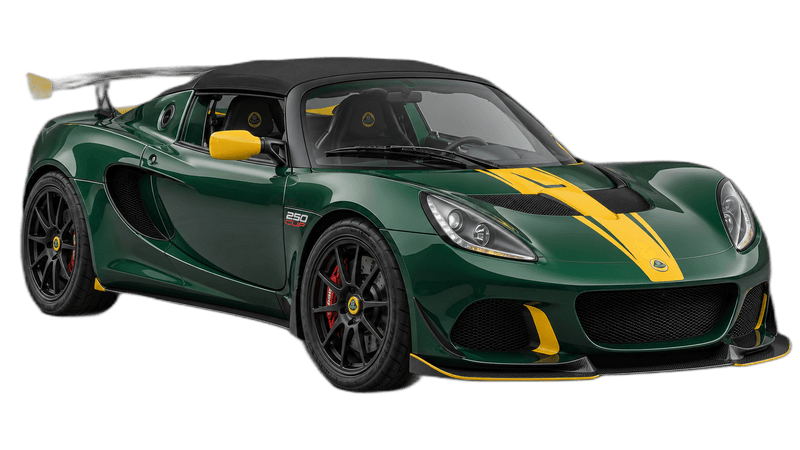
Lotus Elise Cup 250
243bhp
Power
4.3s
0-100 km/h
248km/h
Top Speed
How hard it pulls.
Peak g-force the instant you bury the throttle, estimated from the car's 0–100 time and drivetrain.
Lotus Elise Cup 250Estimated peak launch g from the 0–100 time and drivetrain: an honest approximation, not a measured figure.
The Lotus Elise Cup 250 is a 2-door roadster by Lotus, with 243 bhp, 250 Nm of torque, a 0-100 km/h time of 4.3 seconds and a top speed of 248 km/h.
Dream Car Garage Editorial · Last updated 3 November 2026
Overview
We have not driven this car. This review is based on published specifications and the sources listed below.
Scope of this guide
This guide is scoped to the Lotus Elise Cup 250, the track-focused version of the third-generation Elise that Lotus revealed at the 2016 Geneva Motor Show as the replacement for the Elise Cup 220. It is a two-door roadster with a mid-engine layout, a transversely mounted supercharged four-cylinder behind the seats, a six-speed manual gearbox and rear-wheel drive. The sources we read do not use the words "mid-engine", so that label is our own summary of the Elise layout, not a quotation.
The model ran in more than one form, and we want the scope to be clear. The main subject here is the Cup 250 as launched in 2016 and as revised for 2017. The Cup 250 Final Edition, unveiled online on 9 February 2021 as one of the end-of-run special editions, is a later and separate trim with a few different figures, and we cover it in its own section rather than blending its numbers into the standard car. This guide is not about the Elise Sport 240, the Sport 220, the Cup 220 or any Exige.
We have not driven this model for this article. We are an editorial desk that reads sources, and everything below comes from pages we opened. This page is for research, not a buying recommendation, and a guide like this cannot replace an inspection by a specialist who knows the car.
The figures at a glance
- Engine: 1.8L supercharged inline-four. Sources describe it as a 1.8-litre supercharged four-cylinder; we use the catalogue label inline-four for the layout. We did not find an exact displacement in cubic centimetres on any page we read, so we show the 1.8-litre rounding only.
- Power: 243 bhp at 7,200 rpm. See the conversion note below.
- Torque: 250 Nm, quoted between 3,500 and 5,500 rpm by several sources (Wikipedia prints 250 Nm at 5,500 rpm). One review prints it as 184 lb-ft.
- 0-100 km/h: 4.3 seconds. This is the figure Lotus gave for the Final Edition, which one source says is unchanged, and the 0-62 mph time printed for the 2017 car. It is not the same as the 3.9 seconds that many 2016 pages quote to 60 mph. See the next section.
- Top speed: 248 km/h, which is 154 mph in the sources that print both.
- Drive: rear-wheel drive through a six-speed manual gearbox.
- Weight: 931 kg in the 2016 launch specification, 921 kg with the optional Carbon Aero pack, and 884 kg dry for the 2017 car, with a 917 kg kerb weight in the same 2017 report. A lightest-possible figure of 860 kg with every option is quoted for 2017.
- Downforce: 66 kg at 100 mph and a total of 155 kg at 154 mph for the 2016 launch car; 125 kg at 140 mph for the 2017 reports.
- Price when new in the UK: 45,600 pounds at launch in February 2016, and from 47,400 pounds in 2017 reporting.
Power: 243 bhp, 246 PS and the 250 in the name
The name says 250, but the figure Lotus published for the launch car is 243 bhp. Wikipedia prints 243 bhp (181 kW; 246 PS), Ultimate Car Page prints 243 hp (246 PS) and Autoblog prints the same. The conversions agree: 246 PS multiplied by 0.98632 is about 242.6 bhp, and 181 kW multiplied by 1.34102 is about 242.7 bhp, so both round to 243 bhp. If the 250 in the name were read as 250 PS it would convert to about 247 bhp, which is not what the 2016 sources print. We read 250 as a model label, not a measured output, and we use 243 bhp throughout. The Final Edition is described differently by different sources: one prints 250 hp (183 kW), Wikipedia prints 245 bhp (248 PS), and we do not try to settle that here.
0-60 mph is not 0-100 km/h
Most 2016 launch coverage gives 3.9 seconds to 60 mph. Evo, Autoblog, Top Speed and Wikipedia all say so, and a Malaysian report says 3.9 seconds to 96 km/h, which is 60 mph. Motor Sport printed 3.9 seconds as a 0-62 mph time. In contrast the 2017 Motoring Research report gives 4.3 seconds to 62 mph, and the Final Edition reports give 4.3 seconds to 100 km/h. We do not convert one into the other. We use 4.3 seconds as the 0-100 km/h figure because it is the only time stated against a 100 km/h benchmark, and we flag that the 60 mph and 62 mph pages disagree with each other.
History and what changed over the run
Lotus announced the Cup 250 in February 2016 as the faster and lighter successor to the Cup 220. Evo, in an article dated 17 February 2016, said it made its debut in April and was the quickest Elise yet. Autoblog, on 16 February 2016, said it would go on sale in major markets from April 2016, excluding North America. Compared with the Cup 220 it has 26 bhp more and is 21 kg lighter, per Evo. The weight saving comes from a lithium-ion battery of about 10 kg, carbon-backed seats of about 6 kg and forged alloy wheels of about 1.5 kg.
Evo adds that the body kit was carried over from the Cup 220, the front tyres became wider at 195/50 R16 while the rears stayed 225/45 R17, and the car could be bought as a roadster with an optional hard top, where the Cup 220 had a fixed roof only. Evo reports a Hethel lap of 1 minute 34 seconds, four seconds quicker than the Cup 220. Motor Sport lists Eibach springs, Bilstein dampers and an AP Racing brake system.
For 2017, Motoring Research and Paul Tan describe an updated car. It is 14 kg lighter than its predecessor, quoted at 917 kg kerb and 884 kg dry. The changes listed include a polycarbonate rear screen, higher damper rates, a T45 steel roll-over hoop, Yokohama Advan A048 LTS tyres and hand-made carbon racing seats. Options in that report include the carbon aero pack at 3,400 pounds, two-piece brake discs at 1,500 pounds and a titanium exhaust at 4,000 pounds. Paul Tan also mentions a lighter front clam panel, wider radiator openings, a mesh grille and two headlamps instead of four.
The Final Edition
The Cup 250 Final Edition belongs to the end-of-run range announced in 2021. Just Cars Australia says power and torque are unchanged at 250 hp (183 kW) and 244 Nm, 0-100 km/h is 4.3 seconds, top speed is 248 km/h, weight is 931 kg, and downforce is 66 kg at 160 km/h and 155 kg at 248 km/h. It adds new colours, forged wheels and Yokohama A052 tyres, and an Australian list price of 109,990 dollars before on-road costs. Secret Classics gives 50,900 pounds for the UK Cup 250 Final Edition and a new digital instrument display. The Supercar Blog says Lotus signed off the last Cup 250 on 28 February 2022, calling it the last of 62 Final Editions, and that it was delivered on 5 May 2022. These Final Edition figures differ from the standard car in torque (244 Nm against 250 Nm), so we keep them out of the headline numbers above.
Aerodynamics and the production page's claims
The existing catalogue description speaks of a fixed rear wing, a front splitter and downforce. We checked each. The sources we read do describe a front splitter, a rear wing, a diffuser and side-floor or sill extensions as part of the aero package, and they give downforce numbers, so those parts are supported. What the sources do not say is that the wing is "fixed" as opposed to adjustable, and they do not make clear which parts are standard on every car and which come in the optional Carbon Aero pack. Evo says the standard body kit carried over from the Cup 220 and the optional carbon parts are the splitter, wing, diffuser and sills; Autoblog says the Carbon Aero pack adds carbon versions and saves 10 kg. The claim that the car could "embarrass much more powerful machinery" is not supported by anything we read, so we have dropped it. The closest evidence is Motor Sport's reviewer saying it is the better track-day car while noting that many rivals now offer similar capability.
What to check before buying
- Which year and specification. A 2016 car and a 2017 or later car differ in weight, dampers and equipment, and the Final Edition differs again. Ask for the build specification, not the badge.
- Options fitted. The carbon aero pack, lighter brake discs and titanium exhaust were extra-cost options in 2017 reporting. Confirm what is actually on the car and what the seller paid for it.
- Weight claims. Sources quote 931, 921, 917, 884 and 860 kg for different conditions. Treat any advertised weight as unverified until you know whether it is dry, kerb or with options.
- Track history. Motor Sport calls it the better track-day car, so expect some cars to have done track work, and a specialist can judge how a given car has been used. We found no inspection checklist from a maker or specialist in the pages we read.
- Gearbox. Motor Sport's reviewer calls the gearbox the car's weakest point dynamically. That is one opinion, not a failure report.
- Documentation. Ask for the service history and for any accident or repair records, and have a specialist look at the car before you commit.
Running costs, recalls and market notes
We found no running-cost data, service intervals, failure rates or recall notices for this model in the pages we opened, so we give none. We did not search a recall database. A used-market price guide is also something we could not find from our sources, so we give no used value. The only prices we have are new prices: 45,600 pounds at the February 2016 launch (Autoblog and Ultimate Car Page), 45,000 pounds in Motor Sport's factfile, 61,100 euros in Germany before options (Top Speed), and from 47,400 pounds (Paul Tan, 2017) or from 47,000 pounds (Motoring Research, 2017). Those differ by outlet and year, and they are not today's values. The car was not sold in North America at launch, per Autoblog and Top Speed.
What we could not find
There is no production count: no figure shown for production volume in any page we read, and we give no number. Wikipedia's 35,124 figure covers the whole Elise run from 1996 to 2021, not the Cup 250. We also found no exact displacement in cubic centimetres and no maker page naming the engine family, so we do not repeat the production row's engine-family claim. We could not open Top Gear (403), Car magazine (402), Auto Express (410), Hagerty (403) and a Lotus dealer page (404), and a Lotus press link redirected to a general page we did not follow. We did not use Lotus's own specification sheet, so all figures are as repeated by press and reference sites.
About the photograph
This page uses the catalogue photograph for the car. Its credit is listed on the credits page.
Verdict
The Elise Cup 250 is a lightweight, mid-engine, rear-wheel-drive roadster with a 1.8L supercharged inline-four making 243 bhp (246 PS) and 250 Nm, a quoted 248 km/h, and a 4.3 seconds 0-100 km/h time where the sources give one against that benchmark. Its appeal in the sources is a track-ready aero kit, a low weight of roughly 884 to 931 kg depending on the basis, and a sharp chassis, as seen by reviewers rather than by us. Practical advice from our reading is to pin down the year and options, to treat weight and performance claims with care, and to get a specialist inspection. We have not driven it, so use the sources, the seller's records and an independent inspection.
Sources
- Evo: Lotus Elise Cup 250 - lighter, more powerful and faster than ever (17 February 2016)
- Autoblog: How the fastest Elise ever compares (February 2016)
- Motor Sport Magazine: Lotus Elise 250 Cup (September 2016)
- Ultimate Car Page: Lotus Elise Cup 250
- Top Speed: 2016 Lotus Elise Cup 250
- Motoring Research: 2017 Lotus Elise Cup 250
- Paul Tan: Lotus Elise Cup 250 - 243 hp, 884 kg (1 June 2017)
- Wikipedia: Lotus Elise
- Just Cars: Lotus Elise Final Editions in detail
- The Supercar Blog: Last Lotus Elise Cup 250 Final Edition, from factory to delivery (9 May 2022)
- Secret Classics: Lotus Elise and Exige Final Edition
Specifications
Engine
1.8L supercharged inline-four
Power
243 bhp
Torque
250 Nm
0-100 km/h
4.3s
Top Speed
248 km/h
Drivetrain
RWD
Country
United Kingdom
Body Style
2-door roadster
Years
2016–2022
Specifications are manufacturer-published figures.
More from Lotus
Frequently Asked Questions
What are the specifications of the Lotus Elise Cup 250?
The Lotus Elise Cup 250 is a 2-door roadster by Lotus, with 243 bhp, 250 Nm of torque, a 0-100 km/h time of 4.3 seconds and a top speed of 248 km/h.
What drivetrain does the Lotus Elise Cup 250 use?
The Lotus Elise Cup 250 is configured with rear-wheel drive.
What type of car is the Lotus Elise Cup 250?
The Lotus Elise Cup 250 is a sports cars manufactured by Lotus in United Kingdom. Production ran from 2016 to 2022.