
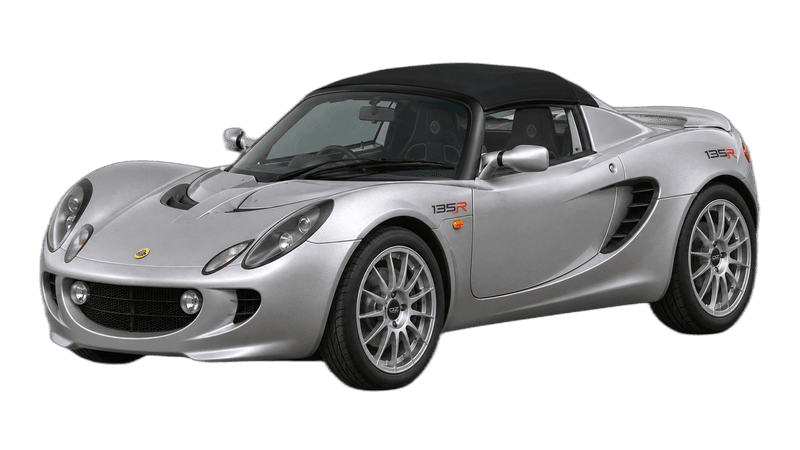
Lotus Elise 135R
135bhp
Power
208km/h
Top Speed
The Lotus Elise 135R is a 2-door roadster by Lotus, with 135 bhp, 171 Nm of torque and a top speed of 208 km/h.
Dream Car Garage Editorial · Last updated 3 November 2026
Overview
We have not driven this car. This review is based on published specifications and the sources listed below.
Scope of this guide
This guide is scoped to the Lotus Elise 135R, the limited-run special edition of the second-generation (S2) Lotus Elise that Lotus Sport and Performance developed with the Lotus Ride and Handling team and put on sale at dealerships on 1 May 2003. It is a mid-engine, rear-wheel drive roadster, with the engine mounted transversely behind the seats. This guide covers only the 135R. It is not a guide to the ordinary S2 Elise, to the 111S or 111R that sat above it in power, or to the earlier Series 1 Sport 135.
We have not driven this model for this article. We are an editorial desk that reads sources, and everything below comes from pages we opened: the PistonHeads launch report from April 2003, a PistonHeads retrospective from July 2020, the Elises.co.uk model page, a period road test on Car Enthusiast, the Supercars.net specification page, the Lotus Driver's Guide genealogy page, a Concept Carz page, and the How Rare Is My Car registration page. The 135R is a rare car that seldom comes to market, so a web guide cannot replace an inspection by a Lotus specialist. This page is for research, not a buying recommendation.
The figures at a glance
- Engine: 1.8L naturally aspirated inline-four, the Rover K-series, 1,796 cc, with twin overhead camshafts and four valves per cylinder, per Supercars.net. Lotus Driver's Guide also gives 1,796 cc.
- Power: 135 bhp at 6,250 rpm. PistonHeads (both the 2003 and 2020 articles), Elises.co.uk, Supercars.net, Lotus Driver's Guide and Concept Carz all give 135 bhp, so there is no disagreement on power. We use 135 bhp throughout.
- Torque: 171 Nm at 4,800 rpm. PistonHeads in 2020 prints 126 lb ft at 4,800 rpm, and Supercars.net prints 171 Nm for the same figure. We checked the conversion ourselves: 126 lb ft multiplied by 1.3558 is about 171 Nm.
- Top speed: 208 km/h. Car Enthusiast lists 129 mph with no km/h figure, and Supercars.net lists about 207.6 km/h, which is 129 mph. We rounded to 208 km/h. Neither is a Lotus document, and we did not find a maker top speed.
- 0-100 km/h: no figure shown. We did not find a 0-100 km/h time in any page we read, and we will not relabel a different measurement as one. The times we did find are 0-62 mph in 5.3 seconds on the Car Enthusiast specification table and about 5.2 seconds to 60 mph on Supercars.net. Car Enthusiast's text also mentions 5.5 seconds for 0-60 in a comparison with other cars. These are mph-based times and they disagree by a few tenths, so we do not publish any of them as a catalogue figure.
- Drive: rear-wheel drive, five-speed manual gearbox, final drive 4.20:1 per Supercars.net.
- Weight: 756 kg on Supercars.net and 757 kg on the Car Enthusiast table. The Car Enthusiast review text says the car has "135 bhp in 700 kg", which does not match its own table, so we treat 700 kg as a loose figure of speech.
- Price when new: 27,995 pounds sterling in the PistonHeads launch report and on Car Enthusiast. PistonHeads in 2020 says about 30,000 pounds, which we read as a rounded figure for the same period.
- Colours: Silver Mica and Blue Mica only, per PistonHeads, Elises.co.uk and Supercars.net.
What the 135R changed
The 135R was aimed at track-day drivers. PistonHeads headlined its 2003 report "New variant targets track day goers". Lotus Driver's Guide describes it as developed by Lotus Sport and Performance in conjunction with the Lotus Ride and Handling team. Reading the launch material across sources, the changes fall into four groups.
Engine
- Reshaped cylinder head ports to improve gas flow. Elises.co.uk and PistonHeads both say so.
- A cast alloy intake manifold taken from the 111 range.
- A reprogrammed engine control unit.
- Together these give the 135 bhp figure. We found no source that says what the standard car's power was in the same wording, so we do not quote an increase.
Suspension
- Bilstein dampers recalibrated with stiffer bump and rebound settings.
- Adjustable upper spring platforms threaded onto the dampers, which allow ride height to be set.
- A stiffer, adjustable anti-roll bar, which the launch material calls a "Motorsport" bar.
Wheels and tyres
- Lightweight, one-piece cast alloy O.Z. Racing 16-spoke wheels.
- Front wheel width grew from 5.5 to 6.5 inches, and the rear was unchanged.
- Yokohama AO48 tyres, which Elises.co.uk says were developed with Lotus with an emphasis on track use. Car Enthusiast calls the tyres semi-slick rubber and says the grip is "simply phenomenal".
Body and interior
- A three-piece rear diffuser, styled after Formula 1 cars, and a new exhaust.
- 135R decals above each side repeater lamp and a larger decal at the rear.
- Blue Alcantara on the instrument binnacle, column cowlings and seats, with carbon leather trim and embroidery.
- Blue footwell carpets embroidered with the 135R logo, which can be taken out for track days.
- A Lotus Sport chassis plate in the passenger footwell identifies it as a special edition.
Each claim in the current catalogue description (modified head ports, alloy intake manifold, revised engine management, recalibrated Bilstein dampers, adjustable anti-roll bar, lightweight O.Z. wheels) is supported by those pages.
Years and how many were made
Every launch source we read points to 2003. PistonHeads reports a dealership launch on 1 May 2003 and Lotus Driver's Guide lists the period as 2003. We therefore keep 2003 as both the start and end year.
The number built is not settled. Lotus Driver's Guide has a "made" field for this model and leaves it blank. PistonHeads in 2003 says only that production would be limited. The most useful number we opened is from How Rare Is My Car, which counts 118 cars registered for road use in the UK, built on DVLA first-registration data: 103 in 2003, 14 in 2004 and 1 in 2005. That page warns that its data can include imports of older cars and previously unregistered cars, and it counts the UK only, so it is a registration count and not a build total. PistonHeads in 2020 says more than 100 were registered in 2003 alone, which agrees with the 103, and says it was suggested that around 35 were left on the roads. We found no official production number, so we propose none and do not publish one in the catalogue. The later registrations in 2004 and 2005 suggest some cars sat unregistered for a while, but that is our inference, not something a source states.
What to check before buying
The 135R rarely comes to market and we have no inspection experience, so this list is built from what the sources say makes the car different, not from any failure data.
- Identification. A genuine car carries the Lotus Sport chassis plate in the passenger footwell and came in Silver Mica or Blue Mica. Anything else needs an explanation from a specialist.
- Specification. Check that the car still has the O.Z. wheels with the wider front rims, the Yokohama tyres or a sensible equivalent, the three-piece diffuser, the alloy intake manifold and the blue Alcantara trim. The distinguishing parts are the whole point of the model.
- Suspension setup. The adjustable spring platforms mean the ride height can have been changed. Ask what the car is set to and why.
- Track history. The car was built for track days, so ask for the history of use. We have no source giving typical wear, so we cannot say what is normal.
- Documents. With around 100 to 120 cars in play and only a registration count to go on, ask for the chassis number, registration history and service records.
- Specialist inspection. We cannot judge a car from a web page, and neither can you.
Running costs and known issues
We found no source giving running costs, service intervals, engine failure rates or parts prices for the 135R, so we give none. Car Enthusiast gives a combined economy of 36.2 mpg and emissions of 184 g/km in its specification table, and its text mentions a 30-plus mpg range. The review itself was candid about trade-offs. It said the suspension is "too hard for regular road use", that the car "feels skittish at low speed", that the brakes can catch you unawares when cold, and that the K-series engine "sounds very uninspiring", while concluding that as a track car for road use it is near perfect. Those are one reviewer's opinions from 2003, repeated here as reported and not tested by us.
Recalls and safety
We found no recall notice in any page we read, but we did not search a recall database, so that is not a clean bill of health. We also found no crash-test data. The 135R is a lightweight roadster from 2003 and should be judged as one. Anyone planning road use should ask a specialist about the condition of the brakes, tyres and steering.
Market and value notes
Prices are thin. PistonHeads in July 2020 reported a car advertised at 19,950 pounds and argued that the rarity, the Lotus Sport and Performance heritage and the track-focused look could justify a price at that level. The same article noted the other side of the argument: the cheaper 111S and 111R offer more performance. It also quoted Autocar's 2003 shootout in which a 135R lapped Rockingham in 1:21 flat. A single advert from 2020 is not a valuation, and we have no current sales data.
What we could not find
We found no maker document for the 135R: no Lotus press sheet or brochure came up in our search, so top speed, acceleration and weight come from Supercars.net and Car Enthusiast, which are not maker sources. We found no 0-100 km/h time and no figure shown for it in the catalogue, only mph-based times that disagree. We found no official production number and no second reliable build count. A search summary mentioned a dealer listing claiming number 72 of 125, a Car and Classic advert claiming about 100 and a Classics World listing giving a 2002 to 2003 run, but the PistonHeads listing and the Car and Classic page would not open for us (not found and forbidden respectively), and we did not open the Classics World page, so we use none of those claims. We also did not open the Wikipedia page for the Series 2 Elise because the address we tried returned not found. We found no recall, crash-safety, running-cost or failure-rate data. None of the pages we read spells out the drive layout in words; we state rear-wheel drive and mid-engine because that is the standard Elise layout, and the Supercars.net page describes the engine as mid-transverse and lists a final drive ratio.
About the photograph
The page uses the catalogue photograph, and its credit is listed on the credits page.
Verdict
The 135R is best understood as a track-day pack for the S2 Elise: a reworked cylinder head and ECU for 135 bhp, firmer and adjustable Bilstein suspension, wider front wheels on grippy Yokohama tyres, and a dedicated trim and diffuser, all sold from May 2003 in two colours. The documented facts are solid on what changed and on the headline power. They are thin on production numbers, official performance and ownership costs, and we have told you where. We have not driven this model for this article, and this page is for research, not a buying recommendation. If a car is in front of you, a Lotus specialist's inspection and the car's paperwork matter more than anything written here.
Sources
- PistonHeads: Elise 135R launch report (29 April 2003)
- PistonHeads: Lotus Elise 135R spotted (2 July 2020)
- Elises.co.uk: S2 135R model page
- Car Enthusiast: 2003 Lotus Elise Sport 135R review
- Supercars.net: 2003 Lotus Elise 135R
- Lotus Driver's Guide: Elise genealogy
- How Rare Is My Car: Elise Sport 135R registrations
- Concept Carz: Lotus Elise S2 135R
Specifications
Engine
1.8L naturally aspirated inline-four
Displacement
1.8L
Power
135 bhp
Torque
171 Nm
Top Speed
208 km/h
Drivetrain
RWD
Country
United Kingdom
Body Style
2-door roadster
Years
2003
Specifications are manufacturer-published figures.
More from Lotus
Frequently Asked Questions
What are the specifications of the Lotus Elise 135R?
The Lotus Elise 135R is a 2-door roadster by Lotus, with 135 bhp, 171 Nm of torque and a top speed of 208 km/h.
What drivetrain does the Lotus Elise 135R use?
The Lotus Elise 135R is configured with rear-wheel drive.
What type of car is the Lotus Elise 135R?
The Lotus Elise 135R is a sports cars manufactured by Lotus in United Kingdom. Production ran from 2003 to 2003.