
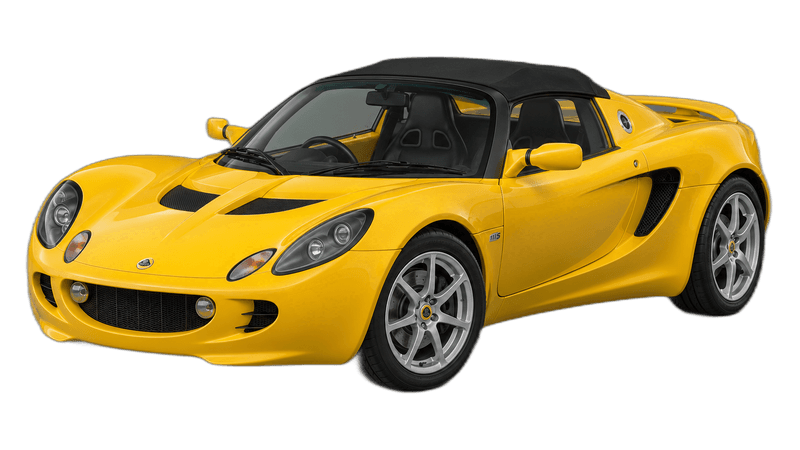
Lotus Elise 111S
156bhp
Power
5.3s
0-100 km/h
212km/h
Top Speed
How hard it pulls.
Peak g-force the instant you bury the throttle, estimated from the car's 0–100 time and drivetrain.
Lotus Elise 111SEstimated peak launch g from the 0–100 time and drivetrain: an honest approximation, not a measured figure.
The Lotus Elise 111S is a 2-door roadster by Lotus, with 156 bhp, 175 Nm of torque, a 0-100 km/h time of 5.3 seconds and a top speed of 212 km/h.
Dream Car Garage Editorial · Last updated 3 November 2026
Overview
We have not driven this car. This review is based on published specifications and the sources listed below.
Scope of this guide
This guide is scoped to the Lotus Elise 111S, the Series 2 Elise sold from 2002 until 2005 with the Rover K-series engine in its variable valve control (VVC) form. It is a two-seat, two-door roadster with a mid-engine layout, a five-speed manual gearbox and rear-wheel drive. It is not a guide to the earlier Series 1 Elise 111S of 1999 to 2001, which carried the same badge on a different car with a lower power figure, and it is not a guide to the Toyota-engined 111R that replaced the K-series cars from 2004.
We have not driven this model for this article. We are an editorial desk that reads sources, and everything below comes from pages we opened: an enthusiast site that archives the 2002 Lotus press material (elises.co.uk), its diary page summarising a 2002 Autocar test, the specialist pages sportscar2.com and autozine.nl, two Australian specification databases (carexpert.com.au and carsales.com.au), motor-car.net, supercars.net and Wikipedia. We did not find a current Lotus Cars page for this model. This guide is for research, not a buying recommendation, and it cannot replace an inspection by a specialist who knows these cars.
The figures at a glance
- Engine: 1.8L naturally aspirated inline-four, the Rover K-series with variable valve control (VVC) and the Lotus K4 engine management system. Displacement is 1,796 cc in the two Australian databases, and the cars are sold as 1.8 litre everywhere else.
- Power: 156 bhp at 7,000 rpm. The enthusiast site's 2002 article and sportscar2.com both print 156 bhp, while the press-release wording quoted on the same site says 160 PS. Those are close but not identical: 160 PS converts to about 157.8 bhp (PS multiplied by 0.98632). Carexpert prints 116 kW (158 hp/PS) at 7,000 rpm, and 116 kW converts to about 155.6 bhp (kW multiplied by 1.34102). Wikipedia prints 160 hp (119 kW). We show 156 bhp because two sources print it directly and the metric figures bracket it.
- Torque: 175 Nm. Carexpert and carsales print 175 Nm at 3,500 rpm and motor-car.net prints 175 Nm. The enthusiast site and sportscar2.com print 129 lb-ft at 4,650 rpm, which is about 174.9 Nm, so the sources agree once units are converted. The quoted peak speed differs (3,500 versus 4,650 rpm) and we do not know why.
- 0-100 km/h: 5.3 seconds. Carexpert and carsales both give 5.3 seconds. Autozine prints 5.1 seconds for 0-100 km/h on its Elise 111 page, while the enthusiast site, its Autocar summary and sportscar2.com give 5.1 seconds for 0-60 mph. A 0-60 mph time is not a 0-100 km/h time, and 60 mph is slightly less than 100 km/h, so a 5.1 second 0-60 mph run is consistent with roughly 5.3 seconds to 100 km/h. We use 5.3 seconds.
- Top speed: 212 km/h. Carexpert and autozine print 212 km/h, the enthusiast site gives 132 mph (212 km/h), sportscar2.com and motor-car.net print 132 mph, and the Autocar summary prints 131 mph.
- Drive: rear-wheel drive, five-speed manual.
- Weight: 806 kg. The press-release text on the enthusiast site, autozine, carexpert and carsales all give 806 kg for the Elise 111 range or the 111S kerb weight.
- Size and economy (Australian-market listing): 3,785 mm long, 1,719 mm wide, 1,143 mm high, 2,301 mm wheelbase, a 36 litre fuel tank and 6.9 L/100 km combined. Autozine and motor-car.net give 163 g/km of CO2.
Where the sources disagree
We say so where sources disagree instead of choosing silently. On power, the figures are 156 bhp, 160 PS, 158 PS, 155 bhp, 160 bhp and 160 hp depending on the page. They describe the same engine, and sportscar2.com contradicts itself between its text (156 bhp) and its data table (about 155 bhp), so we cannot say which is the original maker figure. On acceleration, we found 5.1 seconds labelled as 0-60 mph and as 0-100 km/h, and 5.3 seconds for 0-100 km/h. On launch date, the enthusiast site dates the official launch to June 2002, while carsales lists a September 2002 launch, which probably reflects the Australian market. On equipment, the enthusiast site says the 111S adds full leather upholstery, carpets and an uprated audio system over the 111, while autozine lists leather, carpet and improved audio on its 111 page, so the sources are not clear on exactly what separated the two cars.
History and where the 111S sits
The Series 2 Elise was announced on 9 October 2000 under the codename Monza, according to Wikipedia, because the Series 1 could not continue past the 2000 model year under new European crash regulations. Sportscar2.com says the Series 2 launched in October 2000 with a modified chassis. The K-series VVC engine had already been used in the Series 1 111S, which supercars.net describes as 143 bhp (145 PS) with 174 Nm, a 755 kg kerb weight and a 5.4 second 0-60 mph time. Our scope is the later car.
The Series 2 Elise 111 was introduced in June 2002, based on the Series 1 Elise 111, with the 1.8-litre VVC engine, per the enthusiast site and sportscar2.com. Autozine describes lightweight eight-spoke wheels, a rear diffuser and three special badges on the 111, with air conditioning and a hard top as options. The 111S followed as the better-equipped sibling. The 2002 Autocar summary on the enthusiast site gives the prices as 25,995 pounds for the 111 and 27,995 pounds for the 111S, and says the 111S adds a stereo, leather and carpeting. That page is an owner's diary summary, not a Lotus price list.
Claims we checked in the catalogue description
The existing catalogue description calls the 111S the faster, more focused version of the Series 2 Elise, with a variable-valve K-series engine, without gaining much weight. The variable-valve engine claim is supported, because the sources we read say VVC. The faster claim is plausible against the non-VVC Series 2 cars, but we did not read a source that gives the power or performance of that base car, so we cannot confirm it. The more focused claim is not supported: the sources we read describe the 111S mainly as an equipment and trim step above the 111, with leather, carpets and an uprated stereo, not as a lightweight or track-oriented step. The without gaining much weight claim also cannot be confirmed, because we found no comparison weight for the base car. Motor-car.net lists kerb weights of 860 kg and 910 kg for the Series 2 range but does not tie them to specific models, so we ignore them.
Variants and what changed over the run
Sportscar2.com says the 111S was offered as Sports Touring, with leather seats and trim and fitted carpets, or Race Tech, and that both had drilled disc brakes, different wheels and metallic paint. It says the Sports Touring was discontinued in 2005 and was not fitted with the long roof. Motor-car.net says the 111S was discontinued in 2005 in favour of the Toyota engine, and adds that a track-focused Lotus Sport 111 with the 156 bhp VVC engine was sold in some markets, including Australia, Hong Kong, Japan and Singapore.
From 2004, according to sportscar2.com, Lotus began replacing the K-series engine with the Toyota 2ZZ-GE used in the 111R. Wikipedia reports that the switch to Toyota power is believed to relate to federalising issues with the Rover engine in the US, but says this is largely unproven and notes the Rover engine would still have met US standards at the time. Wikipedia also gives 35,124 as the total number of Elises produced across all series from 1996 to 2021. It does not break out a 111S count, and we found none elsewhere, so we show no production figure.
What to check before buying
We found no source that lists faults, so this section is a checklist of questions, not a list of known failures.
- Confirm which car it is. The Series 1 111S, the Series 2 111, the Series 2 111S and the Toyota-engined 111R look similar and carry related names. Ask for the registration documents and the engine number and have a specialist confirm the engine is the 1.8L K-series with VVC.
- Ask which 111S it is. Sportscar2.com describes Sports Touring and Race Tech specifications, so check equipment against the car's paperwork.
- Documentation. Ask for the full service history and any invoices for engine work. We found no maker service schedule or interval in the pages we read.
- Use of the car. The Elise is a light, thinly built roadster and track-focused Lotus Sport 111 cars existed, so ask whether the car has been used on track or modified. Autozine mentions Lotus tuning kits, but gives no model-specific details.
- Condition of the hood, roof and body panels, and the state of any accident repair. A specialist can judge this far better than we can from a web page.
- Market of origin. The Australian listings show that cars were sold outside the UK, and equipment and emissions specifications can differ, so ask where the car was first registered.
Running costs and known issues
We found no source giving running costs, servicing prices, engine-rebuild intervals or failure rates for the 111S, so we give none. Fuel use is the only running figure we found: carexpert prints 6.9 L/100 km combined under the Australian test and 5.4 L/100 km on a country highway, with premium unleaded (95 octane) specified, and motor-car.net prints about 281 miles per tank. Anyone quoting repair costs or known failure rates without a source is guessing.
Recalls and safety
We found no recall notice for the 111S in any page we read, but that is not a clean bill of health, because we did not search a recall database. The Series 2 was reworked to meet new European crash regulations, per Wikipedia, but we found no crash-test results and no safety-equipment list for this model. Owners should check with a specialist and the relevant national authority.
Market and value notes
We found no used sale prices or valuations for the 111S in the pages we read. The only price figures are the 2002 list prices quoted above, from a diary summary of an Autocar review, which say little about what a car is worth today. We give no valuation.
What we could not find
We found no figure shown in any maker document for this model: we did not open a Lotus Cars page, and the Autocar article returned a payment-required error, which we did not work around, so we relied on a diary summary of it. A Wikipedia page for the Series 2 returned not-found, so we used the main Elise article. A Car and Classic listing returned a forbidden error and we did not use it. We found no production count for the 111S, so no figure shown for production in this guide. We also found no torque curve, no running costs, no failure rates, no recall information and no crash-test data.
About the photograph
This page uses the catalogue photograph for the car. Its credit is listed on the credits page.
Verdict
The Elise 111S is a mid-engine, rear-wheel-drive roadster with a 1.8L naturally aspirated inline-four making 156 bhp and 175 Nm, a quoted 5.3 seconds to 100 km/h and a quoted 212 km/h, in a car of about 806 kg. The numbers differ a little between sources, mainly in how power and acceleration are labelled, and the evidence for a focused, faster-than-the-rest character is thin: it reads as a better-equipped 111. Treat the figures as published claims rather than test results. We have not driven it, so use the sources, the seller's records and an independent specialist inspection to decide.
Sources
- elises.co.uk: Elise S2 111 and 111S (2002 launch article)
- elises.co.uk diary, May 2002 (summary of an Autocar test of the 111 and 111S)
- sportscar2.com: The Early Lotus Elise Series 2
- Autozine: New Lotus Elise versions (111 and 111S), June 2002
- CarExpert: 2004 Lotus Elise 111S features and specs
- carsales: 2002 Lotus Elise 111S overview
- motor-car.net: Lotus Elise Series 2
- supercars.net: 1999-2001 Lotus Elise 111S (Series 1, for comparison)
- Wikipedia: Lotus Elise
Specifications
Engine
1.8L naturally aspirated inline-four
Displacement
1.8L
Power
156 bhp
Torque
175 Nm
0-100 km/h
5.3s
Top Speed
212 km/h
Drivetrain
RWD
Country
United Kingdom
Body Style
2-door roadster
Years
2002–2005
Specifications are manufacturer-published figures.
More from Lotus
Frequently Asked Questions
What are the specifications of the Lotus Elise 111S?
The Lotus Elise 111S is a 2-door roadster by Lotus, with 156 bhp, 175 Nm of torque, a 0-100 km/h time of 5.3 seconds and a top speed of 212 km/h.
What drivetrain does the Lotus Elise 111S use?
The Lotus Elise 111S is configured with rear-wheel drive.
What type of car is the Lotus Elise 111S?
The Lotus Elise 111S is a sports cars manufactured by Lotus in United Kingdom. Production ran from 2002 to 2005.