
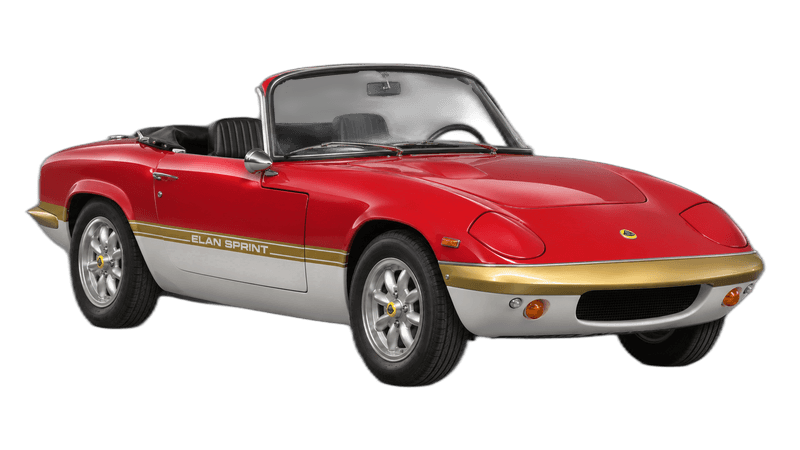
Lotus Elan Sprint
126bhp
Power
195km/h
Top Speed
The Lotus Elan Sprint is a 2-door roadster by Lotus, with 126 bhp, 153 Nm of torque and a top speed of 195 km/h.
Dream Car Garage Editorial · Last updated 3 November 2026
Overview
We have not driven this car. This review is based on published specifications and the sources listed below.
Scope of this guide
This guide is scoped to the Lotus Elan Sprint, the last version of the Series 4 Lotus Elan, announced at the October 1970 Earls Court show and built at Hethel from January 1971 until March 1973. It is a front-engine, rear-wheel drive, two-seat sports car with a fibreglass body over a steel backbone chassis. Lotus offered it as a drophead coupe (Type 45, the open car) and as a fixed-head coupe (Type 36), and our catalogue entry lists it as a roadster, so the open drophead is the body style this page has in mind. Where a source covers both bodies we say so.
The guide does not cover the earlier Series 1 to Series 4 Elans, which had the smaller-valve twin-cam engine, and it does not cover the longer Elan +2 family. The Wikipedia Elan article we read does not mention any Sprint version of the +2; it says the +2S received the Big Valve engine in 1971 and became the +2S 130, which is a different car, so we leave it out. It also does not cover the unrelated front-wheel drive Elan of 1989 to 1996.
We have not driven this model for this article. We are an editorial desk that reads sources, and everything below comes from pages we opened: the Lotus Elan site lotuselan.net, supercars.net (two pages), a Bonhams auction lot, Wikipedia, a Motor road test of March 1971 as transcribed on a Lotus Elan forum, and a specification database. This page is for research, not a buying recommendation, and it cannot replace an inspection by a specialist who knows these cars.
The figures at a glance
- Engine: 1.6L naturally aspirated inline-four, the Lotus twin-cam in Big Valve form. Displacement is 1,558 cc and the compression ratio is 10.3:1, according to lotuselan.net, supercars.net and Wikipedia. Supercars.net gives the engine code as 2731E.
- Power: 126 bhp at 6,500 rpm, net. Lotuselan.net, supercars.net, Wikipedia and Bonhams all print 126 bhp. The Motor test prints the same number as 126 PS, and the database prints 128 PS / 126 HP. See the disagreements section for why we use 126 bhp.
- Torque: 153 Nm at 5,500 rpm. The sources print 113 lb ft; multiplied by 1.35582 that is 153.2 Nm. Supercars.net prints 153.2 Nm and Wikipedia prints 153 N m.
- 0-100 km/h: no figure shown. Every source gives 0-60 mph, which is a different speed from 100 km/h, so we do not relabel it. The database shows a dash for 0-100 km/h.
- Top speed: 195 km/h. Motor measured 121 mph, and 121 mph multiplied by 1.60934 is 194.7 km/h, which rounds to 195. Wikipedia and the database also print 195 km/h.
- Drive and gearbox: rear-wheel drive with a Ford-based four-speed manual gearbox, according to supercars.net. Lotus later offered an optional five-speed on late Sprint/5 cars, but lotuselan.net says very few were built.
- Weight: about 700 kg. Lotuselan.net gives 1,550 lb for the fixed head and 1,540 lb for the drophead; 1,540 lb multiplied by 0.45359 is about 699 kg. Supercars.net prints 708 kg and the database 687 kg, so published weights differ by about twenty kilograms.
- Production: 1,353 Sprints in total, covering both body styles. See below.
The Sprint in context
The Series 4 Elan arrived in March 1968, according to the Bonhams lot we read. The Sprint was announced in October 1970 and went on sale properly in early 1971, when the final engine specification was ready. Lotuselan.net says it was relaunched in February 1971 for that reason, that the decision to stop production was taken in July 1972, and that the last car was built on 6 March 1973, reportedly a maroon drophead sold to a customer in Portugal. Dealer stock lasted until August 1973.
Lotuselan.net lists what changed from the Series 4: the Big Valve engine, a strengthened differential mounting, hazard warning lights, a heated rear screen (standard on the fixed head only), strengthened Rotoflex driveline components and revised styling. Wikipedia adds an ignition key steering lock and a differential strengthening brace.
The Big Valve engine gets its name from slightly larger inlet valves, per Wikipedia. Supercars.net credits Tony Rudd with developing it and says he did so in only ten days, and mentions a D camshaft. Bonhams says the Sprint engine produced 126 bhp, about twenty horsepower more than the standard Elan, but gives no comparison number for the earlier engine.
Power ratings: where the sources disagree
We choose 126 bhp net at 6,500 rpm and use it throughout this page, because four of the six sources that give a figure print 126 bhp. Some points are worth knowing.
- Early marketing figure. Lotuselan.net says early brochure material quoted 135 bhp, which it describes as a gross measurement. The 126 bhp number is the net one.
- Unit labels. The Motor test, as transcribed, says 126 PS net, and compares it with 115 PS for the previous SE. Converting 126 PS by 0.98632 gives about 124 bhp, so there is a small gap between the sources. We could not tell whether Motor was using PS loosely or whether the transcriber changed the units. The database prints 128 PS / 126 HP.
- Emissions version. Wikipedia lists a Sprint Emission rating of 113 bhp and 104 lb ft (141 Nm). We read no source that explains which cars carried it, so the main figure on this page is the standard 126 bhp.
- Carburettors. Lotuselan.net says Weber 40 DCOE carburettors were fitted at launch, Dellorto DHLA 40 from mid-1972, and Zenith-Stromberg units on Federal cars for the US market. Supercars.net says the Stromberg-equipped Federal cars needed a large power bulge on the bonnet.
Performance and what the road testers said
Wikipedia and lotuselan.net list several contemporary tests, all in mph. They do not agree exactly:
- Autosport, March 1971: 6.2 seconds to 60 mph, 121 mph top speed.
- Motor, March 1971: 6.7 seconds to 60 mph, 20.3 seconds to 100 mph, 121 mph (195 km/h), 22.2 mpg overall.
- Car, June 1971: 6.6 seconds to 60 mph. The top speed is 122 mph on lotuselan.net and 123 mph (198 km/h) on Wikipedia, which also marks that test as a drophead.
- Autocar, June 1971: 7.0 seconds to 60 mph, 118 mph.
- Supercars.net: about 6.5 seconds to 60 mph and about 121 mph. The database prints 6.20 seconds to 60 mph.
We use Motor for the top speed because it gives a figure measured in the timed quarter mile and the number lines up with two other sources. None of these tests give a 0-100 km/h time, which is why we show no figure for it.
The Motor test of 6 March 1971 is the most detailed we read. It called the Sprint the best Elan the magazine had tested and one of the finest sports cars in the world. It praised the dry grip, the ride and the flat torque, and said cold starts were good without choke, though hot starts were harder. Its criticisms were specific: the gearbox gave a click, click on shifts, the switch panel was confusing at night, the pop-up headlights were slow to rise, and the car was less secure in the wet and easy to unsettle at the rear. At 90 mph the press studs on the hood edge tore off during testing, and hood wind noise was high. Motor also gave its fuel consumption: 22.2 mpg overall, which is 12.7 L/100 km, with 30.5 mpg touring and 17 mpg in urban use. Its price was 1,686 pounds for the soft top and 1,663 pounds for the coupe, both supplied in kit form, with the optional 3.55:1 differential at 22 pounds extra. Those are 1971 figures from one magazine, not a modern valuation.
Looks and identification
Lotuselan.net says the standard colours were a red, white and gold two-tone scheme inspired by the Gold Leaf racing livery, with single colours as an alternative and metallic paint at extra cost. It lists semi-gloss black wheels with trim rings and gold-lacquer bumpers as Sprint-only features. Bonhams describes the Sprint as distinguished by duo-colour paint, gold bumpers and black wheels. Supercars.net says the bumpers were gold on most cars and lists a palette that includes Cirrus White, Carnival Red, Pistachio Lime Green, Colorado Orange, Maroon, Metallic Lagoon Blue and Lotus Yellow. A redesigned badge arrived from November 1972, according to the same page, tied to Lotus's 1972 Formula One title.
Claims we checked in the summary of this car
- Last twin-cam Elan: supported. Lotuselan.net and Wikipedia place it at the end of Elan production in 1973.
- Big-valve head: supported by every spec source.
- 126 bhp: supported, with the net versus gross caveat above.
- Higher compression ratio: the 10.3:1 figure is supported, but we did not read the earlier engine's ratio, so we cannot confirm that it was higher.
- Revised camshafts: only supercars.net mentions a D camshaft, and we read nothing that compares it with the older cam, so this is not confirmed.
- Under 700 kg: weights are about 700 kg or slightly above in most sources and 687 kg in one, so we describe the car as about 700 kg and not as well under it.
- Gold separating stripe: the sources describe a two-tone red and white scheme with gold bumpers, but we did not read a description of a gold stripe, so we left it out.
Production numbers
Wikipedia gives the Sprint total as 1,353, attributed to Bolster, and says Robinshaw and Ross estimate between 900 and 1,353. Lotuselan.net says approximately 1,353. The total for all Elans is given by Wikipedia as 12,224 (Bolster) or an estimated 8,676 to 9,153, and by Bonhams as slightly fewer than nine thousand, so the Elan totals are themselves disputed. We found no split between drophead and fixed head, so the 1,353 figure covers both bodies and cannot be used for the open car alone. For that reason we show no production figure in the catalogue. Lotuselan.net lists chassis type letters: G for a UK drophead, H for an export drophead and K for a Federal drophead. It describes the Federal fixed head as very rare.
What to check before buying
The sources give some specifics, though not a full inspection guide. We found no source that lists failure rates or repair costs.
- Is it a genuine Sprint? Lotuselan.net warns that Sprints can be confused with Series 4 cars and later conversions, and lists the identifiers: the Gold Leaf style two-tone paint, semi-gloss black wheels, gold bumpers, the Big Valve cam cover, the differential brace that is unique to the Sprint chassis, and a flat bonnet on most production cars. Check the chassis number and type letter against the paperwork.
- Documentation. The Bonhams lot shows how messy records can get: it says the V5 registration document recorded the chassis number wrongly and that a saleroom notice said the chassis plate appeared to show a different number from the catalogue. Ask for a specialist to compare plates and papers.
- The hood. Motor lost press studs from the hood at 90 mph and found refitting tricky, so look closely at fit and fixings on a drophead.
- Wet-weather handling and tyres. Motor found the car easy to unsettle in the wet, so look at the condition and type of the tyres fitted.
- Driveline. Motor said the new radially laminated doughnuts largely cured driveshaft surge. Lotuselan.net mentions strengthened Rotoflex components, so ask what has been replaced.
- Restoration history. The Bonhams car was restored to Sprint specification over three years and finished in May 2010, built originally as a May 1970 car. Bonhams noted a larger fuel tank and wider wheels as its only deviations. Ask what any car has had done and by whom.
Running costs and known issues
Fuel consumption is the one running figure we have: Motor's overall 22.2 mpg, with owners expected to reach nearer 25 mpg. Lotuselan.net lists capacities of 9.25 gallons of fuel and 7.5 pints of engine oil, but gives no servicing costs. We found no source with maintenance schedules, repair costs or known failure rates, and we give none. Lotuselan.net lists a Classic and Sportscar article titled How to avoid a duff one but does not summarise it, and we did not read it.
Market and value notes
The only auction figure we read is a Bonhams estimate of 29,000 to 34,000 pounds for a restored 1970-built Sprint drophead at the Goodwood Festival of Speed sale on 27 June 2014. The page gave no hammer price or sold status. Lotuselan.net lists a drophead for sale at 29,500 pounds, with no date shown in what we read. We give no current valuation.
What we could not find
We found no production split between drophead and fixed head, no Lotus factory document, and no 0-100 km/h time, so no figure shown for it. We could not open several pages: a Hagerty sales page redirected to a login, a Honest John page redirected to another site, a Classic and Sportscar page returned nothing readable, a Christie's lot page did not contain the car, one specification page was not found, and two buying guides refused access or returned an error, so we did not use them and did not work around the refusal. We found no recall information for this model and no crash-test data.
About the photograph
This page uses the catalogue photograph for the car. Its credit is listed on the credits page.
Verdict
The Lotus Elan Sprint is a light, front-engine, rear-wheel drive sports car with a 1.6L naturally aspirated inline-four rated at 126 bhp and 153 Nm, a measured 195 km/h top speed and about 700 kg of weight, built in only 1,353 examples across drophead and fixed-head bodies. Its numbers are well documented in mph terms, but not in 0-100 km/h terms, and its identity is easy to blur with Series 4 cars, so paperwork and specialist checks matter more than the badge. Treat every figure here as a published claim. We have not driven it, so rely on the sources, the seller's records and an independent specialist inspection.
Sources
- lotuselan.net: Lotus Elan Sprint
- supercars.net: 1971-1973 Lotus Elan Sprint DHC
- supercars.net: 1971-1973 Lotus Elan Sprint FHC
- Bonhams: 1970 Lotus Elan S4 Sprint drophead coupe, Goodwood Festival of Speed sale 2014
- Wikipedia: Lotus Elan
- Motor, 6 March 1971: road test of the Lotus Elan Sprint (transcription on forums.lotuselan.net)
- UltimateSpecs: Lotus Elan Sprint specifications
Specifications
Engine
1.6L naturally aspirated inline-four
Displacement
1.6L
Power
126 bhp
Torque
153 Nm
Top Speed
195 km/h
Drivetrain
RWD
Country
United Kingdom
Body Style
2-door roadster
Years
1971–1973
Specifications are manufacturer-published figures.
More from Lotus
Frequently Asked Questions
What are the specifications of the Lotus Elan Sprint?
The Lotus Elan Sprint is a 2-door roadster by Lotus, with 126 bhp, 153 Nm of torque and a top speed of 195 km/h.
What drivetrain does the Lotus Elan Sprint use?
The Lotus Elan Sprint is configured with rear-wheel drive.
What type of car is the Lotus Elan Sprint?
The Lotus Elan Sprint is a sports cars manufactured by Lotus in United Kingdom. Production ran from 1971 to 1973.