
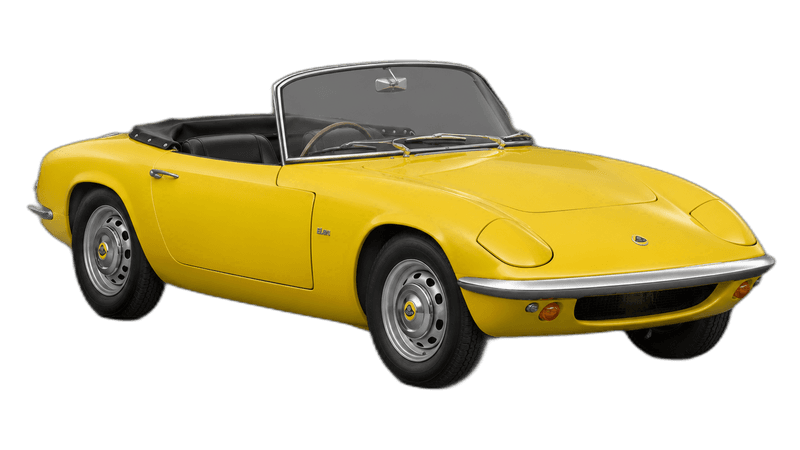
Lotus Elan S1
105bhp
Power
9s
0-100 km/h
181km/h
Top Speed
How hard it pulls.
Peak g-force the instant you bury the throttle, estimated from the car's 0–100 time and drivetrain.
Lotus Elan S1Estimated peak launch g from the 0–100 time and drivetrain: an honest approximation, not a measured figure.
The Lotus Elan S1 is a 2-door roadster by Lotus, with 105 bhp, 146 Nm of torque, a 0-100 km/h time of 9 seconds and a top speed of 181 km/h.
Dream Car Garage Editorial · Last updated 3 November 2026
Overview
We have not driven this car. This review is based on published specifications and the sources listed below.
Scope of this guide
This guide is scoped to the Lotus Elan S1, the first series of the two-seat Lotus roadster, which Lotus lists as Type 26 and dates 1962 to 1964. It is a front-engine, rear-wheel drive car with a Lotus twin-cam four-cylinder engine, a four-speed gearbox, a folded steel backbone chassis and a fibreglass body. It is not a guide to the later Series 2, Series 3, Series 4 or Sprint cars, nor to the Plus Two, which are different models with different figures.
We have not driven this model for this article. We are an editorial desk that reads sources, and everything below comes from pages we opened: the Lotus Cars heritage page, Wikipedia, a Goodwood Insurance buyer's guide, a Silodrome buying guide, a Lotus Marques history article and the Sportscar2 early Elan page. This is a classic collector car, and a guide like this cannot replace an inspection by a specialist who knows Elans. This page is for research, not a buying recommendation.
The figures at a glance
- Engine: 1.6L naturally aspirated inline-four, the Lotus twin-cam. The displacement we carry is 1,558 cc. The first few cars had 1,498 cc, which we explain below.
- Power: 105 bhp. Wikipedia quotes 105 bhp at 5,500 rpm from the pre-Sprint workshop manual for the standard car, and Silodrome and Sportscar2 also print 105 bhp for the 1600. The Lotus page prints 100 bhp in its Series 1 table.
- Torque: 146 Nm. Wikipedia and Silodrome both give 108 lb ft at 4,000 rpm, and we converted it at 1.3558 Nm per lb ft.
- 0-100 km/h: 9.0 seconds. Lotus's heritage text says 9 seconds to 100 kph, a whole number, and we show it as 9.0 seconds. Period road tests, which use 0-60 mph, are discussed below.
- Top speed: 181 km/h. The Lotus page gives 181 kph, and Wikipedia says Motor recorded 112.5 mph, which is about 181 km/h, for the 1600 in September 1964.
- Drive: rear-wheel drive, four-speed manual gearbox.
- Weight: 549 kg in the Lotus table. Other sources give different figures, shown below.
- Production: 848 cars in the Lotus Series 1 table.
- Price when new: Lotus says the component kit cost 1,095 pounds sterling.
Where the sources disagree
Power is the first disagreement. The Lotus Series 1 table says 100 bhp, but another sentence on the same page says the 1,558 cc engine could produce up to 108 bhp. Sportscar2 gives 100 bhp for the 1500 of 1962 and 105 bhp for the 1600 of 1963. Wikipedia lists 105 bhp for the pre-Sprint manual and a later revised manual figure of 90 bhp at 5,500 rpm, and it does not explain the gap, so we do not use the lower number. We carry 105 bhp because nearly every S1 had the 1,558 cc engine and three separate sources agree on 105 bhp for it. We treat 100 bhp as the figure for the very first 1,498 cc cars.
Acceleration disagrees more. Wikipedia reports 8.6 seconds to 60 mph for the 1964 Elan 1600 from the Zero to 60 Times site, and 9.0 seconds from Motor in September 1964, with 24.1 seconds to 100 mph. Silodrome says about nine seconds for the original S1 and S2 cars. Sportscar2 prints 7.0 seconds for the 1500 and 7.5 seconds for the 1600, and Goodwood prints 7.0 seconds to 62 mph for the later SE. A 0-60 mph time is not a 0-100 km/h time and we have not relabelled one. We keep the Lotus 9 seconds to 100 kph because it comes from the maker and is close to the Motor and Silodrome figures, but the faster Sportscar2 and Goodwood numbers show that period claims varied.
Top speed spans 109 mph (Sportscar2 for the 1500), 112 mph (Sportscar2 for the 1600), 112.5 mph (Motor), around 110 mph (Silodrome) and 115 mph (Goodwood, for the whole Elan range). We keep 181 km/h, which matches the maker and Motor.
Weight also varies. Lotus gives 549 kg. Wikipedia lists 640 kg from the workshop manual, 584 kg from Lotus marketing material and 572 kg measured in a 1964 Cars Illustrated test. We have not tried to settle this.
Production is uncertain too. Lotus gives 848 for the Series 1. Wikipedia reports an estimate of 900 for Series 1 output from Robinshaw and Ross. We carry the maker's 848 and flag it as one count among estimates.
Why the engine size matters: 1,498 cc or 1,558 cc
The car was first shown as the Elan 1500 at the Earls Court Motor Show in October 1962, according to Lotus Marques and Sportscar2. The 1,498 cc twin-cam was quickly replaced by the 1,558 cc version, and the car became the Elan 1600. Sources disagree on how many 1,498 cc cars were built: Silodrome and Wikipedia say 22, while Lotus Marques and Sportscar2 say the first 20. Lotus Marques says the engine change happened in early 1963, around when the first customer cars were delivered. Silodrome says owners could swap the 1,498 cc engine for the 1,558 cc unit free of charge, and suggests few if any cars kept the original engine. Lotus Marques says all early road cars were converted under that deal.
For the catalogue we recommend 1,558 cc and 105 bhp. That is the engine in almost all S1 cars, and the Lotus page itself gives a range of 1,499 cc to 1,558 cc. A genuine 1,498 cc car is a very small group, and we would treat any claim of one as something for a specialist and the factory records to confirm.
History and construction
Lotus lists the Series 1 as running from 1962 to 1964. The car was designed by Ron Hickman and John Frayling, per the Lotus page. Wikipedia says the Elan was Lotus's first road car with a steel backbone chassis and a fibreglass body, with the body bolted to the chassis at 16 points. Silodrome describes the backbone as folded mild steel with sixteen bolts, and Goodwood confirms a steel backbone chassis under fibreglass. Lotus Marques says the layout was light, rigid and relatively easy to make, and that the Elan was originally planned as a glassfibre monocoque.
Suspension used Lotus double wishbones at the front with Triumph-derived uprights and a Triumph steering rack. The rear used Ford Cortina struts adapted to a Chapman strut layout. Goodwood and Sportscar2 both state that the car had disc brakes all round. Wikipedia lists Girling discs, 9.5 inches at the front and 10.0 inches at the rear. Sportscar2 says Series 2 cars gained larger discs, and servo assistance arrived later with the Special Equipment car, not the Series 1.
Goodwood describes the Elan's pop-up headlights as vacuum-operated and sometimes troublesome. That is a comment on the Elan generally, and none of the sources we read talked about the S1 headlights specifically. The Series 2 and SE models arrived in November 1964, per Sportscar2, which ends the S1 run. First customer cars reached owners in early spring 1963, per Lotus Marques.
What to check before buying
- The chassis. Goodwood lists the backbone, suspension towers and the gearbox, engine and differential mounts as the corrosion areas. Silodrome adds the front and rear Y sections, the rear suspension turrets and tubes, and the torque rod mounts. Replacement galvanised backbones exist, per Goodwood, so ask whether the original has been replaced and by whom.
- The fibreglass. Silodrome says to look for cracking, crazing and poor repairs. Goodwood adds that the fibreglass body is largely free of the corrosion seen on most cars of the era, so the main body risk is damage and repair quality.
- Rotoflex couplings. Goodwood and Silodrome both mention the rubber driveshaft couplings, which need replacing and vary in quality. Goodwood says the bushings cause transmission wind-up.
- Cooling and the water pump. Both guides call the water pump and overheating a weak point. Silodrome gives oil pressure of about 20 psi at idle and 40 psi when driving, and says to check for oil in the coolant.
- Pop-up headlights. Check that they rise and fall smoothly together.
- Originality and identity. Silodrome says to verify documents and the chassis number, because a car can be altered to resemble a scarcer model. Goodwood notes that many Elans are modified.
- A specialist inspection. We cannot judge a car from a web page, and neither can you.
Running costs and known issues
None of our sources gave a service schedule, an annual running cost or a failure rate for the S1, so we give none. Goodwood says the use of mainstream parts in the Elan makes it relatively cost-effective to run and parts easy to source, but gives no figures. Treat any repair estimate that lacks a named source as a guess.
Recalls and safety
We found no recall notice for the Elan S1 in any page we read, and that is not a clean bill of health because we did not search a recall database. The car is light and has no modern crash structure, and we found no crash-test data. The one recall-like event we did read about is commercial: the earliest 1,498 cc cars were offered an engine swap, as described above.
Market and value notes
We have little price data. Sportscar2 says a 1964 Series 1 in very good condition was listed at about 22,000 pounds sterling or 35,000 US dollars, but the page is undated and we could not tell the year of that listing. Lotus says the component kit cost 1,095 pounds sterling when new. We searched for auction results, but the auction pages we tried to open returned no readable content, so we cite no sale prices. Originality strongly affects value, per Silodrome.
What we could not find
We did not find torque, a firm changeover date for the engine, or a verified S1 production count beyond the sources named above. We found no S1-specific statement on pop-up headlights; we read about them only for the Elan range. Hagerty and Autotrader pages returned a 403 error and we did not work around it. The Classic and Sports Car buyer's guide and an Iconic Auctioneers lot page returned empty content when we opened them, so we do not cite them. No source we read gave 5,700 rpm for the original 100 bhp rating. We found no running costs, recall data or crash data.
About the photograph
This page uses the catalogue photograph for the car. Its credit is listed on the credits page.
Verdict
The Elan S1 is a light, front-engine, rear-wheel drive roadster with a 1.6L naturally aspirated inline-four making 105 bhp and 146 Nm, a quoted 9.0 seconds to 100 km/h and a quoted 181 km/h. On the best evidence we found, 848 were built, and almost all ended up with the 1,558 cc engine. The practical advice from our reading is to have the backbone chassis, fibreglass, Rotoflex couplings and cooling system inspected, to verify documents and chassis numbers, and to expect that sources will disagree on the exact figures. We have not driven it, so use the sources, the seller's records and an independent specialist inspection to decide.
Specifications
Engine
1.6L naturally aspirated inline-four
Displacement
1.6L
Power
105 bhp
Torque
146 Nm
0-100 km/h
9s
Top Speed
181 km/h
Drivetrain
RWD
Country
United Kingdom
Body Style
2-door roadster
Years
1962–1964
Production
848
Specifications are manufacturer-published figures.
More from Lotus
Frequently Asked Questions
What are the specifications of the Lotus Elan S1?
The Lotus Elan S1 is a 2-door roadster by Lotus, with 105 bhp, 146 Nm of torque, a 0-100 km/h time of 9 seconds and a top speed of 181 km/h.
How many Lotus Elan S1 were made?
Lotus produced 848 units of the Lotus Elan S1.
What drivetrain does the Lotus Elan S1 use?
The Lotus Elan S1 is configured with rear-wheel drive.
What type of car is the Lotus Elan S1?
The Lotus Elan S1 is a sports cars manufactured by Lotus in United Kingdom. Production ran from 1962 to 1964.