
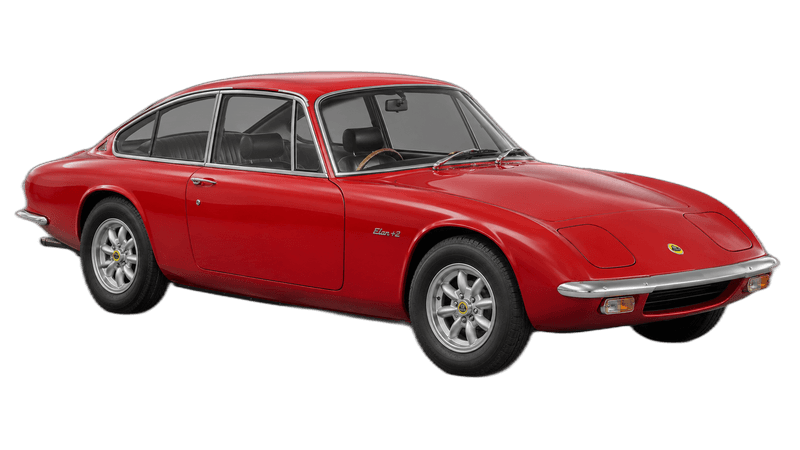
Lotus Elan +2
118bhp
Power
193km/h
Top Speed
The Lotus Elan +2 is a 2-door coupé by Lotus, with 118 bhp, 152 Nm of torque and a top speed of 193 km/h.
Dream Car Garage Editorial · Last updated 3 November 2026
Overview
We have not driven this car. This review is based on published specifications and the sources listed below.
Scope of this guide
This guide is scoped to the Lotus Elan +2, the longer, wider two-plus-two coupé that Lotus built at Hethel in Norfolk from 1967 until production ended in December 1974. It is a front-engine, rear-wheel drive car with a fixed roof, a fibreglass body on a steel backbone chassis and a 1.6 litre Lotus twin-cam engine. It is not a guide to the two-seat Elan roadster or the two-seat Elan coupé, which share a name and an engine family but are a different, smaller car. Where we talk about later +2S, +2S 130 and +2S 130/5 cars, we say so, because they are changes within the same model line.
We have not driven this model for this article. We are an editorial desk that reads sources, and everything below comes from pages we opened: the lotuselan.net overview and Type 50 pages, the Lotus Driver's Guide genealogy page, sportscar2.com, the auto-data.net specification page, an Aguttes auction listing for a 1972 car, Wikipedia and a 2021 forum post on emiraforum.com. This page is for research, not a buying recommendation, and it cannot replace an inspection by a specialist who knows these cars.
The figures at a glance
- Engine: 1.6L naturally aspirated inline-four. It is the 1,558 cc Lotus twin-cam with two overhead camshafts, shared with the Elan, and auto-data.net lists it as a four-cylinder inline, DOHC, naturally aspirated engine of 1,558 cm3.
- Power: 118 bhp. Sportscar2.com prints 118 bhp for the +2, the Aguttes listing prints 118 hp for the first +2 and lotuselan.net says about 118 hp for the base car. Auto-data.net prints 118 Hp at 6,250 rpm; it does not say whether that is PS or bhp, and if it were metric horsepower the conversion (PS multiplied by 0.98632) would give about 116 bhp. We use 118 bhp because the only source that labels the unit prints bhp, and the same figure is used everywhere below. Other sources give a different figure, see the next section.
- Torque: 152 Nm. Auto-data.net prints 152 Nm at 4,600 rpm. Sportscar2.com prints 112 lb-ft, which is 151.9 Nm using the conversion lb-ft multiplied by 1.35582, so the two sources agree once the units are converted.
- 0-100 km/h: no figure shown. The sources we read give 0-60 mph, not 0-100 km/h, and a 0-60 mph time is not a 0-100 km/h time, so we do not convert it or relabel it. Sportscar2.com, Wikipedia and auto-data.net give 7.9 seconds to 60 mph.
- Top speed: 193 km/h. Auto-data.net prints 193 km/h (120 mph), and sportscar2.com and Wikipedia print 120 mph, which is 193.1 km/h using the conversion mph multiplied by 1.60934.
- Drive: rear-wheel drive with a four-speed manual gearbox on early cars and a five-speed on the last cars.
- Dimensions: wheelbase 2,438 mm, length 4,293 mm, width 1,676 mm, height 1,194 mm, as printed by Wikipedia and auto-data.net.
- Weight: Wikipedia gives approximately 1,960 lb, which is about 889 kg (pounds multiplied by 0.45359). Auto-data.net gives a range of 853 to 946 kg.
- Fuel use: auto-data.net prints 10.9 L/100 km combined, which is a database figure rather than a test result.
Where the sources disagree
We say where sources disagree and which we chose. On power, the numbers range from 108 to 126 bhp. Wikipedia prints 108-126 bhp net depending on the model, lotuselan.net says between 118 and 126 horsepower, with the big-valve +2S 130 at 126, and the Lotus Driver's Guide lists the first +2 at 115 bhp and the whole +2S family at 118-126 bhp. We chose 118 bhp because three sources give it for the original +2 and it is also the figure we carried before. A later +2S 130 had more.
On top speed, sportscar2.com has a technical table that says 120 mph and 7.9 seconds to 60 mph, but one of its photograph captions says 118 mph and 8.9 seconds for the same engine. We take the technical table and treat the caption as a typing slip, but we cannot prove that. Lotuselan.net says 0-60 mph in 8 to 9 seconds depending on engine specification and a top speed of over 120 mph for the higher-performance variants. Wikipedia adds 0-100 mph in 21.8 seconds.
Our earlier data gave 185 km/h. None of the pages we read prints that figure. The only figures we found are 193 km/h and 120 mph, so we replace it.
On the end of production, lotuselan.net and the Lotus Driver's Guide put the end at December 1974. Sportscar2.com says the car was phased out in 1975 and replaced by the Eclat, and Wikipedia says it was produced until 1975. We use 1974, because the factory chassis timeline on lotuselan.net ends with the last cars in December 1974 and the 1975 dates may reflect the replacement model arriving. Treat the exact end as uncertain.
History and variants
The +2 was Lotus type 50. Lotuselan.net dates its introduction to September 1967 (chassis 50/0001) while sportscar2.com says August 1967, so the car was launched around late summer 1967. The Lotus Driver's Guide says the first examples were sold as kits. A federal version for the United States became available in March 1968 and in all markets from April 1968, according to lotuselan.net.
The +2 was the Elan stretched into a four-seat grand tourer. Sportscar2.com says it was two feet longer, ten inches wider and 340 pounds heavier than the standard Elan, and the Aguttes listing says the body was 60 cm longer and 26 cm wider than the two-seater's, with a stated drag coefficient of 0.30. Wikipedia says the two rear seats are small and suitable for children. It used a backbone chassis with double wishbone front suspension and Chapman strut rear suspension, with disc brakes on all four wheels, per lotuselan.net and Wikipedia. Sportscar2.com lists wind-up windows, carpets, a heater and a wooden fascia, which supports the idea that the +2 was the more refined Elan.
The main changes over the run were these:
- +2S, March 1969 per lotuselan.net and Aguttes, April 1969 per sportscar2.com and 1968 per Wikipedia and the Lotus Driver's Guide. The sources disagree on the date. It brought upgraded upholstery and electric windows (lotuselan.net), fog lamps, reversing lights and a heated rear window (Aguttes), and black and chrome wheels (Lotus Driver's Guide). A federal +2S followed in November 1969.
- A new chassis numbering system began in January 1970, with suffix letters for UK, export and federal cars, as lotuselan.net records.
- +2S 130, February 1971 per lotuselan.net, January 1971 per Aguttes. It used the big-valve twin-cam, rated 126 bhp by lotuselan.net and Aguttes, and added alloy wheels and unique badging. The Lotus Driver's Guide says it can be identified by a silver flake roof.
- +2S 130/5, October 1972. A five-speed gearbox was optional, which Wikipedia says was based on an Austin Maxi unit and which improved high-speed cruising.
- A commemorative John Player Special coloured +2 marked the 50th Grand Prix victory, and the Lotus Driver's Guide says 50 were made in 1973.
On gearboxes the sources are not tidy. Aguttes says the first +2 used a four-speed derived from the Ford Corsair 2000E, while sportscar2.com says the +2S used a four-speed from the Maxi. We cannot reconcile those, so we do not say more.
How many were built
Production figures vary widely, and we could not find a single authoritative count in the pages we read. The Aguttes listing says 5,168 coupé +2 cars were built between 1967 and 1974 according to Lotus factory figures, with 579 of them built in 1972. The Lotus Driver's Guide gives 1,562 original +2 cars and 3,576 of the +2S family, which adds up to 5,138. Wikipedia estimates about 5,200 and mentions a figure of 3,300 from John Bolster's guide. Sportscar2.com says a further 5,200 +2 cars were built alongside 12,224 Elans, and lotuselan.net says reported output varies between 4,526 and 5,228, with about 4,600 the commonly cited figure and notes that records were not carefully kept. The 5,168 figure is the only one attributed to the factory, but the sources disagree, so we show no production figure in the catalogue.
Wikipedia also says fewer than 1,200 remain on the road and that a voluntary registry listed about 330 +2 cars as of April 2018. That is a registry count, not a census.
What to check before buying
The only buying specifics we read come from one forum post on emiraforum.com, written in 2021 by an owner. It is a single person's view, not a survey or a maker document, and it may be dated.
- Chassis. The post says most cars now run on replacement chassis, that the Spyder chassis is an acceptable alternative, and that some original chassis have been repaired or strengthened. So ask which chassis is fitted and who made it.
- Body. The body is fibreglass, and the post warns of potential for osmosis and stress cracks. It advises looking for a restoration that is at least two years old, with receipts, so any flaws have had time to show. It also notes the body can be removed from the chassis.
- Engine. The twin-cam is often rebuilt at some point, so check the history. Small oil leaks are described as common, and anything more serious needs budget.
- Gearbox. Earlier cars have four speeds and later cars five.
- Electrics and interior. Original wiring and earthing can cause trouble, so check the electric windows and heater, and note that many owners swap the vacuum system that lifts the headlights for an electric one. Wooden dashboards are prone to varnish cracks.
- Brakes. The author removed the servo from his own car, which changes how it brakes, so find out what the car you are looking at has.
Prices quoted by that same 2021 post, which are old by now: about 25,000 pounds privately for a restored, good, reliable car with dealers asking 5,000 pounds or more above that, 40,000 pounds or more for concours condition, and about 12,000 pounds for a running restoration project. The author's own car had twin Dellorto carburettors and produced 140 bhp on a rolling road, which is a modified example and well above the figure we use. The post also says paying someone else to restore a car usually means you will not recover the cost, and a proper body restoration can cost 10,000 pounds or more.
Market and value notes
The only sale result we read is the Aguttes listing for a 1972 car, chassis 500014M, with a French registration title and no roadworthiness certificate. Its estimate was 10,000 to 20,000 euros with no reserve, and it sold for 16,290 euros including fees. The listing says the car needed an easy restart from its future owner. The page we read did not show the sale date, so we cannot say how current that result is. We give no valuation of our own.
What we could not find
We found no torque curve from a maker, and no figure shown for 0-100 km/h in any source, so the catalogue should not carry a 0-100 km/h time for this model. We found no weight figure for the standard Elan to compare, and no wheelbase for it either. The Classic and Sports Car guide pages returned no readable content when we asked for them, an Honest John review link redirected to a different site, and Classics World returned a forbidden error, so we did not use any of them and did not work around it. We found no recall information and no crash-test data, and no running costs or failure rates beyond the single forum post above. Anyone quoting repair costs or failure rates without a source is guessing.
About the photograph
This page uses the catalogue photograph for the car. Its credit is listed on the credits page.
Verdict
The Elan +2 is a front-engine, rear-wheel drive 2+2 coupé with a 1.6L naturally aspirated inline-four making 118 bhp and 152 Nm, quoted at 193 km/h and 7.9 seconds to 60 mph, in a fibreglass body weighing roughly 889 kg. It was the Elan made longer, wider and more comfortable, and the sources agree on that, but they disagree on power across the run, on dates, and on how many were built. Treat every number here as a published claim rather than a test result. We have not driven it, so use the sources, the seller's records and an independent specialist inspection to decide.
Sources
- lotuselan.net: Lotus Elan +2 overview
- lotuselan.net: Lotus Type 50 (chassis timeline)
- Lotus Driver's Guide: Elan +2 genealogy
- sportscar2.com: The Early Lotus Elan Sports Car
- auto-data.net: Lotus Elan 2 (Type 50) 1.6 118 hp
- Aguttes: 1972 Lotus Elan +2 auction listing
- Wikipedia: Lotus Elan
- emiraforum.com: Lotus Elan Plus 2, insight to buying and owning
Specifications
Engine
1.6L naturally aspirated inline-four
Displacement
1.6L
Power
118 bhp
Torque
152 Nm
Top Speed
193 km/h
Drivetrain
RWD
Country
United Kingdom
Body Style
2-door coupé
Years
1967–1974
Specifications are manufacturer-published figures.
More from Lotus
Frequently Asked Questions
What are the specifications of the Lotus Elan +2?
The Lotus Elan +2 is a 2-door coupé by Lotus, with 118 bhp, 152 Nm of torque and a top speed of 193 km/h.
What drivetrain does the Lotus Elan +2 use?
The Lotus Elan +2 is configured with rear-wheel drive.
What type of car is the Lotus Elan +2?
The Lotus Elan +2 is a sports cars manufactured by Lotus in United Kingdom. Production ran from 1967 to 1974.