
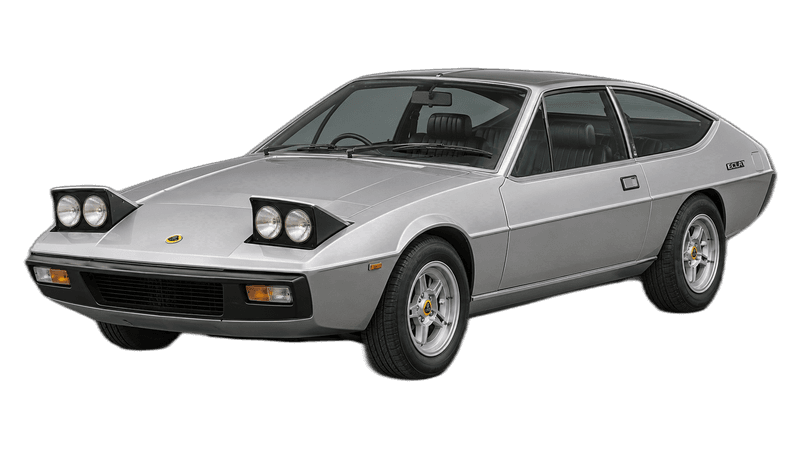
Lotus Eclat
160bhp
Power
203km/h
Top Speed
The Lotus Eclat is a 2-door coupé by Lotus, with 160 bhp, 190 Nm of torque and a top speed of 203 km/h.
Dream Car Garage Editorial · Last updated 3 November 2026
Overview
We have not driven this car. This review is based on published specifications and the sources listed below.
Scope of this guide
This guide is scoped to the Lotus Eclat, the fastback 2+2 coupe that Lotus built at Hethel in Norfolk from 1975 to 1982. It is a front-engine, rear-wheel drive car with a steel backbone chassis and a glass-fibre body, and the specification figures below are those of the Series 1 car (Type 76) with the 2.0L Lotus 907 engine, because that is the version the catalogue entry describes. The later Series 2 car (Type 84) with the 2.2 litre 912 engine is covered where our sources describe it, but its figures are not the headline numbers here. The Eclat is not the same car as the Lotus Elite of 1974 that it was based on, and it is not the later Excel that grew out of it.
We have not driven this model for this article. We are an editorial desk that reads sources, and everything below comes from pages we opened: the Lotus Cars heritage page for the Eclat, sportscar2.com, Wikipedia (the Eclat article and the Lotus 907 engine article), motor-car.net, a June 1977 road test in Motor Sport magazine, oldmotors.net, a dealer page at Beverly Hills Car Club and the spec database auto-data.net. This guide is for research, not a buying recommendation, and it cannot replace an inspection by a specialist who knows Lotus steel chassis cars.
The figures at a glance
- Engine: 2.0L naturally aspirated inline-four. This is the Lotus 907, an aluminium twin-cam 16-valve engine of 1,973 cc that is which is the engine commonly called a slant-four. Wikipedia's engine article says Lotus negotiated to buy Vauxhall cast-iron blocks, whose bore centres matched Lotus's proposed ones, and describes the 907 as the first production version of the Lotus 900 series. The Series 2 car instead used the 2,174 cc Lotus 912 (sportscar2.com prints 2,173 cc).
- Power: 160 bhp. The Lotus Cars page lists 160bhp for the Series 1, and the 1977 Motor Sport test prints a claimed 160 bhp at 6200 rpm. Wikipedia prints 160 hp (120 kW). The spec database auto-data.net prints 162 hp for the 2.0 litre car, a third slightly different rating. Sportscar2.com prints 155 bhp for the Series 1 and 160 bhp for the Series 2, and the 907 engine page at motor-car.net prints 140 hp DIN at 6,500 rpm, with Wikipedia's engine article saying about 144 bhp for the engine in most markets. These are different ratings of different states of tune and market, not one number. We use 160 bhp because the maker page and the period test agree on it and it is the figure that goes with the Eclat itself.
- Torque: 190 Nm. Motor Sport prints a claimed 140 lb ft at 4,900 rpm. Multiplying by 1.35582 gives 189.8 Nm, which we round to 190 Nm. Sportscar2.com prints 130 lb-ft for the Series 1 (about 176 Nm) and motor-car.net prints 130 lb ft DIN at 5,000 rpm for the engine alone. The sources disagree; we chose the figure printed beside the 160 bhp claim in the road test.
- 0-100 km/h: no figure shown. The sources we read give 0-60 mph, not 0-100 km/h, and a 0-60 mph time must not be relabelled. Motor Sport measured 7.4 seconds to 60 mph, quoting Lotus's own claim of 7.9 seconds, while sportscar2.com and auto-data.net print 7.8 seconds to 60 mph.
- Top speed: 203 km/h. Motor Sport reported about 126 mph in fifth gear, and sportscar2.com prints 126 mph for the Series 1. Converting 126 mph at 1.60934 gives 202.8 km/h, which we round to 203 km/h. Sportscar2.com prints 132 mph (about 212 km/h) for the Series 2.
- Drive: rear-wheel drive, with a front-engine layout. Sportscar2.com calls it front-engined and rear-drive.
- Gearbox: four-speed (Ford-derived) or five-speed manual on early cars, a Getrag five-speed on later ones, and a three-speed automatic as an option, according to Wikipedia. The Lotus page lists a four-speed for the Series 1 and a five-speed for the Series 2.
- Weight: the Lotus page gives 980 kg for the Series 1 and 1,152 kg for the Series 2. Wikipedia gives a kerb weight of 1,055 kg. Motor Sport says the Sprint test car weighed over 21 cwt (about 2,350 lb), roughly two hundred pounds less than an equivalent Elite. The sources do not agree, and the lower figure may be a dry or maker figure rather than a kerb weight.
- Size: Wikipedia gives 4,458 mm long, 1,816 mm wide, 1,194 mm high and a wheelbase of 2,438 mm. Motor Sport gives a wheelbase of 97.75 in, which is longer than Wikipedia's 96.0 in, so the wheelbase also differs by source.
How the sources disagree on production and dates
The Lotus Cars page says 1,299 Series 1 cars (1975 to 1980) and 223 Series 2 cars (1980 to 1982) were built, which adds up to 1,522 for the whole run. Wikipedia says the Series 1 was announced in October 1975 and approximately 1,500 were produced, and also says 223 of the later 2.2 cars were built. Sportscar2.com instead gives a per-year table that sums to 1,114 across 1975 to 1982, with 16 built in 1975, 212 in 1976, 133 in 1977, 258 in 1978, 232 in 1979, 95 in 1980, 25 in 1981 and 143 in 1982. That is a long way from the maker's number and we do not know why. We did not find one printed total for the whole Eclat in any single source, only the two Lotus figures that we added ourselves, so we show no production figure in the catalogue.
On dates, Wikipedia and the Lotus page both date the car to 1975, and oldmotors.net says it was shown at the Paris Motor Show in October 1975. Sportscar2.com says the Series 1 was introduced in 1974, which fits the idea that the Eclat was planned alongside the Elite, but also says the car launched in October 1975. We use 1975 to 1982 for the run.
History and design
The Eclat began life as the Elite Coupe. Wikipedia says it was announced in October 1975 as the Series 1 and was designed by Oliver Winterbottom, who had also drawn the Elite. The Lotus page says Winterbottom extended the angular profile of the Elite into a fastback coupe, and that founder Colin Chapman wanted more practical sports cars for everyday and grand touring use rather than outright track performance. The lower half of the glass-fibre body matched the Elite, per Wikipedia, but the Eclat offered more luggage space at the cost of rear headroom. Sportscar2.com describes it as a three-door, 2+2 fixed-head fastback coupe, which means the rear is a tailgate and not a separate boot lid. The Lotus page also refers to the tailgate when it describes a new external locking catch on the Series 2. Oldmotors.net calls it an entry-level, cheaper, lighter and more accessible version of the Elite, priced typically 10 to 15 percent below it and weighing roughly two hundred to three hundred lb less. In North America, according to Wikipedia, it was sold as the Lotus Sprint.
Variants and what changed over the run
Series 1 cars carried a code number that described the equipment. Wikipedia says the 520 had a four-speed gearbox, smaller brakes and steel wheels, the 521 added Elite-style disc brakes, GKN alloy wheels and a twin exhaust, the 522 added power steering, the 523 added air conditioning, and the 524 was a 523 with automatic transmission. Oldmotors.net gives a similar ladder but says the five-speed gearbox came with the 521, while sportscar2.com says the 522 is the one with a five-speed gearbox from the Austin Maxi and air conditioning. The three sources do not match, so anyone checking a particular car should rely on its documents and a specialist, not on a code number alone.
The Eclat Sprint was a sporty Series 1 package. Motor Sport's 1977 test of the Sprint says the pack cost 298.35 pounds as a factory option on the 520 and 521, and that the 521 cost 8,316 pounds before the pack. It describes a black and white finish that divided opinion, while the Lotus page describes the Sprint as an S1 with Union Jack colours on the rear quarter panels, so those two sources describe its look differently.
The Series 2 or Type 84, sold from 1980, used the 2,174 cc Lotus 912 engine. Sportscar2.com says it ran a 9.4:1 compression ratio with Dell'Orto DHLA 45 carburettors and that the 912 made 160 bhp against 155 bhp for the 907 because of US emissions rules. Wikipedia says power stayed at 160 hp but torque increased, and the Lotus page says the extra torque across more of the engine's range improved fuel economy as petrol prices rose. The Lotus page also lists a smoother front spoiler, new sills, electric instead of vacuum pop-up headlamp operation and a five-speed gearbox. Wikipedia reports that the Series 2 had a Getrag five-speed. The 2.2 Riviera, announced in December 1981 per the Lotus page, added a removable roof panel and other equipment, and Wikipedia says 73 of the 223 Series 2 cars were Rivieras. The Eclat then developed into the Excel, which Wikipedia says kept the engine but gained a modified chassis, new bodywork and a Toyota gearbox, driveline and brakes.
What a period road test said
We found one period road test we could read, a Motor Sport piece from June 1977 on the Sprint. Its author called the engine smooth, quick to start and free of flat spots, praised the gear change and low-speed flexibility, and described handling as agile and neutral with strong grip, though the rear broke away easily on wet roads. The brakes were called excellent, though the pedal felt soft at times. The ride was firmer and choppier than the Elite's but still comfortable, wind noise was almost absent and the glass-fibre body damped road noise well. Against that, the heater was not especially powerful, the high rear window sill hampered rear vision, the pedals were small and close together, and the author said some of the detail finish was not up to the price. Fuel economy under hard driving was 20 to 21 mpg, with 25 mpg expected on a touring run from a 14.75-gallon tank. The same piece mentions a reader's letter about Lotus quality and reliability problems, which is one owner's account and not a failure statistic. That is one writer's view of one car in 1977, and it is not a substitute for a current inspection.
What to check before buying
Sportscar2.com, Wikipedia and the Beverly Hills Car Club page agree on the main issue, so the first check is the chassis.
- Chassis corrosion. The original mild steel chassis had a felt strip between the chassis and the body. Sportscar2.com says this held moisture in damp climates and sped up corrosion of the steel chassis, and Wikipedia says it caused rear corrosion. Both say a chassis replacement was expensive, which hurt resale values. The Beverly Hills Car Club page calls structural corrosion a known issue and says many owners have fitted galvanised replacements, so ask whether this has been done.
- Series 2 cars. Wikipedia and sportscar2.com both say the later cars came with a galvanised chassis as standard. The Lotus page does not mention this, so treat it as reported by two sources.
- Identity. Ask which series and which code the car is, since the Series 1 and Series 2 have different engines (907 and 912) and the sources disagree on what each code number included.
- Documentation. Ask for the service history and for any record of chassis work. We found no maker service schedule.
- Equipment. Power steering and air conditioning were options according to Wikipedia and the Beverly Hills Car Club page, so check that what is fitted matches the paperwork.
- A classic Lotus expert. The dealer page itself advises having an expert confirm the price and check for hidden damage that could be expensive to repair.
Running costs and known issues
We found no source giving servicing prices, engine rebuild intervals or failure rates for the Eclat, so we give none. The only running figures we found are the 1977 fuel figures above. Sportscar2.com and the dealer page flag the chassis and its felt strip as the known weak point. Anyone quoting repair costs or failure rates without a source is guessing, and we did not read a page that gave us a chassis replacement cost we could cite.
Recalls and safety
We found no recall notice for the Eclat in any page we read, but that is not a clean bill of health, because we did not search a recall database. We found no crash-test result and no safety-equipment list for this model. Owners should ask a specialist and the relevant national authority.
Market and value notes
We found no current sale prices or valuations that we could cite with a date. Motor Sport gives 1977 new prices: 8,316 pounds for a 521, and 10,108 pounds for the Elite 503, up from 6,674 pounds in 1975, against 8,182 pounds for a Jaguar 4.2C and 9,999 pounds for the cheapest Porsche 911 in the same piece. Those are period list prices, not values today. Sportscar2.com gives a range of used values but does not date it, so we do not repeat it as a valuation. Oldmotors.net says good Eclats are very rare now, but that is an opinion from one site and not a market statistic.
What we could not find
We found no figure shown for 0-100 km/h in any source we could read, so the catalogue figure for that is empty. We also found no single printed production total for the whole Eclat, only the Lotus page's Series 1 and Series 2 numbers, so no production total is shown. The Classics World buyer's guide, auto.ae, fastcarcheck.uk, the Classic Car Weekly page on PressReader and encycarpedia.com returned forbidden errors, a Brightwells auction page returned not-found, an H&H auction lot page returned a browser verification screen, and the Hagerty valuation page asked us to log in; we did not work around any of these. We found no torque curve, no running costs, no failure rates and no recall data.
About the photograph
This page uses the catalogue photograph for the car. Its credit is listed on the credits page.
Verdict
The Eclat is a front-engine, rear-wheel drive 2+2 fastback built from a steel backbone and a glass-fibre body, with a 2.0L naturally aspirated inline-four rated at 160 bhp and 190 Nm in its Series 1 form, a quoted 203 km/h and a time to 60 mph of between 7.4 and 7.8 seconds depending on the source. It was designed as a more practical and cheaper alternative to the Elite, and the one period test we read liked the way it drove. The best documented weakness is the original chassis. The numbers differ between sources, especially for torque, weight and production, so treat them as published claims rather than test results. We have not driven it, so use the sources, the seller's records and an independent specialist inspection to decide.
Sources
- Lotus Cars: Eclat (Lotus story, road cars)
- sportscar2.com: The Lotus Eclat Sports Car
- Wikipedia: Lotus Eclat
- Wikipedia: Lotus 907
- motor-car.net: Lotus 907 engine
- Motor Sport magazine, June 1977: Road Impressions (Eclat Sprint)
- Old Motors: Lotus' New Looks, 1976 Lotus Eclat
- Beverly Hills Car Club: 1979 Lotus Eclat
- auto-data.net: Lotus Eclat 2.0 (162 hp)
Specifications
Engine
2.0L naturally aspirated inline-four
Displacement
2.0L
Power
160 bhp
Torque
190 Nm
Top Speed
203 km/h
Drivetrain
RWD
Country
United Kingdom
Body Style
2-door coupé
Years
1975–1982
Specifications are manufacturer-published figures.
More from Lotus
Frequently Asked Questions
What are the specifications of the Lotus Eclat?
The Lotus Eclat is a 2-door coupé by Lotus, with 160 bhp, 190 Nm of torque and a top speed of 203 km/h.
What drivetrain does the Lotus Eclat use?
The Lotus Eclat is configured with rear-wheel drive.
What type of car is the Lotus Eclat?
The Lotus Eclat is a sports cars manufactured by Lotus in United Kingdom. Production ran from 1975 to 1982.