
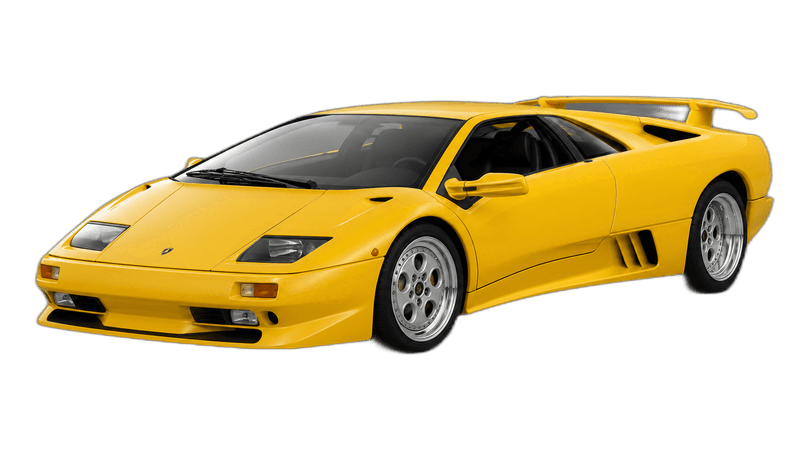
Lamborghini Diablo SV
£350,000
usedIndicative market price, updated periodically.
523bhp
Power
3.8s
0-100 km/h
320km/h
Top Speed
£350,000
Price Used
How hard it pulls.
Peak g-force the instant you bury the throttle, estimated from the car's 0–100 time and drivetrain.
Lamborghini Diablo SVEstimated peak launch g from the 0–100 time and drivetrain: an honest approximation, not a measured figure.
The Lamborghini Diablo SV is a 2-door coupe by Lamborghini, with 523 bhp, 580 Nm of torque, a 0-100 km/h time of 3.8 seconds and a top speed of 320 km/h. Indicative used value: approximately £350,000. Actual values vary with specification, condition and history.
Dream Car Garage Editorial · Last updated 29 October 2026
Overview
We have not driven this car. This review is based on published specifications and the sources listed below.
The last old-school Lamborghini flagship
The Lamborghini Diablo was launched in 1990 at the Hotel de Paris in Monte Carlo, the last car developed under the Mimram family and the last supercar to wear pop-up headlights before legislation closed that era. Its V12 traces a continuous line back through the Countach to the Miura: a sixty-degree, longitudinally mounted all-alloy unit with chain-driven double overhead camshafts on each bank, here in 5,707 cc form. The catalogue records 523 bhp, 580 Nm, a run to 100 km/h in 3.8 seconds and a 320 km/h maximum, sent to the rear wheels through a five-speed transaxle. The SV, or Sport Veloce, was the rear-drive derivative with a pronounced rear wing and a character some way sharper than the all-wheel-drive VT that arrived in 1993.
We have not driven this model for this article. This desk-researched ownership guide relies on Lamborghini's official Diablo history page, the PistonHeads Lamborghini Diablo used buying guide and the DVSA vehicle recall service. The PistonHeads guide covers the Diablo range including the SV rather than the SV alone, so its observations are inspection prompts for the individual example, not predictions that every SV will behave the same way.
What the SV is and how it differs
Where the VT added a viscous all-wheel-drive system that lightened the clutch and could send up to forty percent of torque forward, the SV kept the pure rear-drive layout and the heavier single dry-plate clutch of the early cars. It also kept the drama: no sequential gearbox was ever offered, so every gear change is a deliberate mechanical act. The SV's wing is its signature and its most copied detail; cars missing it or wearing non-standard replacements deserve questions about their history. The power figure quoted here sits at the top of the 5.7-litre SV range; the 6.0-litre evolution of 2000 is a different car and should not be conflated with the original SV.
The V12 and the gearbox
The V12 is an evolution of the Countach unit with electronic fuel injection from launch. It is robust in its fundamentals but demands respect: oil level matters because the pump can fail when the sump runs low, and the catalytic converters of restricted-market cars were known to break up and damage internals, which is one reason so many Diablos wear aftermarket exhaust systems. The dry-sump lubrication and chain drive are service items rather than weaknesses if the schedule is kept.
The gearbox defines the ownership experience. The single-plate clutch is heavy and wears on a rhythm measured in the low thousands of miles for enthusiastic drivers; gentle use stretches it considerably. Clutch slave cylinders fail around the twelve-thousand-mile mark on many cars, and the gear lever itself can snap on early examples. The starter motor works hard against high compression and is routinely abused; replacements are engine-out on most ramps, so a car that cranks slowly or fires reluctantly is telling you something. None of this is exotic by Diablo standards, but it is all priced into the ownership budget.
Chassis, cooling and the details that matter
The square-tube spaceframe and composite body are straightforward compared with modern cars, and the SV's hydraulic steering is unassisted and heavy at parking speeds. Cam-chain tensioners deserve specific attention: pre-1994 cars carried hydraulic tensioners that could tighten until the chain snapped, and the manual-adjustment conversion of 1994 is a known and desirable update. Confirm which type the car has and whether the work was done. Cooling is conventional but marginal when neglected; electric fans, hoses and the radiator all age, and an engine that runs hot in traffic will not be cheap to ignore.
Cabin and daily realities
The interior is the clearest reminder that the SV predates the modern supercar. The pedal offset carried over from the Countach, the air conditioning struggles on a hot day, and rearward visibility is a theory rather than a fact. Yet the driving position is commandingly good once settled, the scissor-door ritual never wears thin, and the unassisted rack communicates honestly at speed. Owners tend to describe the SV as demanding in town and deeply satisfying on the right road, which is precisely the trade the last analog flagships asked of their drivers.
Buying and values
The Diablo market rewards originality and documented history. Production records for the SV specifically are incomplete, but the range total of under three thousand cars across all variants keeps supply genuinely scarce. Values have firmed as the last analog supercar generation has been reassessed, though no trajectory is guaranteed; the SV sits below the earliest Countach values but well above where it rested a decade ago. The buying discipline is consistent: verify the chain-tensioner status, budget for clutch and gearbox work with the same realism you would apply to tyres, and walk away from cars with unexplained electrical or oil-consumption histories. A specialist inspection is the price of admission, and it is cheaper than the first three months of deferred maintenance.
We have not driven this model for this article. No present valuation, investment assurance or universal failure rate is offered. The Diablo SV's value as an ownership proposition is that it is the most honest expression of the original Diablo formula: rear drive, a huge wing, a clutch that keeps you honest and a V12 with half a century of Lamborghini behind it. Buy on mechanical health and honest history, and the theatre comes included. Few cars of its era ask so plainly whether the driver is as committed as the machine, and fewer still reward that commitment so directly.
Specifications
Engine
5.7L (5707 cc) naturally aspirated V12 petrol
Displacement
5.7L
Power
523 bhp
Torque
580 Nm
0-100 km/h
3.8s
Top Speed
320 km/h
Drivetrain
RWD
Country
Italy
Body Style
2-door coupe
Years
1996–1999
Price Used
£350,000
Specifications are manufacturer-published figures.
More from Lamborghini
Frequently Asked Questions
What are the specifications of the Lamborghini Diablo SV?
The Lamborghini Diablo SV is a 2-door coupe by Lamborghini, with 523 bhp, 580 Nm of torque, a 0-100 km/h time of 3.8 seconds and a top speed of 320 km/h. Indicative used value: approximately £350,000. Actual values vary with specification, condition and history.
How much does a Lamborghini Diablo SV cost?
Indicative used value: approximately £350,000. Actual values vary with specification, condition and history.
What drivetrain does the Lamborghini Diablo SV use?
The Lamborghini Diablo SV is configured with rear-wheel drive.
What type of car is the Lamborghini Diablo SV?
The Lamborghini Diablo SV is a supercars manufactured by Lamborghini in Italy. Production ran from 1996 to 1999.