
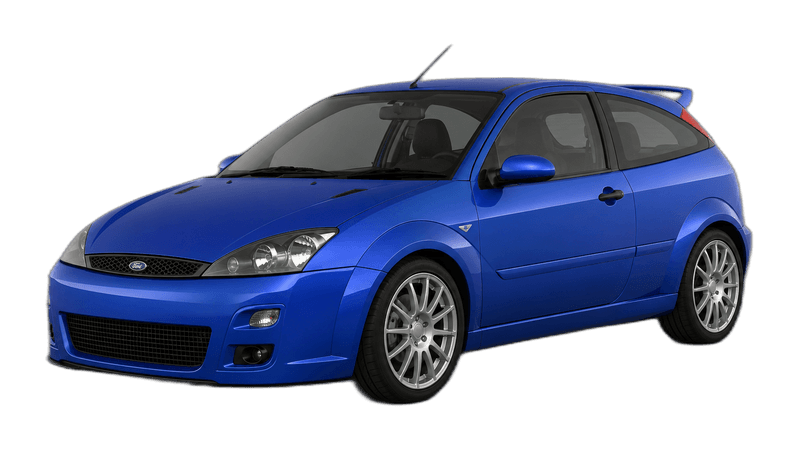
Ford Focus RS (Mk1)
£22,000
usedIndicative market price, updated periodically.
212bhp
Power
5.7s
0-100 km/h
230km/h
Top Speed
£22,000
Price Used
How hard it pulls.
Peak g-force the instant you bury the throttle, estimated from the car's 0–100 time and drivetrain.
Ford Focus RS (Mk1)Estimated peak launch g from the 0–100 time and drivetrain: an honest approximation, not a measured figure.
The Ford Focus RS (Mk1) is a 4/5 seater hatchback by Ford, with 212 bhp, 310 Nm of torque, a 0-100 km/h time of 5.7 seconds and a top speed of 230 km/h. Indicative used value: approximately £22,000. Actual values vary with specification, condition and history.
Dream Car Garage Editorial · Last updated 30 October 2026
Overview
We have not driven this car. This review is based on published specifications and the sources listed below.
The Focus RS Mk1 gave Ford a serious hot-hatch reset
The Ford Focus RS Mk1 is a compact, front-wheel-drive hot hatch from the early 2000s, but it has the feel of a limited-run machine because it was one. Our catalogue uses the 2002–2003 production window: a 1988 cc 2.0-litre turbo inline-4 with 212 bhp, 310 Nm, 0 to 100 km/h in 5.7 seconds and a 230 km/h maximum. We have not driven this model for this article. This is a desk-researched ownership guide using Retro Motor's contemporary road test, the PistonHeads Focus RS Mk1 buying guide and the DVSA recall service. Their evidence should shape an inspection, not replace one.
Retro Motor records 4,501 cars, 212 hp at 5,500 rpm, 229 lb-ft at 3,500 rpm, a 0–60 mph time of 5.9 seconds and a 143 mph maximum. PistonHeads also records the 4,501-car run, a 0–60 mph time of 6.4 seconds and 144 mph. The differences are modest but worth noting: market, timing method and car condition can affect the published numbers. Use the catalogue's 212 bhp and 5.7-second 0–100 km/h figure as the anchor, then judge the actual car by condition, provenance and mechanical evidence.
The limited-run identity should be visible everywhere
The Mk1 Focus RS was built in limited numbers, and that identity should be verified rather than assumed. Check the VIN, build plate, service book, original invoices and any Ford records that confirm the car is a genuine RS. The bodykit, bumpers, spoiler, wheels, Recaro seats, instruments and trim should match the known factory specification. PistonHeads and Retro Motor both point to the Quaife torque-biasing differential as a core part of the car's character. If the seller cannot explain the differential, the wheel and tyre setup or the car's originality, the price should reflect that uncertainty.
Look for evidence of accident repair, colour change or replacement panels. Panel gaps, paint texture, bolt heads, underbonnet stickers and the boot floor all help tell the story. Because the car is now a modern classic, originality matters alongside condition. A well-kept modified car can be enjoyable, but it should not be presented as a factory-original limited-run car unless the paperwork supports that claim.
Turbo engine and cambelt evidence come first
The 2.0-litre turbo engine is the heart of the Mk1 RS. It should start cleanly from cold, idle smoothly and pull strongly without smoke, hesitation or boost leaks. Ask for oil-change history, coolant work, spark plugs, coil packs, boost pipes and any turbo replacement records. Listen for whining or rattling from the turbo area, check the intercooler pipes and inspect for oil around the breather system. The engine bay should be complete and consistent with the car's age.
Retro Motor specifically mentions the cambelt, and this is not a place for guesswork. Ask when the belt, tensioners and water pump were last replaced and whether the work was done by a Ford specialist. Check for coolant leaks, overheating evidence and condition of the radiator and hoses. The exhaust should be sound and not overly restrictive unless a known upgrade is documented. Remaps and induction kits are common on turbo Fords. They can be acceptable with invoices and a clean diagnostic readout, but undisclosed tuning can hide harder use.
Differential, gearbox and suspension create the driving character
The Quaife differential is central to how the Mk1 RS puts power down. On the test drive, the car should pull cleanly under power without the front axle feeling chaotic or violent. Listen for whine, clunks and axle tramp. The gearbox should move cleanly through all gears, with no crunching into second or jumping out of gear. The clutch should bite without slip or judder. Because the car is front-wheel drive and turbocharged, worn engine and gearbox mounts can make the drivetrain feel looser than it should.
Suspension and brakes should be checked for wear and consistency. The car should track straight, brake without pulling and settle after bumps. Check dampers, top mounts, bushes, anti-roll-bar links, wheel bearings and tyre wear. Aftermarket suspension can improve the stance, but it can also hide tired standard parts or poor geometry. Wheels should be correct or clearly documented, and tyres should be matched and appropriate for the car. Brake discs, pads, hoses and fluid condition matter more than a polished caliper.
The ownership experience should feel focused but not fragile. A healthy car will be lively on boost, yet it should also idle cleanly, return to temperature after a hard run and show no fluid leaks after a test drive. Look underneath for oil around the gearbox and differential, coolant staining around the radiator and hoses, and corrosion on brake pipes. If the car has been stored for long periods, ask about battery condition, fuel-system work and the date of the last brake-fluid change. Limited-run cars are often kept as second cars, and low use can create its own maintenance problems.
Buy the clearest documented car, not the loudest story
The right Focus RS Mk1 should have a genuine limited-run identity, a clear cambelt and service file, healthy turbo engine, strong gearbox and Quaife differential, straight body panels and believable trim. Use the DVSA recall service to check outstanding safety actions and verify the car through Ford or specialist records where possible. This guide combines Retro Motor's contemporary figures, PistonHeads' buying checks and DVSA recall evidence. It assigns no exact production count beyond the cited limited-run figure because the catalogue keeps productionCount unset for this derivative.
Specifications
Engine
2.0-litre (1988 cc) turbo inline-4 petrol
Displacement
2.0L
Power
212 bhp
Torque
310 Nm
0-100 km/h
5.7s
Top Speed
230 km/h
Drivetrain
FWD
Country
Germany
Body Style
4/5 seater hatchback
Years
2002–2003
Price Used
£22,000
Specifications are manufacturer-published figures.
More from Ford
Frequently Asked Questions
What are the specifications of the Ford Focus RS (Mk1)?
The Ford Focus RS (Mk1) is a 4/5 seater hatchback by Ford, with 212 bhp, 310 Nm of torque, a 0-100 km/h time of 5.7 seconds and a top speed of 230 km/h. Indicative used value: approximately £22,000. Actual values vary with specification, condition and history.
How much does a Ford Focus RS (Mk1) cost?
Indicative used value: approximately £22,000. Actual values vary with specification, condition and history.
What drivetrain does the Ford Focus RS (Mk1) use?
The Ford Focus RS (Mk1) is configured with front-wheel drive.
What type of car is the Ford Focus RS (Mk1)?
The Ford Focus RS (Mk1) is a hot hatches manufactured by Ford in Germany. Production ran from 2002 to 2003.