
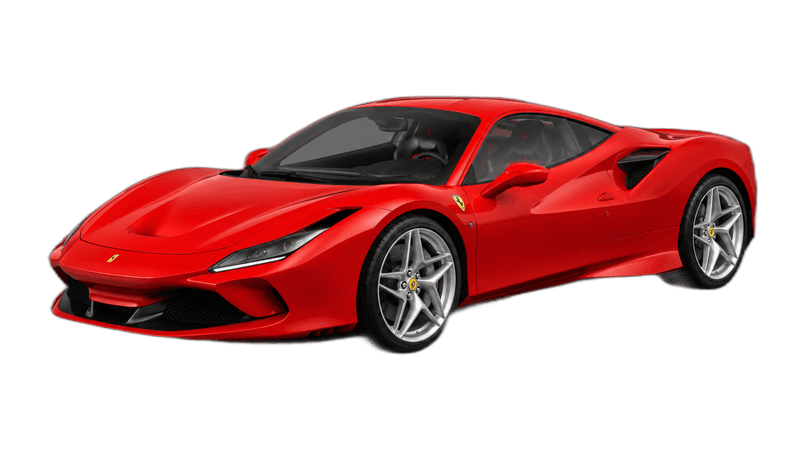
Ferrari F8 Tributo
£250,000
usedIndicative market price, updated periodically.
710bhp
Power
2.9s
0-100 km/h
340km/h
Top Speed
£250,000
Price Used
How hard it pulls.
Peak g-force the instant you bury the throttle, estimated from the car's 0–100 time and drivetrain.
Ferrari F8 TributoEstimated peak launch g from the 0–100 time and drivetrain: an honest approximation, not a measured figure.
The Ferrari F8 Tributo is a 2-door coupe by Ferrari, with 710 bhp, 770 Nm of torque, a 0-100 km/h time of 2.9 seconds and a top speed of 340 km/h. Indicative used value: approximately £250,000. Actual values vary with specification, condition and history.
Dream Car Garage Editorial · Last updated 27 October 2026
Overview
We have not driven this car. This review is based on published specifications and the sources listed below.
A Pista-derived engine in the F8 package
Ferrari revealed the F8 Tributo in 2019 as the successor to the 488. Its 3.9-litre dry-sump twin-turbo V8 produces 720 PS, about 710 bhp, and 770 Nm at 3,250 rpm. Official figures are 0-100 km/h in 2.9 seconds and a 340 km/h top speed. The engine shares development with the Pista, including internal and airflow revisions, but the F8 has its own aerodynamic and electronic package.
This is a desk-researched ownership guide. We have not driven this model for this article. Ferrari did not publish a total production figure. The individual service file, campaign status, battery history and delivered options provide more useful evidence than a production estimate.
Startup, battery and powertrain checks
Observe a cold start and a warmed-up assessment with the seller's permission. The F8 owner's documentation discussed by PistonHeads includes warnings for exhaust and clutch overheating, plus startup checks involving electrical contacts and a fuel-pump fuse. Those instructions are not proof of a common failure. They are reasons to take warnings seriously and to investigate their cause.
Battery care is especially important. Ask whether the car was stored on the recommended trickle charger, when the battery was last replaced and whether any electrical warnings followed periods of inactivity. Charging a weak battery may allow an inspection, but it should not be used to hide a recurring fault.
Request oil, coolant and diagnostic checks, together with gearbox and engine service records. The seven-year maintenance package was included from new, but condition-based warnings and wear items still require documentation. Verify what coverage remains on this chassis instead of treating the programme name as unlimited protection.
Electrical inspection should include the charging socket itself. A damaged lead, loose connection or incorrect maintainer can undermine an otherwise careful storage routine. Check that the dashboard is free of warnings after startup and ask for any battery or charging invoices. If the car has recently been reconnected after storage, give the specialist time to review stored faults before accepting that the system is healthy. The report should distinguish a weak battery from a wider electrical issue instead of relying on a single successful start.
SSC 6.1, Dynamic Enhancer and chassis condition
The F8 uses Side Slip Control 6.1 and Ferrari Dynamic Enhancer Plus, with the latter available in Race mode. These systems distinguish it from earlier 488 calibrations. They should be assessed through diagnostics and an appropriate specialist road evaluation, not through an unsafe attempt to test their limits during an ordinary viewing.
Inspect the suspension, dampers and geometry, and compare the results with tyre age and wear. Steering, ride and gearchange behaviour should be considered in context: a firm response is part of the car's calibration, while a warning or inconsistent operation still needs diagnosis.
The underbody and aero components should be examined for contact, missing fasteners and poor repairs. If front lift is fitted, test its operation. The optional lifter raises the front by 40 mm and is useful evidence to check rather than assume from the presence of a switch.
Brakes, wheels and the parking-brake recall
Carbon-ceramic brakes with 398 mm front discs require measured condition and a clear service history. Inspect pads, fluid and visible hydraulic components. The inspector should explain any area that could not be assessed.
PistonHeads identifies a recall involving the parking-brake fluid-reservoir cap, which could allow a vacuum and fluid leak with serious braking consequences. Confirm completion by VIN through Ferrari channels. Do not assume that a car has had the work simply because it is relatively recent or has a full service book.
Check wheel condition and tyre specification. Optional carbon-fibre wheels should be identified from the build record and examined carefully for damage. A replacement wheel or non-standard tyre size needs a documented reason.
Seats, screens and delivered equipment
Daytona-style seats, infotainment, the passenger display and parking cameras should all be checked for presence and operation. Seat comfort and adjustment are individual requirements, so sit in the car rather than relying on an option name. Inspect bolsters, stitching and controls for wear.
Carbon cabin parts and other visible options should be matched to the factory record. Later modifications should be listed, with original parts and invoices included where available. A complete file helps separate factory equipment from cosmetic additions.
Ask for maintenance, storage, warranty and recall records in one continuous history. If the car has been used on circuit, request the related service and inspection evidence rather than treating that use as either automatic damage or automatic proof of careful ownership.
Independent inspection before decision
A Ferrari specialist should inspect the engine, gearbox, diagnostics, underbody, brakes, suspension and service file. The report should identify measured findings and anything that could not be checked. A cold-start observation and diagnostic review are more useful than a short presentation drive.
No official production total is assigned to this catalogue entry. That uncertainty does not reduce the car's identity. It simply avoids turning an estimate into a fact. The individual VIN, equipment and condition should drive the purchase assessment.
How this review was compiled
We have not driven this model for this article. Ferrari's official F8 Tributo page and technical sheet supply the engine, performance and control-system identity. The PistonHeads F8 buying guide supplies the service, battery, equipment and recall topics. This guide makes no claim about production totals, transaction prices, future value or guaranteed reliability. VIN-based campaign checks and an independent Ferrari inspection remain necessary.
Specifications
Engine
3.9L (3902 cc) twin-turbocharged V8
Displacement
3.9L
Power
710 bhp
Torque
770 Nm
0-100 km/h
2.9s
Top Speed
340 km/h
Drivetrain
RWD
Country
Italy
Body Style
2-door coupe
Years
2019–2022
Price Used
£250,000
Specifications are manufacturer-published figures.
More from Ferrari
Frequently Asked Questions
What are the specifications of the Ferrari F8 Tributo?
The Ferrari F8 Tributo is a 2-door coupe by Ferrari, with 710 bhp, 770 Nm of torque, a 0-100 km/h time of 2.9 seconds and a top speed of 340 km/h. Indicative used value: approximately £250,000. Actual values vary with specification, condition and history.
How much does a Ferrari F8 Tributo cost?
Indicative used value: approximately £250,000. Actual values vary with specification, condition and history.
What drivetrain does the Ferrari F8 Tributo use?
The Ferrari F8 Tributo is configured with rear-wheel drive.
What type of car is the Ferrari F8 Tributo?
The Ferrari F8 Tributo is a supercars manufactured by Ferrari in Italy. Production ran from 2019 to 2022.