
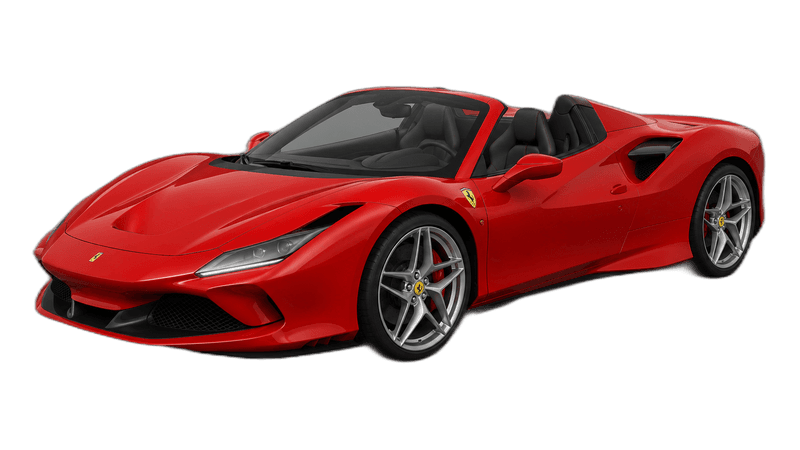
Ferrari F8 Spider
£280,000
usedIndicative market price, updated periodically.
710bhp
Power
2.9s
0-100 km/h
340km/h
Top Speed
£280,000
Price Used
How hard it pulls.
Peak g-force the instant you bury the throttle, estimated from the car's 0–100 time and drivetrain.
Ferrari F8 SpiderEstimated peak launch g from the 0–100 time and drivetrain: an honest approximation, not a measured figure.
The Ferrari F8 Spider is a 2-door convertible by Ferrari, with 710 bhp, 770 Nm of torque, a 0-100 km/h time of 2.9 seconds and a top speed of 340 km/h. Indicative used value: approximately £280,000. Actual values vary with specification, condition and history.
Dream Car Garage Editorial · Last updated 27 October 2026
Overview
We have not driven this car. This review is based on published specifications and the sources listed below.
Open-air driving with the F8 powertrain
The F8 Spider uses the same 3.9-litre dry-sump twin-turbo V8 as the Tributo, producing 720 PS, about 710 bhp, and 770 Nm at 3,250 rpm. Ferrari and PistonHeads quote 0-100 km/h in 2.9 seconds and a 340 km/h top speed. The Spider adds a retractable hardtop and approximately 70 kg, with slightly slower 0-200 km/h acceleration but the same headline 0-100 figure.
This is a desk-researched ownership guide. We have not driven this model for this article. No official total production figure was published. The roof, service coverage, battery history and original equipment should be assessed on this individual car rather than inferred from the coupe.
Fourteen-second roof and body inspection
The retractable hardtop opens or closes in 14 seconds and can operate at up to 28 mph, approximately 45 km/h. Test complete cycles with the seller's permission, watching for even movement, correct alignment and a secure finish. Investigate hesitation, abnormal noise or warnings rather than accepting them as ordinary convertible behaviour.
Inspect the seals, drainage paths, rear deck and tonneau for water marks, contact and previous adjustment. The roof mechanism and surrounding trim should be assessed by someone familiar with the model. A closed roof in a photograph says little about the condition of its sensors, hydraulics or alignment.
Battery condition and storage practice are relevant to electrical operation. Ask whether the recommended maintainer was used and whether any warnings followed storage. Charging the battery before a viewing is sensible preparation, not an explanation for a recurring fault.
Request records for roof adjustment, seal replacement or hydraulic and sensor work. A reset warning is not proof of repair. If the roof cannot be demonstrated on the day, treat it as an open inspection item and arrange a later test. The cabin should also be checked after the roof has been operated, because damp carpet or a musty smell can reveal a drainage issue that clean exterior photographs hide. Any water marks around the rear deck or cabin should be traced to their source, and the inspection report should say whether those areas were accessible. Roof condition should be established on the day of inspection rather than from an older video or a seller's assurance. Record anything that could not be tested.
Engine, gearbox and service coverage
The engine should be observed cold and warm, with oil, coolant, intake and diagnostic checks. PistonHeads discusses the owner's manual warnings for exhaust and clutch overheating and startup checks involving electrical contacts and a fuel-pump fuse. These are inspection prompts, not evidence that every F8 Spider will develop the same problem.
Request engine and gearbox service records and investigate any warning or inconsistent shift with Ferrari diagnostic equipment. The seven-year maintenance package was included from new, but its remaining dates and scope should be verified. Wear items and condition-based work still require invoices.
Ask how the car was stored and what was done before sale. A recent service is most useful when the invoice identifies the work and parts. An independent specialist should be able to connect diagnostic findings to the maintenance record.
Chassis, brakes and aerodynamic equipment
SSC 6.1 and Ferrari Dynamic Enhancer Plus remain part of the Spider's electronic package, with FDE Plus available in Race mode. Have the systems checked through diagnostics and an appropriate specialist evaluation. Do not attempt to explore their limits during an unplanned test drive.
Inspect suspension, dampers, geometry and tyre wear together. The underbody, splitter and rear aero components should be checked for contact and correct repairs. Front lift was optional and raises the nose by 40 mm, so confirm its presence and operation rather than assuming every car has it.
Carbon-ceramic brakes with 398 mm front discs require measured condition, pad inspection and a fluid history. PistonHeads identifies a parking-brake fluid-reservoir-cap recall that can lead to vacuum and fluid loss. Verify campaign completion by VIN through Ferrari channels.
Optional carbon-fibre wheels should be documented and inspected for damage. Check tyre specification and age, and ask for an explanation of any non-standard fitment.
Cabin, seats and factory options
Test the infotainment, passenger display, parking cameras and seat controls. Daytona-style seats can be supportive but should be tried for entry, adjustment and comfort. Inspect bolsters, stitching and switchgear for wear.
Match visible carbon parts, wheels and cabin equipment to the build record. Later modifications should be documented separately from factory options. Original parts supplied with the car should be listed.
Service, recall, storage and warranty records should form a continuous file. Circuit use should prompt questions about inspection and maintenance, not an automatic conclusion about condition. The aim is to understand this car's history, not to rely on a stereotype.
A complete Spider-specific assessment
An independent Ferrari specialist should inspect the roof, engine, gearbox, diagnostics, underbody, brakes and records. The report should state what was measured and what remained inaccessible. Roof operation and a cold-start observation add evidence that photographs cannot provide.
There is no official production total to use as a provenance shortcut. The VIN, factory equipment and maintenance history establish the car's identity. Condition should be established through inspection rather than a prediction about future demand.
How this review was compiled
We have not driven this model for this article. Ferrari's official F8 Spider material supplies the engine, roof and performance identity. Ferrari's F8 technical documentation supports the shared powertrain and electronic systems, while the PistonHeads F8 guide supplies the service, equipment and recall topics. No claim is made about production totals, prices, future value or guaranteed reliability. VIN-based campaign checks and a Ferrari-specialist inspection remain necessary.
Specifications
Engine
3.9L (3902 cc) twin-turbocharged V8
Displacement
3.9L
Power
710 bhp
Torque
770 Nm
0-100 km/h
2.9s
Top Speed
340 km/h
Drivetrain
RWD
Country
Italy
Body Style
2-door convertible
Years
2019–2022
Price Used
£280,000
Specifications are manufacturer-published figures.
More from Ferrari
Frequently Asked Questions
What are the specifications of the Ferrari F8 Spider?
The Ferrari F8 Spider is a 2-door convertible by Ferrari, with 710 bhp, 770 Nm of torque, a 0-100 km/h time of 2.9 seconds and a top speed of 340 km/h. Indicative used value: approximately £280,000. Actual values vary with specification, condition and history.
How much does a Ferrari F8 Spider cost?
Indicative used value: approximately £280,000. Actual values vary with specification, condition and history.
What drivetrain does the Ferrari F8 Spider use?
The Ferrari F8 Spider is configured with rear-wheel drive.
What type of car is the Ferrari F8 Spider?
The Ferrari F8 Spider is a supercars manufactured by Ferrari in Italy. Production ran from 2019 to 2022.