
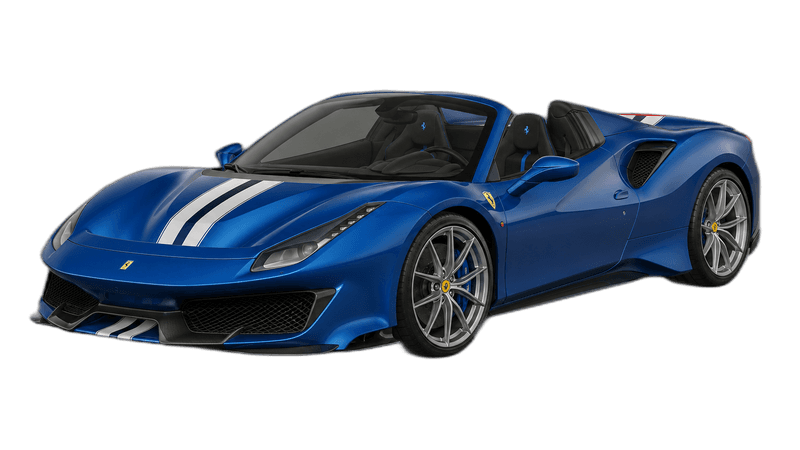
Ferrari 488 Pista Spider
£420,000
usedIndicative market price, updated periodically.
710bhp
Power
2.85s
0-100 km/h
340km/h
Top Speed
£420,000
Price Used
How hard it pulls.
Peak g-force the instant you bury the throttle, estimated from the car's 0–100 time and drivetrain.
Ferrari 488 Pista SpiderEstimated peak launch g from the 0–100 time and drivetrain: an honest approximation, not a measured figure.
The Ferrari 488 Pista Spider is a 2-door convertible by Ferrari, with 710 bhp, 770 Nm of torque, a 0-100 km/h time of 2.85 seconds and a top speed of 340 km/h. Indicative used value: approximately £420,000. Actual values vary with specification, condition and history.
Dream Car Garage Editorial · Last updated 27 October 2026
Overview
We have not driven this car. This review is based on published specifications and the sources listed below.
The open version of the Pista formula
Ferrari revealed the 488 Pista Spider in 2018, extending the Pista's 3.9-litre twin-turbocharged V8 and racing-derived chassis package to a retractable-hardtop body. Output is 720 PS, about 710 bhp, with 770 Nm. Official figures give 0-100 km/h in 2.85 seconds and a 340 km/h top speed.
This is a desk-researched ownership guide. We have not driven this model for this article. Ferrari did not publish a total production figure, so no global count is assigned here. The Spider should be assessed on its own roof, body and equipment rather than described as a coupe with a generic convertible conversion.
Roof, seals and body inspection
The retractable hardtop should be operated through complete cycles with the seller's permission. Watch for even movement, correct alignment and a clean finish at the seals. Investigate hesitation, abnormal noise or warning messages with a Ferrari specialist rather than assuming that an older roof is expected to be temperamental.
Inspect drainage paths, weather seals and surrounding trim for water marks or previous adjustment. Check the rear deck and tonneau for panel alignment and contact. The underbody and aero surfaces also need examination, because a low car can hide splitter and undertray damage in ordinary photographs.
Battery condition and storage history are relevant to electrical operation. Ask whether a factory-approved maintainer was used and how long the car was left unused. A charged battery is useful for the test, but it does not explain away a recurring roof or electrical warning.
Ask for invoices for roof adjustment, seal replacement or sensor work. The paperwork should show whether a technician resolved a fault or simply reset a warning. If the roof cannot be operated during the viewing, record that limitation and arrange a later demonstration rather than treating it as a minor omission. Water marks around the rear deck or cabin should be traced to their source, not covered by replacement trim. The cabin should then be checked after the roof has been open and closed, because a musty smell or damp carpet can reveal a drainage issue that dry exterior photographs miss. Recent cleaning should be considered alongside the rest of the evidence.
Turbocharged V8 and service history
The dry-sump V8 should be inspected cold and warm, including oil, coolant, hoses and the intake system. PistonHeads notes that a faint fan-like flutter from the rear intake accompanied by power loss can justify a turbo investigation. Any such symptom needs proper diagnosis, not a parts replacement based on guesswork.
The same guide explains that an early low-pressure fuel-line concern was resolved before customer delivery. That development issue should not be repeated as if every used Pista Spider has a current defect. The useful action is to verify VIN-specific campaigns and inspect the car that is actually for sale.
Ask for diagnostic and service records, including any turbo, fuel-system or warning-related work. Annual service evidence and the remaining coverage under Ferrari's service or warranty programmes should be checked by date. Do not assume that a seven-year package still covers every repair.
Chassis, steering and carbon-ceramic brakes
The Pista chassis is lower and stiffer than the GTB's, and its electronic controls are part of the driving package. Have the suspension, dampers and geometry measured, and compare the findings with tyre wear. Steering warnings, play or inconsistent assistance deserve attention because the wider 488 guide reports steering-rack failures.
Carbon-ceramic brakes need more than a visual glance. Document disc and pad condition, fluid history and any brake-wear-warning software work. The recall status of braking and parking-related systems should be confirmed by VIN.
Optional carbon-fibre wheels should be identified from the build record and inspected for damage. Use the correct tyre specification; PistonHeads warns that diameter changes can trigger electronic problems. Front lift and parking equipment should be tested where fitted.
Seats, battery and original options
The battery in the passenger footwell should be checked for condition and charging history. Test the cabin screens, cameras and parking aids. Look for seat-bolster wear and assess whether the available seat option provides enough adjustment and support for the intended driver.
Visible carbon trim does not prove a complete factory package. Match the wheels, seats, aero and cabin options to the build record. Replacement parts or later modifications should be listed separately, with original components included where available.
A documented file should explain maintenance, storage, recall completion and warranty work. If the car has been used on circuit, ask for that history and the associated inspection evidence without assuming that circuit use automatically means poor condition.
A Spider-specific purchase inspection
An independent Ferrari specialist should inspect the roof, underbody, engine, diagnostics, chassis, brakes and records. The report should identify any area that could not be examined and should distinguish measured wear from seller assurances.
There is no official production total to use as a shortcut for provenance. The individual chassis, equipment and service file provide the meaningful identity. A careful inspection gives more useful information than an unsupported production estimate or a prediction about future demand.
How this review was compiled
We have not driven this model for this article. Ferrari's official Pista Spider page supplies the roof, engine, performance and equipment identity. Ferrari's Pista technical material supports the shared powertrain and chassis facts, while the PistonHeads 488 guide supplies the ownership topics. This guide makes no claim about total production, prices, future value or universal reliability. VIN-based campaign checks and a Ferrari-specialist inspection remain necessary.
Specifications
Engine
3.9L (3902 cc) twin-turbocharged V8
Displacement
3.9L
Power
710 bhp
Torque
770 Nm
0-100 km/h
2.85s
Top Speed
340 km/h
Drivetrain
RWD
Country
Italy
Body Style
2-door convertible
Years
2018–2020
Price Used
£420,000
Specifications are manufacturer-published figures.
More from Ferrari
Frequently Asked Questions
What are the specifications of the Ferrari 488 Pista Spider?
The Ferrari 488 Pista Spider is a 2-door convertible by Ferrari, with 710 bhp, 770 Nm of torque, a 0-100 km/h time of 2.85 seconds and a top speed of 340 km/h. Indicative used value: approximately £420,000. Actual values vary with specification, condition and history.
How much does a Ferrari 488 Pista Spider cost?
Indicative used value: approximately £420,000. Actual values vary with specification, condition and history.
What drivetrain does the Ferrari 488 Pista Spider use?
The Ferrari 488 Pista Spider is configured with rear-wheel drive.
What type of car is the Ferrari 488 Pista Spider?
The Ferrari 488 Pista Spider is a track focused manufactured by Ferrari in Italy. Production ran from 2018 to 2020.