
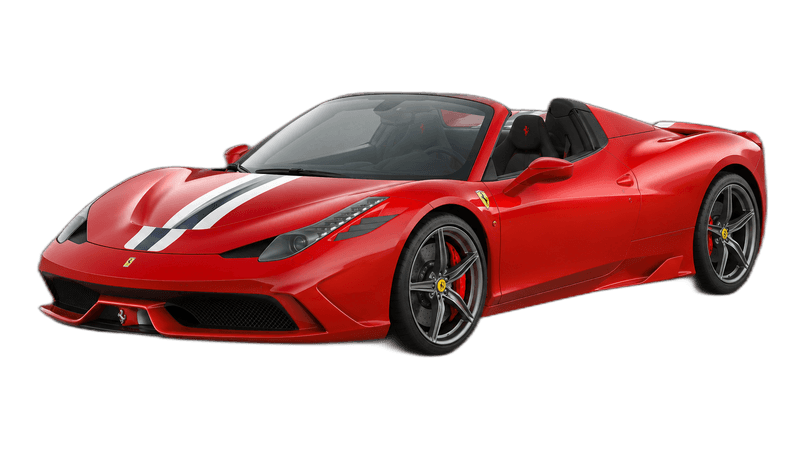
Ferrari 458 Speciale A
£450,000
usedIndicative market price, updated periodically.
597bhp
Power
3s
0-100 km/h
320km/h
Top Speed
£450,000
Price Used
How hard it pulls.
Peak g-force the instant you bury the throttle, estimated from the car's 0–100 time and drivetrain.
Ferrari 458 Speciale AEstimated peak launch g from the 0–100 time and drivetrain: an honest approximation, not a measured figure.
The Ferrari 458 Speciale A is a 2-door convertible by Ferrari, with 597 bhp, 540 Nm of torque, a 0-100 km/h time of 3 seconds and a top speed of 320 km/h. Indicative used value: approximately £450,000. Actual values vary with specification, condition and history.
Dream Car Garage Editorial · Last updated 27 October 2026
Overview
We have not driven this car. This review is based on published specifications and the sources listed below.
A separate 499-car open-top identity
Ferrari revealed the 458 Speciale A in 2014 and built 499 cars during a one-year run before the 458 family was phased out. Its 4.5-litre naturally aspirated V8 produces 605 PS, about 597 bhp, and 540 Nm. The official figures are 0-100 km/h in 3.0 seconds and a 320 km/h top speed, so the Spider should not inherit the coupe's higher maximum-speed figure.
This is a desk-researched ownership guide. We have not driven this model for this article. The production total is specific to the Speciale A and should not be extended to the coupe. For an individual car, the roof, documentation, service coverage and original equipment still matter more than a rarity statement.
Retractable-hardtop operation
The retractable hardtop is central to the inspection. Collecting Cars recommends cycling a 458 Spider roof repeatedly and watching for smooth, quiet operation and correct alignment. Apply that discipline here. Run the full open-and-close sequence with the seller's permission, observe both sides and listen for hesitation or abnormal hydraulic noise.
Check the seals, drainage paths and visible trim for water marks or poor adjustment. A roof that eventually closes is not necessarily operating correctly. Warning messages, inconsistent movement or a sensor fault should be diagnosed rather than explained away as normal for an older convertible.
Battery condition can influence electrical behaviour, so ask how the car was stored and whether a suitable maintainer was used. The roof inspection should also include the area around the rear deck and tonneau for contact, panel alignment and previous repairs.
Naturally aspirated engine and dual-clutch records
The V8 should be observed cold and warm, with attention to oil, coolant and exhaust condition. Collecting Cars identifies exhaust-manifold cracks as a 458-family inspection topic, with cold-start ticking or white residue as reasons to look closer. Any replacement or upgraded manifold should have an invoice and a clear parts description.
The dual-clutch transmission also deserves a record-led assessment. PistonHeads describes clutch-position sensor, speed-sensor and software issues across the family. That is not a diagnosis for this car. It is a reason to ask for gearbox invoices and to investigate inconsistent engagement, warnings or abnormal shifts with Ferrari diagnostic equipment.
Verify recall and campaign completion by VIN. Early 458 engine work and airbag campaigns should not be generalized into a claim that every Speciale A was affected. Service-pack coverage needs the same precision: establish what remains in date and what has expired.
Geometry, braking and front-axle equipment
A low, stiffly suspended car can show the consequences of geometry and use in its tyres and dampers. PistonHeads links geometry problems with inner-edge tyre wear, while Collecting Cars identifies MagneRide damper weep as an inspection point. Check tyre ages, sizes and wear patterns, and request a measured geometry assessment.
Carbon-ceramic discs should be inspected and weighed by a technician rather than judged by appearance. Include pads, fluid and hoses in the report. Inspect the wheels and underbody for damage, and examine the aero surfaces for contact or poor repairs.
Front lift and a rear camera are useful on this body style. If fitted, test the lifter through several cycles and listen for hesitation or pump noise. Confirm that cameras and parking aids work rather than treating them as assumed equipment.
Seats, trim and provenance
Inspect the cabin for sticky switchgear, shrunken or rippled dashboard leather, loose headlining and rattles. Test the screens, controls and fuel-sender behaviour. Carbon racing seats can be restrictive, so the buyer should assess entry, adjustment and support in person.
The Speciale A's stripe and cabin specification should be tied to the build record. Tailor Made features or replacement trim need documentation. Roof conversion, paint or upholstery changes should never be accepted on appearance alone.
The 499-car figure makes provenance especially important, but it does not remove ordinary checks. Confirm the chassis identity, service continuity and original parts supplied with the car. Keep this production figure separate from special editions and from the unspecified coupe total.
Ask whether roof work was performed by a Ferrari technician and whether replaced seals, sensors or hydraulic parts are listed. A clear invoice helps distinguish routine adjustment from a larger repair. If the roof cannot be demonstrated because the car is being transported or stored, treat that as an unresolved inspection item rather than assuming it works. The same caution applies to a seller who offers only a video of an earlier operation. Roof condition should be assessed on the day of inspection wherever possible. Keep the demonstration unhurried, because rushing through one cycle can hide hesitation, noise or a warning that appears only when the mechanism completes its sequence.
A specialist inspection with clear limits
Arrange an independent Ferrari inspection that includes the roof, underbody, diagnostics, brakes, suspension and document file. The report should list areas that could not be accessed and should distinguish measured findings from assurances. Storage, recent recommissioning and any circuit use should be explained by records where possible.
No production-count claim or rare specification replaces that work. A well-documented car gives the buyer a clearer basis for decision than a polished presentation or an unsupported assertion about future desirability.
How this review was compiled
We have not driven this model for this article. Ferrari's official Speciale A page supplies the 499-car run, engine, roof and performance identity. PistonHeads provides the 458-family service and chassis topics, while Collecting Cars supplies the roof, brake, manifold and cabin inspection detail. No claim is made about prices, future value or a universal failure pattern. VIN-based campaign checks and a Ferrari-specialist inspection remain necessary.
Specifications
Engine
4.5L (4497 cc) naturally aspirated V8
Displacement
4.5L
Power
597 bhp
Torque
540 Nm
0-100 km/h
3s
Top Speed
320 km/h
Drivetrain
RWD
Country
Italy
Body Style
2-door convertible
Years
2014–2015
Production
499
Price Used
£450,000
Specifications are manufacturer-published figures.
More from Ferrari
Frequently Asked Questions
What are the specifications of the Ferrari 458 Speciale A?
The Ferrari 458 Speciale A is a 2-door convertible by Ferrari, with 597 bhp, 540 Nm of torque, a 0-100 km/h time of 3 seconds and a top speed of 320 km/h. Indicative used value: approximately £450,000. Actual values vary with specification, condition and history.
How much does a Ferrari 458 Speciale A cost?
Indicative used value: approximately £450,000. Actual values vary with specification, condition and history.
How many Ferrari 458 Speciale A were made?
Ferrari produced 499 units of the Ferrari 458 Speciale A.
What drivetrain does the Ferrari 458 Speciale A use?
The Ferrari 458 Speciale A is configured with rear-wheel drive.
What type of car is the Ferrari 458 Speciale A?
The Ferrari 458 Speciale A is a track focused manufactured by Ferrari in Italy. Production ran from 2014 to 2015.