
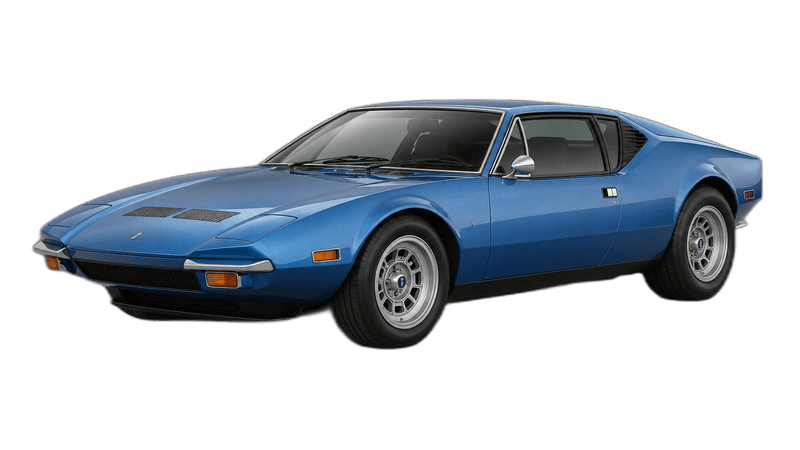
De Tomaso Pantera
£175,000
usedIndicative market price, updated periodically.
330bhp
Power
5.5s
0-100 km/h
256km/h
Top Speed
£175,000
Price Used
How hard it pulls.
Peak g-force the instant you bury the throttle, estimated from the car's 0–100 time and drivetrain.
De Tomaso PanteraEstimated peak launch g from the 0–100 time and drivetrain: an honest approximation, not a measured figure.
The De Tomaso Pantera is a 2-door coupé by De Tomaso, with 330 bhp, 441 Nm of torque, a 0-100 km/h time of 5.5 seconds and a top speed of 256 km/h. Indicative used value: approximately £175,000. Actual values vary with specification, condition and history.
Dream Car Garage Editorial · Last updated 2 November 2026
Overview
We have not driven this car. This review is based on published specifications and the sources listed below.
Scope of this guide
This guide is scoped to the original De Tomaso Pantera as launched in 1971 and sold up to 1972, the Italian two-seat, mid-engine, rear-wheel drive coupe with the 5.8L Ford 351 Cleveland V8 naturally aspirated petrol engine (5763 cc) and a ZF five-speed transaxle, in its early form before emissions rules cut power. It is not a guide to the later Pantera L and GTS, the GT5 and GT5-S of the 1980s, or the 1990 Si, and it does not cover the Group 3 and Group 4 racing cars. We say below where those cars differ, so that you can tell which one an advert really describes.
We have not driven this model for this article. Everything here rests on three cited sources: a 2006 Irish Times feature on the car, a PistonHeads Spotted article from 2018, and the government recall checker. We also read a few pages we do not cite, namely a Wikipedia article, an Autozine model page, a Sports Car Market knowledge-base page, a Secret Classics article and a second PistonHeads Spotted article about a GTS, and we flag each point that rests on them. Two buyer-guide pages (Hagerty and Car and Classic) and a Classic Cars magazine page returned a 403 error to our reader, so we did not use them and did not try to get round the block. Where sources disagree we say so rather than pick a winner quietly. Prices are history or asking prices, not valuations.
The figures at a glance
- Engine: 5.8L Ford 351 Cleveland V8 naturally aspirated petrol, 5763 cc, pushrod, cast-iron, mounted behind the cabin.
- Power: 330 bhp. The Irish Times and PistonHeads both print 330hp, and we have not converted it. Autozine says that figure is gross, and Wikipedia's specification table prints 330 PS, which is about 325 bhp.
- Torque: 441 Nm, which is PistonHeads' 325 lb ft converted by us (325 x 1.3558 is about 440.6). Wikipedia's table prints 344 lb ft (466 Nm), so this one is contested.
- 0-100 km/h: not published by any source we read. The quoted figure is 5.5 seconds for 0-60 mph (about 97 km/h), which the Irish Times and PistonHeads give and Autozine credits to Car and Driver.
- Top speed: 256 km/h, which is 159 mph, the figure Autozine credits to Car and Driver's first test. PistonHeads prints 170 mph on a spec sheet for a 1974 car and does not explain it.
- Drive: rear-wheel drive with the engine in the middle of the car, a mid-engine layout, and a five-speed ZF manual transaxle.
- Weight: 1,413 kg in Autozine, 1,420 kg in Wikipedia. The two are close but not the same.
- Years: launched 1971. We scope to 1971-1972, because 1973 cars sold in America were already detuned.
What the Pantera was
The Irish Times says the Pantera was launched in 1971, styled by the American Tom Tjaarda and built in Italy by Ghia and Vignale. PistonHeads agrees that Tjaarda drew the body while he was at Ghia, and adds that the car has a monocoque designed by Dallara with double wishbones and independent suspension all round. It was De Tomaso's first monocoque, according to the Irish Times, and it replaced the Mangusta. The Irish Times says Ford took an 80 per cent stake in De Tomaso in the late 1960s because it wanted a rival to the Chevrolet Corvette, and that the Pantera sold well in the United States through Lincoln-Mercury for about two years. The PistonHeads example, a 1974 car with 21,000 miles, was sold that way, which fits.
The car sat in the same company as the Lamborghini Miura and Countach in the minds of its fans, but it used a cheap, simple Ford engine, and that is the main reason owners still like it. The 5.8L Cleveland V8 is a low-tech pushrod unit that mechanics know. Autozine says it is the engine from the Mustang Boss 351 and that Ford funded the project and sold the car in America while De Tomaso handled Europe and the rest of the world. That is Autozine's account, and we have not tested it against Ford's own records.
Why the quoted power and torque vary
Power is the first thing to pin down. The Irish Times and PistonHeads both say 330hp, and Autozine says 330 hp gross. Wikipedia's text says 335 PS (330 hp) and its specification table says 330 PS (325 hp). These are the same engine and differ only in rating method and rounding, and the catalogue figure of 330 bhp is the one the press and PistonHeads print. Treat it as a maker-era claim, not a measured value.
The Irish Times adds that about a year after launch emissions rules forced a drop in power, partly offset by modified cam characteristics. Wikipedia gives 264 hp for a 1973 American-market Pantera L, and a Sports Car Market page says output of Ford-era American cars fell because of emissions equipment, without a number. That is why this guide stops at 1972. If an advert quotes 330 hp for a later American-market car, ask what it is based on.
Torque is less tidy. PistonHeads and Autozine both print 325 lb ft, which converts to 441 Nm, but Wikipedia's table prints 344 lb ft and 466 Nm at 3,500 rpm. The production catalogue we started from held 466 Nm. We use 441 Nm because it matches the two sources that agree and because the Wikipedia figure comes from a page we do not cite. This is a judgement, and a person with a period Ford or De Tomaso document should settle it.
Performance claims and what they mean
The 5.5 seconds figure is a 0-60 mph time. The Irish Times and PistonHeads both state it, and Autozine credits it to Car and Driver, which also recorded 14.1 seconds to 100 mph. Autozine gives a slower 6.2 seconds from Autocar for 0-60 mph, so the time depends on who was holding the stopwatch. The 256 km/h top speed is Car and Driver's first test as reported by Autozine, and Wikipedia's table also lists 159 mph (256 km/h). None of the sources we read gives a 0-100 km/h time, and we did not convert 0-60 mph into one. They are period magazine figures for a new car, not current measurements.
How the Pantera differs from other versions
The GTS was a Group 3 homologation special and the PistonHeads GTS article says only a handful were built to that specification, with a forged aluminium intake manifold, larger carburettors, upgraded exhaust headers, adjustable spring rates, bigger brakes and a faster steering rack. That article prints 350hp at 6,000 rpm and 362 lb ft for it, and Wikipedia says the same 350 PS for the European GTS. The Irish Times says only 14 Group 4 race cars were built.
The Irish Times says the GT5 came in 1980 with a deep front spoiler, side skirts and an optional wing, the GT5S in 1984 with larger brakes and uprated suspension, with 300hp or 350hp, and the Si in 1990, of which only 41 of an expected 225 were made. Secret Classics says the Si has a 5.0-litre Ford V8 with 305 hp. We did not verify those independently. If an advert mentions flared wheelarches, a 5.0-litre engine or a figure of 350hp or more, it describes a different car from the one in this guide.
Engine and gearbox
We found no source that lists specific engine or gearbox failures for the early Pantera. The Sports Car Market page says the ZF transaxle is expensive to rebuild or replace, and warns of gear noise, worn synchromesh and differential trouble, and a labour-intensive clutch change. The same page says cooling is the main practical concern, with a front radiator and long coolant pipes to the mid-mounted engine, that early cars could overheat and that air conditioning was often poor. This is from one page that we read but do not cite, so check it with a Pantera specialist.
Chassis, body and brakes
PistonHeads describes a car that is temperamental and hard to drive and own, with heavy steering, an awkward driving position, compromised visibility and no ventilation. Wikipedia says rust-proofing on early cars was minimal, with poor fit and finish and body solder covering panel flaws, and the Sports Car Market page lists rust in rockers, floors, wheelhouses and suspension mounts. We cannot confirm these from our cited sources alone. Original brakes may feel weak by modern standards, and the monocoque needs to be straight, so ask whether the car has been in a collision.
Running costs and ownership
We have no current fuel, tax or insurance figures, because none of the cited sources gives them. PistonHeads' 1974 example had an asking price of 109,900 pounds with a refurbishment, a full service and a health check, and its GTS article asked 124,995 pounds in 2022. Those are asking prices, not valuations, and we have not tracked the market since. Sports Car Market lists auction results, but it does not give a valuation, and we do not repeat them. The Cleveland V8 is a simple engine, but parts for the transaxle, the body and the trim are scarcer, so budget for specialist help and for time without the car.
Buying notes
Ford stopped importing the Pantera into the United States in 1974 or 1975, depending on the source, after selling about 5,500 cars according to Autozine and Wikipedia. The Irish Times says production fell after the split with Ford in 1974 and ended in 1993, though its header says 1996. Production totals also vary by source. Wikipedia prints 7,260 for 1971 to 1992, PistonHeads' GTS article says well over 7,000, and Autozine says about 7,200 for the early cars alone, which cannot be right alongside the 7,260 total. We therefore give no production count for the early cars and do not claim one. If you buy an imported car, remember that US-market cars were sold through Lincoln-Mercury and may differ in trim and engine tune from European ones.
What to check before buying
- Confirm the chassis number and the build date against the paperwork, and ask what year the car really is, because 1973 and later cars differ.
- Find out whether the engine is the original Cleveland or a replacement, and whether the power claim is from a dyno sheet.
- Inspect sills, floors, wheelhouses and suspension mounts for rust or poor repairs.
- Run the engine to temperature and watch the cooling system, the fans and the heater.
- Drive the car and listen to the ZF transaxle for noise, then check synchromesh and the clutch.
- Check for collision repairs and straight geometry on the monocoque.
- Look at the brakes, the tyres and their age.
- Run the registration through the recall check described below.
Recalls and the DVSA check
We did not find a recall list for a UK-registered early Pantera in the cited sources, and PistonHeads mentions none. A search showed a third-party recall page for American cars, which we did not open, so we make no claim about it. None of that proves a particular car is affected or clear. Run the registration or VIN through the DVSA vehicle recall check on GOV.UK, and ask a De Tomaso specialist to confirm anything open. We have not checked how far back the GOV.UK service reaches for a car this old.
Verdict
The early Pantera is 330 bhp, 441 Nm, 5.5 seconds to 60 mph and 256 km/h in a mid-engine, rear-wheel drive Italian coupe with an American V8. It rewards an owner who accepts rust checks, cooling attention and specialist help for the gearbox. If you are shopping for one, confirm which version it is, insist on a full history, and treat the published figures as claims with the caveats above. We have not driven it, so use the sources and a proper inspection to decide.
Specifications
Engine
5.8L Ford 351 Cleveland V8 naturally aspirated petrol
Displacement
5.8L
Power
330 bhp
Torque
441 Nm
0-100 km/h
5.5s
Top Speed
256 km/h
Drivetrain
MR
Country
Italy
Body Style
2-door coupé
Years
1971–1972
Price Used
£175,000
Specifications are manufacturer-published figures.
More from De Tomaso
Frequently Asked Questions
What are the specifications of the De Tomaso Pantera?
The De Tomaso Pantera is a 2-door coupé by De Tomaso, with 330 bhp, 441 Nm of torque, a 0-100 km/h time of 5.5 seconds and a top speed of 256 km/h. Indicative used value: approximately £175,000. Actual values vary with specification, condition and history.
How much does a De Tomaso Pantera cost?
Indicative used value: approximately £175,000. Actual values vary with specification, condition and history.
What drivetrain does the De Tomaso Pantera use?
The De Tomaso Pantera is configured with a mid-mounted engine and rear-wheel drive.
What type of car is the De Tomaso Pantera?
The De Tomaso Pantera is a gts manufactured by De Tomaso in Italy. Production ran from 1971 to 1972.