
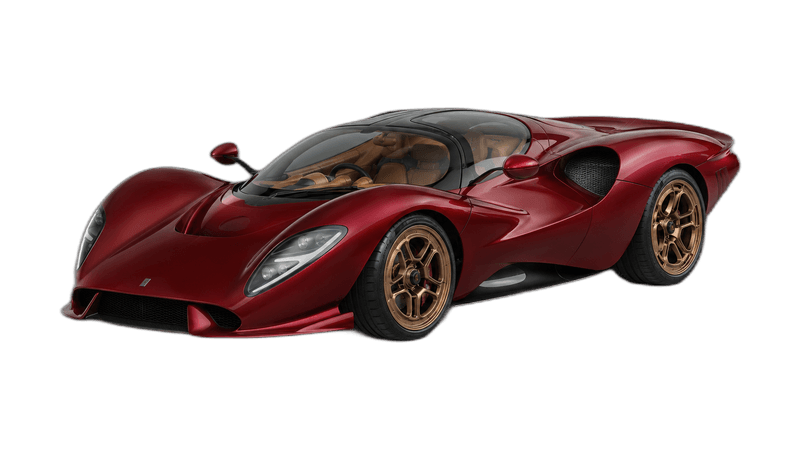
De Tomaso P72
£750,000
usedIndicative market price, updated periodically.
700bhp
Power
3.4s
0-100 km/h
350km/h
Top Speed
£750,000
Price Used
How hard it pulls.
Peak g-force the instant you bury the throttle, estimated from the car's 0–100 time and drivetrain.
De Tomaso P72Estimated peak launch g from the 0–100 time and drivetrain: an honest approximation, not a measured figure.
The De Tomaso P72 is a 2-door coupé by De Tomaso, with 700 bhp, 820 Nm of torque, a 0-100 km/h time of 3.4 seconds and a top speed of 350 km/h. Indicative used value: approximately £750,000. Actual values vary with specification, condition and history.
Overview
This page is a catalogue summary while we rebuild it as a full ownership review. It is not yet a buying guide.
The De Tomaso P72 presents an unusual split in the numbers: its 0-100 km/h ranking places it 166th among 600 cars, yet its top speed ranking places it 38th. That contrast reveals a car whose performance character is not defined by one headline metric alone. The P72 reaches 350 km/h, but its 3.4 second sprint to 100 km/h sits in a different part of the catalogue, suggesting a balance between outright speed and the broader shape of its performance.
The detail that separates it from most of the collection is not a single figure, but the combination behind those figures. The P72 uses a supercharged 5.0 litre V8 with 700 bhp and 820 Nm, paired with MR drivetrain layout. Just 9 of the 600 cars in the catalogue combine a V8 with MR, while 30 are supercharged V8 cars. That places the P72 in a particularly narrow part of the collection, where layout and engine character meet rather than simply chasing the highest numbers.
Its position in the wider catalogue reinforces that distinction. A power rank of 98 out of 600 puts it in the top 16%, while its used price rank of 71 means it sits above 529 cars by cost, with a listed used price of £750,000. The relationship between price and output is equally distinctive, with a cost of £1,071 per bhp. This is not a car defined by efficiency of expenditure, but by the specific combination it brings to a garage.
The production figure adds another layer. The P72 has a production count of 72, and among the 177 cars in the catalogue with known production figures, only 34 are rarer. That figure stands without needing exaggeration. It places the car in a small group where exclusivity can be measured rather than assumed.
With 118 Italian cars in the catalogue and three De Tomaso cars represented, the P72 occupies a particular corner of the collection. Its 2025 model year, 2-door coupé body style and V8 configuration create a presence that is distinct from a garage built around simple ranking positions. A garage without the P72 has another high-performance car; a garage with it gains a car whose identity comes from an uncommon mix of speed, layout, rarity and cost. It changes the balance of the collection by adding something difficult to replicate from the remaining 599 choices.
Specifications
Engine
5.0L Supercharged V8
Displacement
5.0L
Power
700 bhp
Torque
820 Nm
0-100 km/h
3.4s
Top Speed
350 km/h
Drivetrain
MR
Country
Italy
Body Style
2-door coupé
Years
2025–present
Production
72
Price Used
£750,000
Specifications are manufacturer-published figures.
More from De Tomaso
Frequently Asked Questions
What are the specifications of the De Tomaso P72?
The De Tomaso P72 is a 2-door coupé by De Tomaso, with 700 bhp, 820 Nm of torque, a 0-100 km/h time of 3.4 seconds and a top speed of 350 km/h. Indicative used value: approximately £750,000. Actual values vary with specification, condition and history.
How much does a De Tomaso P72 cost?
Indicative used value: approximately £750,000. Actual values vary with specification, condition and history.
How many De Tomaso P72 were made?
De Tomaso produced 72 units of the De Tomaso P72.
What drivetrain does the De Tomaso P72 use?
The De Tomaso P72 is configured with a mid-mounted engine and rear-wheel drive.
What type of car is the De Tomaso P72?
The De Tomaso P72 is a supercars manufactured by De Tomaso in Italy. Production started in 2025.