
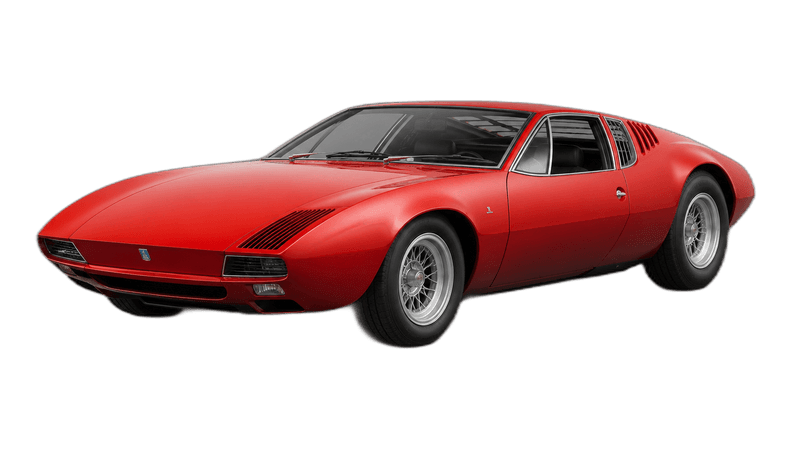
De Tomaso Mangusta
£250,000
usedIndicative market price, updated periodically.
306bhp
Power
5.9s
0-100 km/h
250km/h
Top Speed
£250,000
Price Used
How hard it pulls.
Peak g-force the instant you bury the throttle, estimated from the car's 0–100 time and drivetrain.
De Tomaso MangustaEstimated peak launch g from the 0–100 time and drivetrain: an honest approximation, not a measured figure.
The De Tomaso Mangusta is a 2-door coupe by De Tomaso, with 306 bhp, 446 Nm of torque, a 0-100 km/h time of 5.9 seconds and a top speed of 250 km/h. Indicative used value: approximately £250,000. Actual values vary with specification, condition and history.
Dream Car Garage Editorial · Last updated 3 November 2026
Overview
We have not driven this car. This review is based on published specifications and the sources listed below.
Scope of this guide
This guide is scoped to the De Tomaso Mangusta built from 1967 to 1971, the Giorgetto Giugiaro design bodied by Ghia, with the 4.7L V8 naturally aspirated Ford 289 cubic inch engine, a rear-wheel drive layout and the engine mounted behind the seats, which makes it a mid-engine car. It is not a guide to the later US-market cars with the 302 cubic inch (5.0 litre) Ford V8, which made less power and are covered only where we say so, nor to the Pantera that replaced it, nor to the modern De Tomaso Automobili cars. Where an advert only says "Mangusta" it can describe either engine, so check which one the car has.
We have not driven this model for this article. Everything here comes from three cited sources: the Mangusta legacy page on the website of De Tomaso Automobili (the relaunched company, not 1960s factory literature), a PistonHeads Pic of the Week from 21 March 2014, and the government recall checker. We also read AutoZine's Mangusta page, two RM Sotheby's catalogue entries (Paris 2015 and Villa Erba 2015), a Silodrome article of 8 May 2023 and the De Tomaso UK Drivers Club page, and we flag every point that rests on them. This is a 1960s car, so every figure below is a period claim, not a measured result, and the sources disagree with each other more than once. Prices are history, not valuations.
The figures at a glance
- Engine: 4.7L V8 naturally aspirated, a Ford 289 cubic inch overhead-valve V8 with two valves per cylinder and Weber carburettors, mounted longitudinally behind the cabin. The maker's page gives 4,728 cc, AutoZine gives 4,727 cc and RM Sotheby's gives 4,735 cc. We use 4728 cc. Our old catalogue value of 4601 cc matches none of them.
- Power: 306 bhp at 6,100 rpm on the maker's page, with a 6,800 rpm redline. AutoZine and Silodrome also say 306 for the early 289 car. The two RM Sotheby's catalogues list 271 bhp for the 289 engine, and we cannot say whether that is a net rating, a different tune or a catalogue slip. Period figures like these are usually gross, so do not compare them directly with modern net ratings.
- Torque: 446 Nm. AutoZine prints 329 lb ft, which converts to about 446 Nm. The maker's page prints no torque figure, and no source we read supports the 531 Nm we used to store.
- 0-100 km/h: 5.9 seconds. The maker's page prints 5.9 seconds for 0-60 mph and 13.7 seconds for 0-100 mph. We found no true 0-100 km/h time, so we treat the 0-60 mph figure as the 0-100 km/h figure, and a genuine 0-62 mph time would be a little longer. AutoZine estimates 6.1 seconds and RM Sotheby's says 6.3 seconds.
- Top speed: 250 km/h (155 mph), a claim on the maker's page and in RM Sotheby's catalogue. AutoZine says 152 mph.
- Drive: rear-wheel drive through a ZF five-speed manual transaxle with a limited-slip differential, according to the maker's narrative and the club. The maker's table says "6 speed Manual", which contradicts its own text, so we treat five speeds as correct.
- Weight: 1,300 kg on the maker's page and 1,400 kg on AutoZine.
What the car is
The maker's page calls the Mangusta its second production road car, after the Vallelunga. De Tomaso needed higher volumes to stay solvent, so he took a Giugiaro design that Ghia had prepared for Iso, which turned it down because it did not want a mid-engine car, and placed it on the backbone chassis that descends from the 1965 Shelby and De Tomaso P70 project. The name is Italian for mongoose, the animal that fights cobras, a dig at Carroll Shelby after the P70 partnership ended. PistonHeads makes the same point and adds that the recipe was not far from the Cobra's: a big Ford V8 in a very pretty body.
The party piece is at the back. The rear engine covers hinge at the centre in a gullwing pattern and open to reach the engine and the rear luggage space. The prototype was shown at the Turin show in 1966 and production ran until 1971. AutoZine and the club say about 401 were built, and we keep 401 as an estimate, because the maker's page does not give a production count.
Chassis, weight and handling
This is the part to read twice. The maker's page describes a steel backbone chassis with a stressed engine, and Silodrome describes a pressed steel backbone with a subframe carrying the engine and rear suspension. AutoZine is blunter: it says the chassis was too weak for a car this long, heavy and powerful, flexed a lot and gave unpredictable handling, and that De Tomaso never tamed the weight distribution of 32:68 front to rear. Silodrome gives a rearward 60/40 bias instead and says less experienced drivers could lose the rear if they were careless. The numbers differ, but the message is the same: weight sits over the rear wheels and the car rewards respect.
For a buyer that means two things. First, a car that has been restored to look right may still flex, so ask a De Tomaso specialist to inspect the backbone, the engine mounts and the subframe attachments. Second, tyres matter. The maker's page lists 185 HR 15 at the front and 225 HR 15 at the rear on Campagnolo magnesium wheels, so check which size and age of tyre is fitted and whether the wheels are the correct type and in good condition.
Rust, build quality and cooling
AutoZine says the cars were built to a poor standard and later troubled by rust. The maker's page says the body is steel and alloy over the backbone in one line and fibre-glass in the table above it, so do not assume what the panels are made of. Check sills, floors, door bottoms, the backbone itself and anywhere water can sit under the engine covers. Ask what was repaired and who did it.
Cooling is a general concern for any mid-engine V8 with its radiator in the nose, and the long coolant run between the two is our own inference, not something the sources we read describe. We found no source that quantifies cooling or overheating problems on the Mangusta, so ask for evidence of recent work on the radiator, hoses, fans and the temperature gauge, and take a long test drive on a warm day with a specialist beside you. Ask the same questions about the carburettors, the ZF transaxle and the limited-slip differential, none of which our sources cover in detail.
Which engine does the car have
The sources agree that early cars used the 289 cubic inch V8, and that the 302 cubic inch V8 followed in later cars. Silodrome says the 302 made between 230 and 330 bhp depending on the version, and describes a 1968 US-market car with the 302 at 230 bhp and 310 lb ft, which is about 420 Nm. The Commons caption of the photograph at the top of this page says the car is a European-market example still fitted with the 289, and that the 302 arrived in US-market cars for 1969. That is a photographer's note, not a factory source. The De Tomaso UK Drivers Club lists a 5.0 litre engine in its essentials, which does not match the 4.7 litre figure and shows how loosely the figures are quoted. Match the engine number and the chassis number to the paperwork before you pay for either.
What to check before buying
- Confirm which engine the car has, 289 or 302, and ask for the engine number and the chassis number. The two RM Sotheby's cars carry chassis numbers beginning 8MA, which is how those catalogues identify them.
- Ask for the full history, including any restoration photographs, and who carried out the work.
- Have the backbone chassis, the sills and floors, and the engine covers and their hinges inspected by someone who knows the car.
- Check for the original features that are expensive to replace: the Campagnolo wheels, the glass in the engine covers, the interior trim and the instruments.
- Ask how the car is registered where you live and what insurance a rare 1960s Italian car needs.
- Verify any claimed history against the club or a specialist, since only about 400 were built and a good story is easy to tell.
- Run the registration through the recall check described below, and then ask a specialist what it cannot tell you.
Market notes
PistonHeads reported in March 2014 that a Mangusta had recently been listed in its classifieds at 149,995 pounds, and described a 1969 early quad-light car restored to its first Lime colour. RM Sotheby's sold a 1969 car in Paris in 2015 for 168,000 euros and a 1968 car at Villa Erba the same year for 235,200 euros. Silodrome in May 2023 said cars in similar condition were selling for roughly 200,000 to 400,000 dollars. Those are historical sale reports from different markets and conditions, not values, so use them only to see how widely prices can vary.
Recalls and the DVSA check
The government page lets you check a car with its registration number, which shows safety recalls that have not been checked or fixed and the car's MOT history. If you do not know the registration, it asks for the manufacturer, model and year. It also says the manufacturer will tell you about non-safety recalls. For a 1960s Italian car this checker is not relevant in any useful way. A recall system built around current manufacturers and registered cars is very unlikely to hold anything on a Mangusta, and we did not run it because we are not looking at a specific car. A result of no recall tells you only that nothing is on that database. It does not mean the brakes, steering, fuel system or backbone are sound, and it replaces neither an MOT, a specialist inspection nor the club's knowledge of known weak points. An imported car may also not appear at all.
About the photograph
The picture at the top of this page shows a 1969 car in gold at the 2021 Lime Rock Historic Festival concours, photographed by Mr.choppers and used under a Creative Commons licence, cropped and resized with no other change. It has the early quad-headlight nose and, according to its caption, the 289 engine. The photograph is only there to show the shape.
Verdict
The Mangusta in this guide is 306 bhp, 446 Nm, a claimed 5.9 seconds to 100 km/h and a claimed 250 km/h, in a rear-wheel drive, mid-engine Italian coupe with a Ford V8 and about 400 built between 1967 and 1971. It is beautiful, rare and described by the sources as flexible, rear-heavy and prone to rust. If you are shopping for one, confirm the engine, insist on a full history and a specialist inspection of the chassis, and treat every published figure as a period claim with the caveats above. We have not driven it, so use the sources and a proper inspection to decide.
Specifications
Engine
4.7L V8 naturally aspirated
Displacement
4.7L
Power
306 bhp
Torque
446 Nm
0-100 km/h
5.9s
Top Speed
250 km/h
Drivetrain
MR
Country
Italy
Body Style
2-door coupe
Years
1967–1971
Production
401
Price Used
£250,000
Specifications are manufacturer-published figures.
More from De Tomaso
Frequently Asked Questions
What are the specifications of the De Tomaso Mangusta?
The De Tomaso Mangusta is a 2-door coupe by De Tomaso, with 306 bhp, 446 Nm of torque, a 0-100 km/h time of 5.9 seconds and a top speed of 250 km/h. Indicative used value: approximately £250,000. Actual values vary with specification, condition and history.
How much does a De Tomaso Mangusta cost?
Indicative used value: approximately £250,000. Actual values vary with specification, condition and history.
How many De Tomaso Mangusta were made?
De Tomaso produced 401 units of the De Tomaso Mangusta.
What drivetrain does the De Tomaso Mangusta use?
The De Tomaso Mangusta is configured with a mid-mounted engine and rear-wheel drive.
What type of car is the De Tomaso Mangusta?
The De Tomaso Mangusta is a gts manufactured by De Tomaso in Italy. Production ran from 1967 to 1971.