
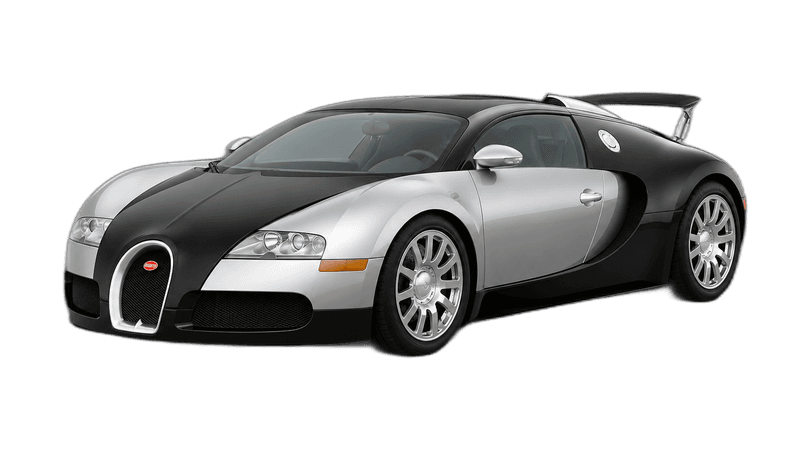
Bugatti Veyron 16.4
£1,200,000
usedIndicative market price, updated periodically.
987bhp
Power
2.5s
0-100 km/h
407km/h
Top Speed
£1,200,000
Price Used
How hard it pulls.
Peak g-force the instant you bury the throttle, estimated from the car's 0–100 time and drivetrain.
Bugatti Veyron 16.4Estimated peak launch g from the 0–100 time and drivetrain: an honest approximation, not a measured figure.
The Bugatti Veyron 16.4 is a 2-door coupé by Bugatti, with 987 bhp, 1250 Nm of torque, a 0-100 km/h time of 2.5 seconds and a top speed of 407 km/h. Indicative used value: approximately £1,200,000. Actual values vary with specification, condition and history.
Dream Car Garage Editorial · Edited by José Teo Lorente Vallecillos · Last updated 2 November 2026
Overview
We have not driven this car. This review is based on published specifications and the sources listed below.
Scope of this guide
This guide is scoped to the original Bugatti Veyron 16.4 coupe, the fixed-roof, two-seat, mid-engine, all-wheel drive hypercar with the 8.0L quad-turbo W16 petrol (7993 cc) engine, built from 2005 to 2011. It is not a guide to the Grand Sport (the targa-topped version from 2009), the Super Sport, the Grand Sport Vitesse or the final La Finale car. Each of those has its own entry in our catalogue, and we say below where they differ, so that you can tell which car an advert really describes.
We have not driven this model for this article. Everything here comes from three cited sources: a 2005 AUTO BILD driving report by Georg Kacher, PistonHeads' used buying guide by Tony Middlehurst (4 April 2021), and the government recall checker. We also read an Irish Times report on the end of production (25 February 2015) for the build totals, and we flag the points that rest on it. Where sources disagree we say so rather than pick a winner quietly. Prices are history or ranges, not valuations.
The figures at a glance
- Engine: 8.0L quad-turbo W16 petrol (7993 cc), mounted behind the cabin, with four turbochargers and 64 valves.
- Power: 987 bhp, which is the quoted 1001 PS converted by us (1001 x 0.98632 is about 987.3, rounded down). AUTO BILD prints 1001 PS and PistonHeads prints 1001 hp, 1,001PS and 1000hp in different places, so the unit in each place needs reading with care.
- Torque: 1250 Nm, printed by AUTO BILD from 2,200 rpm. PistonHeads gives 922 lb ft, which we convert to the same 1250 Nm (922 x 1.3558 is about 1250).
- 0-100 km/h: 2.5 seconds, as AUTO BILD prints it. PistonHeads prints 2.5 seconds for 0-62 mph, which we treat as the same 0-100 km/h figure.
- Top speed: 407 km/h, which is the 253 mph that PistonHeads prints (253 x 1.609 is about 407). Without the second key the car stops at about 217 mph, roughly 349 km/h by our conversion.
- Drive: all-wheel drive with a seven-speed dual-clutch gearbox (DSG) and paddle shifters. PistonHeads names the all-wheel-drive system as Haldex.
- Weight: 1,888 kg on PistonHeads and 1,950 kg fully fuelled in AUTO BILD.
What the 16.4 coupe was
The car was the first production Veyron, announced as a 1001 PS road car that would reach about 400 km/h. AUTO BILD's 2005 report quotes a price of 1.16 million euros and describes the 400 km/h target in its text while its headline carries 407 km/h. PistonHeads says the new price was 1.6 million pounds and that Volkswagen lost more than 6 million dollars on each car. The first production car, PistonHeads reports, sold at auction in 2015 for 1.8 million dollars including fees. All of those figures are history, not a current price.
How many were built
The count is the weakest number in this guide, and it depends on what you are counting. PistonHeads says 450 Veyrons in total, 252 of them the 16.4 coupe made from 2005 to 2011, 150 Grand Sports, and 30 Super Sports plus 5 World Record Edition cars. The Irish Times, reporting the end of production in 2015, says 300 coupes and 150 roadsters. These do not add up cleanly: 252 plus 30 plus 5 is 287, not 300, so some coupes are either unlisted in PistonHeads' split or counted differently. We use 252 for the standard 16.4 coupe because it is PistonHeads' stated figure for exactly this model, and we say plainly that it is one source's number. If a seller quotes a chassis number or a build number, ask which count they are using.
Why the quoted power and speed vary
Metric horsepower (PS) and brake horsepower differ by about 1.4 per cent, so 1001 PS is 987 bhp. The 1001 hp printed on PistonHeads' specification table is therefore a PS figure under a different label, not a different engine. The same engine is quoted in several units across the web, which is why we state the conversion. We have not checked how each outlet labelled its own figure.
Top speed also has more than one version. AUTO BILD led with 407 km/h in 2005 but said the target was 400 km/h. PistonHeads gives 253 mph with the second key and a normal limit of 217 mph. The Irish Times says the car was limited to 407 km/h when it launched. Treat 407 km/h as the maker's claim, reached in a special mode, and not what any used car will do. Weight and power figures are, in PistonHeads' own words, hard to pin down with certainty and best treated as relative.
Drivetrain and driving modes
The standard car is all-wheel drive with dynamic torque distribution, per AUTO BILD, and a seven-speed DSG. PistonHeads describes the normal top speed of 217 mph and a top-speed mode that needs the second key. It also describes a handling mode in which the car lowers hydraulically at 137 mph and deploys the rear wing, with 770 lb of downforce. The carbon ceramic brakes are quoted at 1.3 g, and above 124 mph the rear wing acts as an airbrake. We have not tested any of this and report it as PistonHeads' account.
How the 16.4 coupe differs from other versions
The Grand Sport, introduced in 2009 and limited to 150 cars according to PistonHeads, has a targa top instead of a fixed roof, so it is a different car with different structural and sealing questions. The Super Sport followed in 2010, with 30 cars and 5 World Record Edition cars in PistonHeads' account. The Vitesse, shown at the 2012 Geneva show, is a 1200 PS targa with a 233 mph limit. The last car, La Finale, was a special Grand Sport Vitesse sold in 2015, and the Irish Times says it was due to be shown at the Geneva show on 3 March 2015. If an advert mentions a targa roof, a higher power figure or a special edition, it describes a different car from the one in this guide.
Running costs
The costs below come only from the 2021 PistonHeads guide and are the most important part of the ownership picture. An annual dealer service is quoted at 10,000 to 20,000 pounds. The recommended fluid change is said to cost more than 20,000 pounds for the fluids alone, because the car has 16 drain plugs and underbody and body panels must be removed. PistonHeads says bills of 100,000 pounds have not been uncommon. Parts examples show how labour dominates: a boost pressure sensor is about 20 pounds but about 1,500 to fit, a cam position sensor is under 10 pounds but about 5,000 in total, and a camshaft is 700 pounds but about 20,000 to access and fit. Two new turbochargers are about 10,000 pounds plus 8,000 to fit, and a fuel tank replacement is about 35,000, mostly labour.
Fuel is also a cost. The tank holds 100 litres (22 gallons) and a fill-up is about 124 pounds, but at the official 11.7 mpg it empties in roughly 240 miles. At 248 mph PistonHeads quotes 1.7 mpg. Insurance and storage figures are not in our sources, so we give none.
Tyres and wheels
PistonHeads says the tyres should be changed every 2 years or 2,500 miles, whichever comes first, and the glue should be renewed every 18 months. The full wheelset should be replaced at the fourth tyre change or every 10,000 miles. The wheelset bill was originally about 50,000 pounds and is now under 30,000, and a full set of tyres is about 25,000 pounds, down from near 40,000. Tyre life at 248 mph is quoted as 37 miles from Bugatti testing. When you look at a car, ask for the dated record of every tyre and glue change, because a lapsed schedule is a safety question and not a cosmetic one.
Known faults and recalls
PistonHeads lists a fuel gauge fault affecting 72 cars (2006 to 2010 Veyrons and 2010 to 2011 Grand Sports), fixed under warranty with software and a new tank. It also lists a 2016 jacking plate recall covering 87 cars (2006 to 2010 Veyrons, 2010 to 2012 Grand Sports and 2011 to 2013 Super Sports) because of corrosion that could let the plates fall off, and a side airbag recall linked to a heat shield assembly that needs the seats removed. One car was driven into a US saltwater lake and was offered for 300,000 dollars as a rebuild, with parts availability a major problem. PistonHeads also warns that the aluminium front grille is vulnerable to bird strikes.
What to check before buying
- Confirm the chassis number and that it is a 16.4 coupe, not a Grand Sport, Super Sport or Vitesse.
- Ask for evidence that the fuel tank, jacking plate and side airbag work was done, and for the dealer's service history.
- Check the underbody and jacking plates for corrosion, and the carpets and interior for damp.
- Ask for the full set of extras, including the second key, the tablet computer and the manuals.
- Get dated records of tyre changes, glue renewals and the wheelset age.
- Look at the front grille and the body for damage, and ask what any repair work involved.
- Run the registration through the recall check described below.
Recalls and the DVSA check
We did not run the government checker, because it needs a registration number or the manufacturer, model and year, and we are not looking at a specific car. The page says the MOT checking service shows outstanding safety recalls for a car with a registration, while the vehicle recalls checker needs the make, model and year. It also says non-safety recalls come from the manufacturer directly. PistonHeads reports the recalls above, and we have not confirmed whether any remain open on a given car. Run the registration through GOV.UK, and ask a Bugatti dealer to confirm anything outstanding.
Verdict
The Veyron 16.4 coupe is 987 bhp, 1250 Nm, a claimed 2.5 seconds to 100 km/h and 407 km/h, all-wheel drive and mid-engine, in a run of about 252 standard coupes. It rewards an owner who treats every service as a specialist job and budgets for labour as much as parts. If you are shopping for one, confirm which version it is, insist on a full history and recall evidence, and treat the published figures as claims with the caveats above. We have not driven it, so use the sources and a proper inspection to decide.
Specifications
Engine
8.0L quad-turbo W16 petrol (7993 cc)
Displacement
8.0L
Power
987 bhp
Torque
1250 Nm
0-100 km/h
2.5s
Top Speed
407 km/h
Drivetrain
AWD
Country
France
Body Style
2-door coupé
Years
2005–2011
Production
252
Price Used
£1,200,000
Specifications are manufacturer-published figures.
More from Bugatti
Featured in Carpedia
Frequently Asked Questions
What are the specifications of the Bugatti Veyron 16.4?
The Bugatti Veyron 16.4 is a 2-door coupé by Bugatti, with 987 bhp, 1250 Nm of torque, a 0-100 km/h time of 2.5 seconds and a top speed of 407 km/h. Indicative used value: approximately £1,200,000. Actual values vary with specification, condition and history.
How much does a Bugatti Veyron 16.4 cost?
Indicative used value: approximately £1,200,000. Actual values vary with specification, condition and history.
How many Bugatti Veyron 16.4 were made?
Bugatti produced 252 units of the Bugatti Veyron 16.4.
What drivetrain does the Bugatti Veyron 16.4 use?
The Bugatti Veyron 16.4 is configured with all-wheel drive.
What type of car is the Bugatti Veyron 16.4?
The Bugatti Veyron 16.4 is a hypercars manufactured by Bugatti in France. Production ran from 2005 to 2011.