
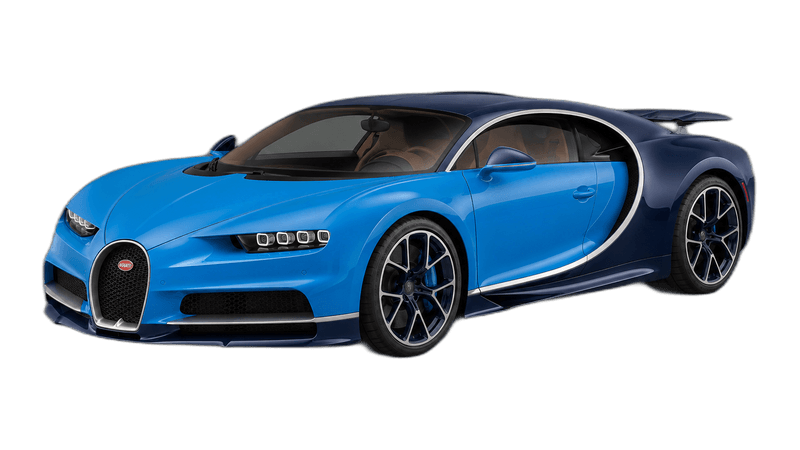
Bugatti Chiron
£3,000,000
usedIndicative market price, updated periodically.
1479bhp
Power
2.4s
0-100 km/h
420km/h
Top Speed
£3,000,000
Price Used
How hard it pulls.
Peak g-force the instant you bury the throttle, estimated from the car's 0–100 time and drivetrain.
Bugatti ChironEstimated peak launch g from the 0–100 time and drivetrain: an honest approximation, not a measured figure.
The Bugatti Chiron is a 2-door coupé by Bugatti, with 1479 bhp, 1600 Nm of torque, a 0-100 km/h time of 2.4 seconds and a top speed of 420 km/h. Indicative used value: approximately £3,000,000. Actual values vary with specification, condition and history.
Dream Car Garage Editorial · Edited by José Teo Lorente Vallecillos · Last updated 2 November 2026
Overview
We have not driven this car. This review is based on published specifications and the sources listed below.
Scope of this guide
This guide is scoped to the standard Bugatti Chiron, the two-seat, mid-engine, all-wheel drive coupe with the 8.0L quad-turbo W16 petrol (7993 cc) engine and the seven-speed dual-clutch gearbox, launched at the Geneva motor show in 2016 and built until 2023 or 2024 depending on the source. It is not a guide to the Chiron Sport, the Pur Sport, the Super Sport or the Super Sport 300+, which are separate cars with their own pages. We say below where those cars differ, so that you can tell which one an advert really describes.
We have not driven this model for this article. Everything here comes from three cited sources: Bugatti's own newsroom release for the Geneva 2016 launch, PistonHeads' used buying guide to the Chiron by Tony Middlehurst (1 April 2024), and the government vehicle recall checker. We also read a second Bugatti release, a Wikipedia article, two spec sheets and two news reports, and we flag every point that rests on them. Where sources disagree we say so rather than pick a winner quietly. Prices are history or asking prices, not valuations.
The figures at a glance
- Engine: 8.0L quad-turbo W16 petrol (7993 cc), mounted behind the cabin, with four turbochargers in a two-stage arrangement.
- Power: 1479 bhp, which is Bugatti's 1,500 PS converted by us (1,500 x 0.98632 is about 1479.5, which we round down to 1479). Bugatti's Geneva page says 1,500 HP and its Vienna release says 1,500 PS, so we are treating the two as the same metric figure. PistonHeads prints 1,500hp.
- Torque: 1600 Nm between 2,000 and 6,000 rpm, as Bugatti prints it. PistonHeads gives 1,179 lb ft, which is about 1598 Nm, so the two agree within rounding.
- 0-100 km/h: 2.4 seconds is the figure we use. PistonHeads prints it as 0-62 mph in 2.4 seconds, and we treat 62 mph as 100 km/h. The Bugatti pages we read give no acceleration time at all.
- Top speed: 420 km/h, which Bugatti describes as a limit for road use, reached in a dedicated Top Speed mode. PistonHeads gives 261 mph, the same figure in miles per hour.
- Drive: all-wheel drive. Bugatti calls it permanent four-wheel drive. The car is mid-engine, so the engine drives all four wheels through the seven-speed dual-clutch gearbox.
- Weight: 1,995 kg in the PistonHeads table. Wikipedia gives 1,996 kg as an estimate. Bugatti's pages we read give no weight.
What the standard Chiron was
The Chiron replaced the Veyron. Bugatti's Geneva release calls it the first production super sports car to bring 1,500 PS and 1,600 Nm of torque onto the road, and says only 500 would be built. The basic price was 2.4 million euros before tax. PistonHeads says the base 2016 to 2018 car cost 2.1 million pounds new and that the final total across all versions was 500, against 450 Veyrons. It also says the Chiron is more than 100 kg heavier than the Veyron.
Bugatti's release describes a redesigned W16 with four larger turbochargers. Two work from a standstill and the other two join in at about 3,800 rpm, which matches PistonHeads' remark that full boost arrives from 3,800 rpm. The Vienna release adds duplex fuel injection with 32 injectors. PistonHeads says about 80 per cent of the engine's internals had changed from the first Veyron by 2021, although we have not verified that figure.
How many were built
The count of standard cars is the weakest number in this guide. PistonHeads' table says 200 base cars, and the production row we started with agreed. Wikipedia, which we read only through a summary, gives about 207 standard cars and 501 across all variants. Bugatti's launch release says only that 500 cars would be produced in total. We use 200 because a cited source states it, and we say plainly that it is one source's figure, not a settled fact. The end of production is also unsettled: PistonHeads says the last cars were built in October 2023, while Wikipedia gives 2016 to 2024, which we keep for the dates in this guide.
Why the quoted power and acceleration vary
Bugatti quotes 1,500 PS or 1,500 HP, PistonHeads prints 1,500hp and Wikipedia prints 1,479 hp alongside 1,500 PS. A news report from the 2016 launch quoted 1479 bhp. These are the same engine rated in different units. Metric horsepower and brake horsepower differ by about 1.4 per cent, so a 1,500 PS car is a 1479 bhp car. The Super Sport is a 1,600 PS car, which is a real difference and not a units issue.
Acceleration is less tidy. The news report we read from March 2016 said the car was preliminary, with 0-100 km/h in under 2.5 seconds, 0-200 km/h in less than 6.5 seconds and 0-300 km/h below 13.6 seconds, because final certification was not complete. A French road test attributes 2.4 seconds, 6.1 seconds and 13.1 seconds to Bugatti and says the maker called them conservative. PistonHeads uses 2.4 seconds. We use 2.4 seconds as the maker's later claim and treat the launch figure as an early estimate. We have not timed a car, and nobody should expect to repeat these numbers on a public road.
Top speed carries a condition. Bugatti says the 420 km/h limit applies for road use and is reached in Top Speed mode. Wikipedia, read by summary, says the car is limited to 375 to 380 km/h without a special key. PistonHeads says the Michelin tyres were rated for only 15 minutes at top speed and that a tyre older than two years stopped the speed mode from engaging. Treat 420 km/h as a claim that needs the right key, tyres and a closed road.
Drivetrain and layout
The standard Chiron is all-wheel drive, which Bugatti calls permanent four-wheel drive, with a seven-speed dual-clutch gearbox that Bugatti says is designed for 1,600 Nm. PistonHeads says it was built by Ricardo and that its clutch was reputedly the largest in automotive production. A German spec page we read lists the engine as mounted longitudinally in the middle of the car. The driving modes alter the ride height and damping, and PistonHeads says Autobahn mode raises the rear.
How the Chiron differs from other versions
The Chiron Sport arrived in 2018 at about 2.5 million pounds, per PistonHeads. Its outputs are the same as the standard car, but it is 18 kg lighter through more carbon fibre, has damping stiffened by about 10 per cent, torque vectoring and a revised rear differential. PistonHeads says it is claimed to be about a tenth of a second quicker to 62 mph.
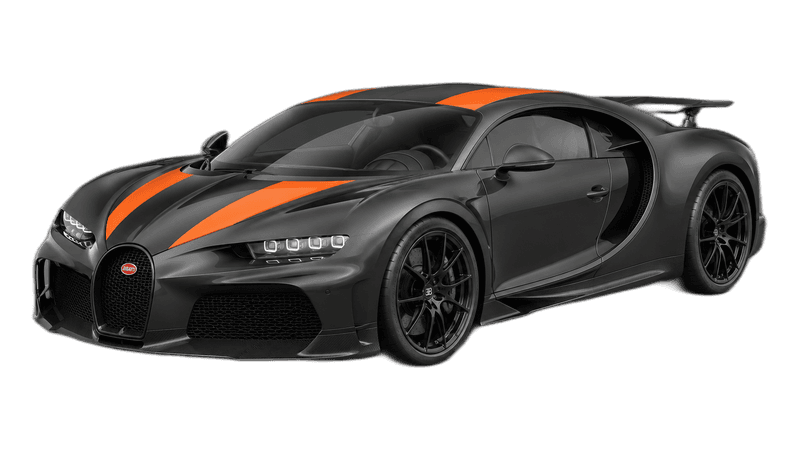
The Super Sport 300+ of 2019 is a 1,600hp car with revised rear bodywork and a 273 mph limiter, and PistonHeads says 30 were sold to customers. The 2021 Super Sport also has 1,600hp and a 273 mph limiter. The Pur Sport of 2020 is a handling car with much firmer suspension, shorter gearing and a top speed limited to 217 mph, with 60 built. There are also limited editions such as the 110 Ans, with 20 cars. If an advert quotes 1,600hp, 273 mph or a limited-run name, it is not a standard car, and you should check the chassis details with Bugatti.
Engine, gearbox and running costs
PistonHeads says annual servicing is likely to cost between 10,000 and 20,000 pounds. That is an estimate from one guide, not a quote, and we found no itemised service schedule in the cited sources. It also says the Veyron had to be returned to France for repair, while the Chiron's dealer network can often collect and repair cars locally, depending on the country, and that Bugatti's support line reportedly operates at any hour with specialist technicians available.
Fuel use is heavy. Bugatti's Geneva page lists 25.2 litres per 100 km combined on the WLTP cycle with 572 g/km of carbon dioxide. PistonHeads says under 12 mpg and notes that the 22-gallon fuel tank may be too small for limit-free touring, since use can pass one gallon a minute at very high speed. The guide also warns that the low-rpm torque may deter some owners from using full throttle. It does not discuss cooling, hydraulics or paint, so we say nothing about them either.
Tyres, wheels and brakes
Bugatti says the Michelin tyres are 285/30 R20 at the front and 355/25 R21 at the rear, and PistonHeads gives 355/24 for the rear. We use Bugatti's figure for the size and flag the difference. Unlike the Veyron, PistonHeads says the Chiron's rims were designed to last the life of the car, so there is no costly wheel-replacement regime. The brakes are carbon ceramic discs with titanium calipers, eight pistons at the front and six at the rear, per Bugatti and PistonHeads. PistonHeads adds that the handbrake has its own anti-lock circuit and that the front heat shields make a little downforce. We found no cited price for tyres or discs, so we give none.
Recalls and software updates
PistonHeads describes a small number of Chiron recalls. A 2018 car needed a front frame support screw inspected and tightened. Defective welds in seat recliner brackets affected 47 early cars. A stability control fault meant the system did not return to full function after Handling mode had been used. A single Super Sport built in March 2023 had the wrong wheels, and the Pur Sport had a rear-tyre cracking recall that led to a maximum life of 2,500 miles for those tyres. A software update for the seatbelt chime may apply to all Chirons. Several of these are specific to one version or a handful of cars, so ask whether a given car was in scope.
Values and buying notes
PistonHeads says many Chirons cost nearer 3 million pounds than 2 million once options are added, that cars are now listed from about 2.5 million pounds, and that one 2017 car was advertised at 2,650,000 pounds with 2,400 miles in March 2024. It says used cars are now slightly dearer than when new. These are asking prices from one outlet, and the guide itself warns that weight and power data are hard to verify and should be treated as relative.
What to check before buying
- Confirm the car is a standard Chiron and not a Sport, Pur Sport, Super Sport or limited edition, using the chassis number and Bugatti's own records.
- Ask for the full service history and who did the work, and confirm any open software updates or campaigns.
- Check the age and condition of the tyres, because PistonHeads says a tyre older than two years blocks Top Speed mode.
- Ask whether the seat, front frame and stability control recalls were done on that car.
- Look at the carbon ceramic brakes, the calipers and any signs of overheating.
- Ask how many miles the car has covered and how it was stored, and prefer a car that has been used.
- Check the options on the build sheet, because they move the price a lot.
- Run the registration through the recall check described below.
The DVSA recall check
The GOV.UK checker for cars takes a registration number and shows outstanding safety recalls that have not been checked or fixed, plus the car's MOT history. If you do not have the registration, a separate recall checker asks for the make, model and year. The page says the manufacturer will tell you about recalls for reasons other than safety, so ask Bugatti or an approved dealer as well. We did not run the checker for any car.
Verdict
The standard Chiron is 1479 bhp, 1600 Nm, a claimed 2.4 seconds to 100 km/h and a limited 420 km/h, all-wheel drive and mid-engine, in a run that PistonHeads puts at 200 standard cars. It suits an owner who accepts specialist servicing, expensive tyres and a lot of paperwork. If you are shopping for one, confirm which version it is, insist on a full history and recall record, and treat every published figure as a claim with the caveats above. We have not driven it, so use the sources and a proper inspection to decide.
Specifications
Engine
8.0L quad-turbo W16 petrol (7993 cc)
Displacement
8.0L
Power
1479 bhp
Torque
1600 Nm
0-100 km/h
2.4s
Top Speed
420 km/h
Drivetrain
AWD
Country
France
Body Style
2-door coupé
Years
2016–2024
Production
200
Price Used
£3,000,000
Specifications are manufacturer-published figures.
More from Bugatti
Featured in Carpedia
Best Hypercars 2026
From Koenigsegg's 2,000bhp Regera to the twin-turbocharged fury of the Hennessey Venom F5, these are the ten hypercars that define the absolute limit of automotive engineering in 2026.
The 25 Fastest Cars from 0-100 km/h, Ranked
The 25 fastest production and limited-production cars ranked by 0-100 km/h time. From the 1.81-second Rimac Nevera to the 2.5-second Chevrolet Corvette E-Ray, every car backed by verified data.
Koenigsegg Jesko Absolut vs Bugatti Chiron Super Sport 300+ vs SSC Tuatara
Above 400 km/h the language of normal automotive comparison breaks down. The Jesko Absolut, the Chiron Super Sport 300+, and the SSC Tuatara are not products: they are engineering manifestos about the limits of what a road car can achieve. Each one believes it is the fastest. Only physics will arbitrate.
How Much Does a Dream Car Garage Cost?
A data-driven analysis of dream car costs using verified pricing from 600 performance and luxury cars. From the GBP 6,000 Mazda MX-5 NB to the GBP 6,000,000 Porsche 911 GT1, with price distributions, value picks, and hidden cost breakdowns.
Frequently Asked Questions
What are the specifications of the Bugatti Chiron?
The Bugatti Chiron is a 2-door coupé by Bugatti, with 1479 bhp, 1600 Nm of torque, a 0-100 km/h time of 2.4 seconds and a top speed of 420 km/h. Indicative used value: approximately £3,000,000. Actual values vary with specification, condition and history.
How much does a Bugatti Chiron cost?
Indicative used value: approximately £3,000,000. Actual values vary with specification, condition and history.
How many Bugatti Chiron were made?
Bugatti produced 200 units of the Bugatti Chiron.
What drivetrain does the Bugatti Chiron use?
The Bugatti Chiron is configured with all-wheel drive.
What type of car is the Bugatti Chiron?
The Bugatti Chiron is a hypercars manufactured by Bugatti in France. Production ran from 2016 to 2024.