
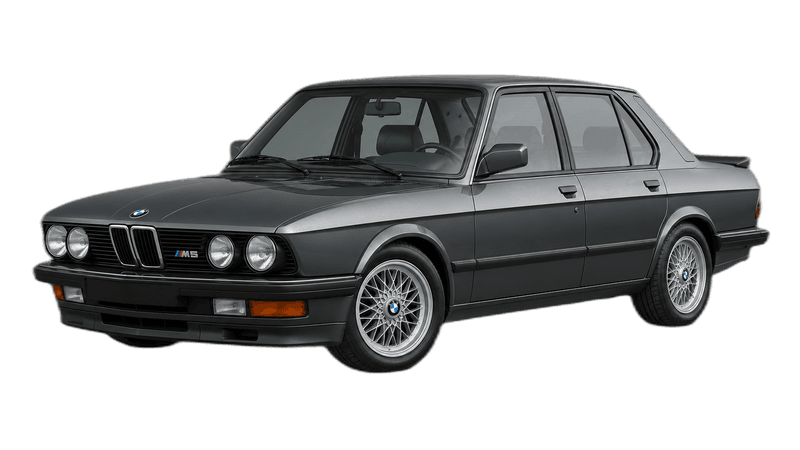
BMW M5 (E39)
£32,000
usedIndicative market price, updated periodically.
394bhp
Power
5.3s
0-100 km/h
250km/h
Top Speed
£32,000
Price Used
How hard it pulls.
Peak g-force the instant you bury the throttle, estimated from the car's 0–100 time and drivetrain.
BMW M5 (E39)Estimated peak launch g from the 0–100 time and drivetrain: an honest approximation, not a measured figure.
The BMW M5 (E39) is a 4/5 seater sedan/saloon by BMW, producing 394 bhp, and 500 Nm of torque, with a 0-100 km/h time of 5.3 seconds, and a top speed of 250 km/h, Valued at approximately £32,000.
Dream Car Garage Editorial · Last updated 24 October 2026
Overview
We have not driven this car. This review is based on published specifications, owner reports and market listings.
A specific kind of performance saloon
The E39 M5 combines a naturally aspirated V8, rear-wheel drive and a six-speed manual transmission. That combination distinguishes it from later turbocharged and automatic M5s more usefully than an argument about which generation is best. The car also retains the practical format of a four-door saloon, although its running requirements should not be inferred from those of an ordinary E39.
We have not driven this model for this article. This desk-researched guide treats published descriptions of its character as context, not personal test results. The relevant purchase is an individual ageing vehicle: its present steering, ride, cooling and engine condition may differ substantially from the qualities described in a period review.
Start with identity and records
Confirm the VIN, original specification and installed drivetrain. Ask about replacement engines, transmission work and modifications, and reconcile the answers with invoices. A comprehensive file should identify what was inspected, what was replaced and who performed the work. The phrase full history does not establish that every supplementary or age-related task has been addressed.
Separate routine servicing from refurbishment. A car may have received regular oil changes while retaining worn suspension or a deteriorated cooling system. Conversely, a recently rebuilt engine does not establish the condition of the body, differential or electronics. Create a list of the outstanding questions before commissioning the inspection so that expensive work is not accidentally treated as irrelevant.
Assess the S62 rather than diagnosing from reputation
VANOS operation, timing-drive condition, cooling and oil leaks warrant specialist attention. Do not treat one cold-start sound as a complete diagnosis of guides, chains or adjusters. Ask how any symptom will be investigated, what records exist and what uncertainty remains. Completed work can be useful evidence without guaranteeing the health of every related component.
Observe a proper cold start and a full warm-up where practical. Check for unstable temperatures, leaks, poor running and warning messages. The inspecting specialist may recommend further tests based on those observations. Neither a quiet demonstration nor a recent replacement tensioner establishes that all internal engine parts are sound, and no universal preventive-replacement interval is prescribed here.
Cooling and use history
Review the radiator, hoses, expansion tank, water-pump history and any recorded overheating. Ask why components were changed and whether subsequent operation was checked. A set of new parts can represent careful maintenance or an unresolved fault; invoices and diagnosis help distinguish the two. Avoid accepting repeated coolant top-ups as a normal feature that needs no explanation.
Low mileage should be interpreted alongside storage and maintenance. Long inactivity can create work involving seals, fluids, tyres and fuel systems. Ask what care continued while the car was unused. A recommissioning invoice should describe its scope rather than merely state that the engine was started and the car passed a basic roadworthiness test.
Body and chassis deserve equal weight
Inspect corrosion, jacking points, sills, wheelarches, floors and previous repairs with someone familiar with the platform. Check water entry and hidden storage areas, not just the visible paint. A polished engine bay does not offset a structural problem. Where an area cannot be inspected without dismantling, have that limitation recorded and decide whether further access is justified.
Assess dampers, bushes, steering joints, mounts and alignment. Uneven tyre wear and vibration need investigation rather than being dismissed as the price of driving an old M car. Test brakes and clutch appropriately and review transmission and differential servicing. A good chassis assessment describes the installed parts and their condition, not a generic instruction to replace the entire suspension.
Cabin equipment matters in a touring car
Test displays, pixels, climate control, windows, locks, seat functions and the equipment fitted to the example. An original navigation system may have historical appeal without being useful for current journeys. Establish the quality of any modern audio or electrical installation and whether it introduced wiring faults, battery drain or missing original components.
Try the driving position and passenger space with the intended users. Check the boot and any towing or carrying requirements against the actual vehicle's approval. Everyday usability is part of the reason to choose this M5, so a purchase that cannot perform the owner's ordinary journeys needs reconsideration regardless of its specification or reputation.
Quote the work instead of inventing an annual bill
Obtain separate estimates for immediate maintenance, unresolved faults and cosmetic work. Labour, parts choice and scope vary, and this guide contains no current quotation survey establishing a universal service fee. Include tyres, fuel, insurance, storage and a contingency. An attractive asking price is not a sufficient budget for a car with several deferred repairs.
Identify the workshop that will support it after purchase. Familiarity with BMW generally is useful, but ask about experience with the S62 installation and diagnostic equipment. Discuss the availability of model-specific parts and transport if the car cannot be driven. A practical repair pathway matters more than a broad assurance that specialists can fix anything.
Price comparisons and alternatives
Use comparable specification, history and condition when examining advertisements. This article does not establish that values have increased, reached a floor or will recover ownership costs. Asking prices and completed transactions are different evidence. Obtain a dated independent valuation if a financial decision depends on the car's market value, and account for selling and restoration costs.
The E60 M5 offers a V10 and a different transmission experience; the F10 changes to turbocharged V8 power. Neither is automatically more reliable or less expensive because it is newer. The E39 suits someone who specifically wants its manual V8 saloon layout and is prepared to maintain the complete vehicle, not merely complete a list of fashionable engine jobs.
How this review was compiled
Model history and published editorial coverage inform this desk-researched overview. No test drive, live transaction survey or measured failure-rate study was undertaken. The links are further reading and cannot certify a particular vehicle. An independent inspection should identify the car's present needs and distinguish evidence from remaining uncertainty.
Specifications
Engine
4.9L S62 V8 petrol (naturally aspirated)
Displacement
4.9L
Power
394 bhp
Torque
500 Nm
0-100 km/h
5.3s
Top Speed
250 km/h
Drivetrain
RWD
Country
Germany
Body Style
4/5 seater sedan/saloon
Years
1998–2003
Price Used
£32,000
Specifications are manufacturer-published figures.
More from BMW
Frequently Asked Questions
What are the specifications of the BMW M5 (E39)?
The BMW M5 (E39) is a 4/5 seater sedan/saloon by BMW, producing 394 bhp, and 500 Nm of torque, with a 0-100 km/h time of 5.3 seconds, and a top speed of 250 km/h, Valued at approximately £32,000.
How much does a BMW M5 (E39) cost?
The BMW M5 (E39) has a used market value of approximately £32,000.
Is the BMW M5 (E39) AWD or RWD?
The BMW M5 (E39) uses a RWD drivetrain configuration in a 4/5 seater sedan/saloon body style.
What type of car is the BMW M5 (E39)?
The BMW M5 (E39) is a super saloons manufactured by BMW in Germany. Production ran from 1998 to 2003.