
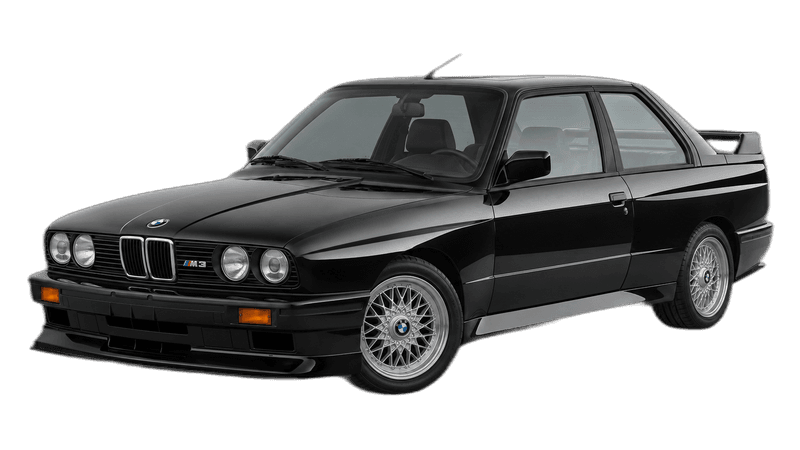
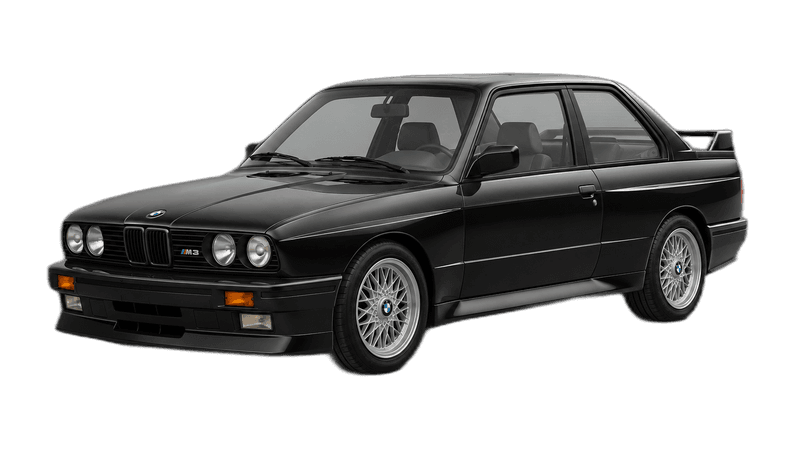
BMW M3 (E30)
£85,000
usedIndicative market price, updated periodically.
197bhp
Power
6.7s
0-100 km/h
235km/h
Top Speed
£85,000
Price Used
How hard it pulls.
Peak g-force the instant you bury the throttle, estimated from the car's 0–100 time and drivetrain.
BMW M3 (E30)Estimated peak launch g from the 0–100 time and drivetrain: an honest approximation, not a measured figure.
The BMW M3 (E30) is a 2-door coupé by BMW, with 197 bhp, 240 Nm of torque, a 0-100 km/h time of 6.7 seconds and a top speed of 235 km/h. Indicative used value: approximately £85,000. Actual values vary with specification, condition and history.
Dream Car Garage Editorial · Last updated 24 October 2026
Overview
We have not driven this car. This review is based on published specifications and the sources listed below.
The case for the E30 M3
The original M3 was built to win races. Created in 1986 to homologate the E30 for Group A touring car racing, it featured a high-revving S14 four-cylinder engine, box-arch bodywork and a chassis developed by BMW Motorsport. With 195hp in standard form (200hp without a catalyst), it was the defining touring car of its era.
The homologation story explains its appeal without deciding whether a particular example is a good purchase. This is a desk-researched guide; we have not driven this model for this article. Published descriptions of the S14's character are context for choosing a car, not a substitute for checking how the actual engine, suspension and steering behave after decades of use.
What it costs to run
Request a maintenance proposal from someone familiar with the S14, separating routine servicing, valve-clearance work and any diagnosed internal engine repairs. A rebuild quotation needs its own scope, parts and exclusions; a broad annual allowance cannot represent every possible car. Include storage and insurance, but confirm policy eligibility and usage limits rather than assuming classic cover applies automatically.
Parts availability is good for mechanical components thanks to BMW Classic and the huge E30 community, but M3-specific body panels, trim and the unique DTM-style bodywork are expensive and increasingly rare. The Getrag dog-leg gearbox is tough but rebuilds are costly.
Known weak points
Rust is the biggest issue. The E30 shell corrodes in the sills, rear arches, jacking points and around the battery tray. Many M3s have been restored or repaired, and quality varies enormously. Check the front suspension turrets and the boot floor for accident damage and rust.
The S14 engine needs careful maintenance. Timing chain wear, valve adjustment and cooling system condition are critical. The engine is sensitive to oil quality and neglect. SMG transmissions are not fitted to the E30; it uses a Getrag manual, which is durable but synchros wear with hard use.
What to check before buying
Structure first. Get the car on a ramp and inspect the sills, arches, jacking points and front turrets for rust, filler and poor repairs. A genuinely rust-free shell is worth a premium. Check for accident damage, particularly to the front chassis legs.
Verify the car's identity and provenance. Check the chassis number and engine number, and confirm the specification is correct. Many standard E30s have been dressed up as M3s, so matching numbers and a documented history matter enormously. A full BMW Classic certificate adds confidence.
Market and depreciation
Compare the same engine, market specification and derivative, accounting for restoration, modifications and steering conversion. A seller's asking price is not a completed sale. There is no dated transaction sample here establishing a current value range, appreciation rate or resale floor. An independent valuation should explain its comparable cars and adjust for their condition rather than repeating an advertised maximum.
Assess restoration costs through actual quotations. A complete car may avoid a difficult trim search, but its higher price is not proof of sound structure. Document what the inspector can establish and what remains uncertain. Neither originality nor competition heritage guarantees recovery of purchase and maintenance spending when the car is sold.
Who it suits
The E30 M3 suits an enthusiast who appreciates its motorsport significance and is prepared to maintain a valuable classic properly. It is still a brilliant driver's car, but values now mean most are cherished rather than used hard.
A 325i or 318is offers a different E30 ownership route without the same M3-specific body and engine requirements. Neither eliminates age-related repairs. Buy the M3 because its history and configuration matter to you, not because a seller describes it as financially safe.
Alternatives
The Sport Evolution offers more power and rarity. The E46 M3 is the modern classic. The Mercedes 190E 2.5-16 is the period rival. The Alfa Romeo 75 is the Italian alternative.
The S14 is the heart of the car: a motorsport four that needs revs and rewards them, with a usable chassis that makes the E30 M3 one of the most complete classic driving experiences. It is not fast in a straight line by modern standards, but momentum driving is the point. Check for the characteristic tappet noise on start-up and ask when the valve clearances were last adjusted.
Document the shell before discussing cosmetic originality. Ask for photographs of structural work, inspection of the rear screen area and evidence of how corrosion around mounting points was repaired. Replacement trim and model-specific panels should be priced and located before purchase if they are missing. A heritage document helps establish original identity but does not certify the condition of the shell today.
Factory E30 M3s were left-hand drive. A right-hand-drive example is a conversion and needs its own installation history, engineering assessment and insurance disclosure. Establish who changed the steering, pedals and related components, and how the work was approved. A converted example may suit its owner, but it must not be advertised or valued as a rare factory right-hand-drive specification.
Engine work is the expensive end: an S14 rebuild by a specialist is a five-figure exercise, so evidence of recent top-end work, chain guides and valve clearances is valuable. Gearboxes and differentials are durable; bushes and dampers wear predictably. Many cars carry sensible upgrades - suspension kits, brakes - which are acceptable if documented and reversible, but original specification commands the premium.
Insurance and security deserve attention now that values are significant: tracker, secure storage and agreed-value cover are standard practice. Join the model registers - provenance documented through clubs and specialists materially supports resale. Used as intended, the E30 M3 is one of the most rewarding classic BMWs and one of the few whose running costs remain rational.
How this review was compiled
Desk-researched guide. We have not driven this model for this article. The references establish model history and inspection questions, not measured reliability or current transaction prices. Have an E30 M3 specialist inspect the structure, installed specification and maintenance requirements before deciding whether an individual car is suitable.
Specifications
Engine
2.3L naturally aspirated inline-4 petrol (S14)
Displacement
2.3L
Power
197 bhp
Torque
240 Nm
0-100 km/h
6.7s
Top Speed
235 km/h
Drivetrain
RWD
Country
Germany
Body Style
2-door coupé
Years
1986–1991
Price Used
£85,000
Specifications are manufacturer-published figures.
More from BMW
Frequently Asked Questions
What are the specifications of the BMW M3 (E30)?
The BMW M3 (E30) is a 2-door coupé by BMW, with 197 bhp, 240 Nm of torque, a 0-100 km/h time of 6.7 seconds and a top speed of 235 km/h. Indicative used value: approximately £85,000. Actual values vary with specification, condition and history.
How much does a BMW M3 (E30) cost?
Indicative used value: approximately £85,000. Actual values vary with specification, condition and history.
What drivetrain does the BMW M3 (E30) use?
The BMW M3 (E30) is configured with rear-wheel drive.
What type of car is the BMW M3 (E30)?
The BMW M3 (E30) is a super saloons manufactured by BMW in Germany. Production ran from 1986 to 1991.