
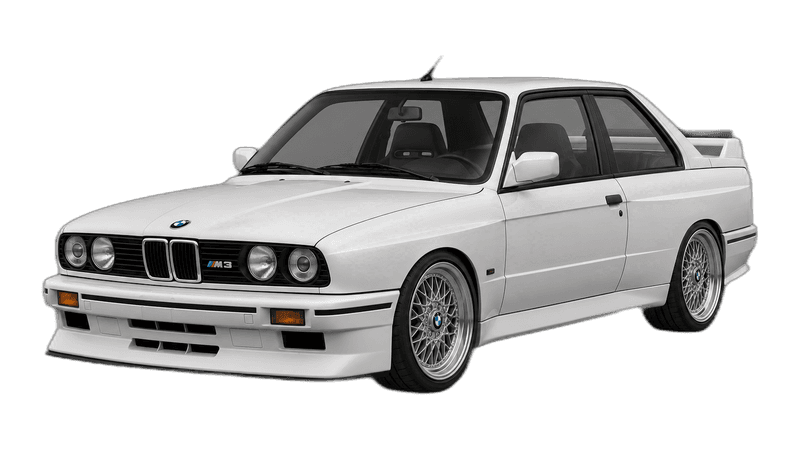
BMW M3 CSL (E46)
£95,000
usedIndicative market price, updated periodically.
360bhp
Power
4.9s
0-100 km/h
250km/h
Top Speed
£95,000
Price Used
How hard it pulls.
Peak g-force the instant you bury the throttle, estimated from the car's 0–100 time and drivetrain.
BMW M3 CSL (E46)Estimated peak launch g from the 0–100 time and drivetrain: an honest approximation, not a measured figure.
The BMW M3 CSL (E46) is a 2-door coupé by BMW, producing 360 bhp, and 370 Nm of torque, with a 0-100 km/h time of 4.9 seconds, and a top speed of 250 km/h, Valued at approximately £95,000.
Dream Car Garage Editorial · Last updated 24 October 2026
Overview
We have not driven this car. This review is based on published specifications, owner reports and market listings.
A derivative to authenticate, not a badge to recognise
The E46 M3 CSL introduced a more focused interpretation of the S54-powered coupe in 2003. BMW's historical account records 1,383 cars. That total provides context, not a way to authenticate an individual vehicle. Confirm the VIN, factory specification and history rather than assuming a carbon roof, front bumper or plaque establishes CSL identity.
We have not driven this model for this article. This desk-researched guide concentrates on the engineering differences and the buying questions they create. Its interest does not depend on a prediction of future prices. A scarce car can still require expensive repairs, be difficult to sell or fail to suit an owner's practical needs.
What actually changed
The CSL combines a carbon-fibre roof and distinctive carbon intake with other weight-saving measures. It is not an all-carbon-bodied M3: materials vary, including an aluminium bonnet. BMW also revised steering, suspension and brakes. Describing the entire running gear as identical to a standard M3 overlooks components that matter when inspecting or ordering replacements.
The gearbox is SMG, an automated single-clutch manual. A converted manual may reflect an owner's preferences, but it is no longer the original factory transmission configuration. Establish what was changed, how it was documented and whether original parts remain. Do not assume a conversion either guarantees desirability or makes the car unacceptable to every buyer.
Establish completeness and condition
Ask for the original equipment record and inspect the seats, trim, intake, roof and aerodynamic components. Some comfort equipment varied, so confirm the build rather than treating the presence of air conditioning or audio as automatic evidence of an incorrect car. Rarity does not excuse missing documents or unexplained deviations from the factory specification.
Obtain current availability and quotations for damaged or missing parts. Do not assume every CSL-specific component is unobtainable, or that ordinary M3 parts are equivalent. The appropriate question is what can be sourced now for this chassis and at what cost. A small incomplete detail can affect usability or authenticity even when the engine runs well.
Carbon parts and accident history
Inspect the carbon roof, intake and relevant body components with an appropriate specialist. A cosmetic mark, damaged removable panel and structural issue are different findings requiring different responses. Ask for photographs and invoices after any incident. Fresh paint or a clean carbon finish cannot establish that the car has never suffered significant damage.
The underlying shell also needs inspection for corrosion and previous repairs. Check alignment, suspension attachment areas and the rear axle-carrier panel. Do not restrict that assessment to cars known to have been tracked. If reinforcement or repairs are documented, review their method and surrounding condition rather than accepting the existence of an invoice as a complete structural certification.
S54 and SMG assessment
Review oil servicing, relevant campaigns, valve-clearance work and any VANOS or bearing repairs. Ask a model-experienced technician to distinguish current diagnosis from preventive options. A guide cannot prescribe one replacement programme for every engine or prove internal condition through sound alone. Completed work should be documented with dates, mileage, parts and the responsible workshop.
Test SMG cold and warm, including normal low-speed manoeuvres and reverse. Its operating character differs from a torque-converter automatic, but unexplained faults should still be diagnosed. Inspect clutch operation and the hydraulic system using appropriate equipment. A cleared warning message or a seller's claim that a pump was recently replaced does not establish the health of every related component.
Track history changes the questions
The CSL's focus makes circuit use unsurprising, but it should be discussed openly. Ask for event-preparation records, alignment information and consumable replacement history. Road mileage is not a reliable measure of braking, tyre or suspension demand during repeated track sessions. An honestly maintained track-used car may be easier to understand than an example with a vague low-use description.
Inspect brakes, wheels, dampers, bushes and tyre specification. Confirm suitability for the intended climate and use; a track-focused tyre is not automatically the best choice for wet or cold roads. If events are planned, establish noise limits, safety requirements, insurance and recovery arrangements before assuming the car can attend every local circuit.
Fit and running costs
Try the seats, access and driving position in person. Lightweight cabin equipment can be appealing without being comfortable for every driver or passenger. Demonstrate the equipment actually fitted and check ventilation and weather sealing. A purchase made mainly for touring should be assessed differently from one intended for occasional circuit use.
No current quotation survey here supports one service fee or annual budget. Request separate estimates for routine work, CSL-specific repairs, structural concerns and consumables. Include storage, insurance and transport where relevant. The ordinary M3's parts network can help, but it does not establish that every CSL repair is straightforward or inexpensive.
Values and alternative choices
Compare documented CSL examples by originality, transmission configuration, repair history and equipment. Asking prices do not establish transactions or a reliable appreciation trend. Do not use an uncertain right-hand-drive production count to justify a premium: market-specific allocations and worldwide steering-side totals are different figures. Obtain a dated valuation if the decision depends on one.
A standard E46 M3 may better suit a buyer who values the engine and practical format more than the CSL equipment. A contemporary Porsche GT3 introduces its own generation-specific inspection and operating requirements. Neither comparison can be decided by rarity alone. Choose the CSL because its documented specification fits the intended use, not because holding it is expected to pay for ownership.
How this review was compiled
BMW's historical material and technical press documentation establish the model distinctions discussed here. No test drive, transaction survey, cost survey or measured reliability study was undertaken. The links are further reading. Have the car independently authenticated and inspected, and obtain quotations for unresolved work before purchase.
Specifications
Engine
3.2L naturally aspirated inline-6 petrol (S54)
Displacement
3.2L
Power
360 bhp
Torque
370 Nm
0-100 km/h
4.9s
Top Speed
250 km/h
Drivetrain
RWD
Country
Germany
Body Style
2-door coupé
Years
2003–2004
Price Used
£95,000
Specifications are manufacturer-published figures.
More from BMW
Frequently Asked Questions
What are the specifications of the BMW M3 CSL (E46)?
The BMW M3 CSL (E46) is a 2-door coupé by BMW, producing 360 bhp, and 370 Nm of torque, with a 0-100 km/h time of 4.9 seconds, and a top speed of 250 km/h, Valued at approximately £95,000.
How much does a BMW M3 CSL (E46) cost?
The BMW M3 CSL (E46) has a used market value of approximately £95,000.
Is the BMW M3 CSL (E46) AWD or RWD?
The BMW M3 CSL (E46) uses a RWD drivetrain configuration in a 2-door coupé body style.
What type of car is the BMW M3 CSL (E46)?
The BMW M3 CSL (E46) is a super saloons manufactured by BMW in Germany. Production ran from 2003 to 2004.