
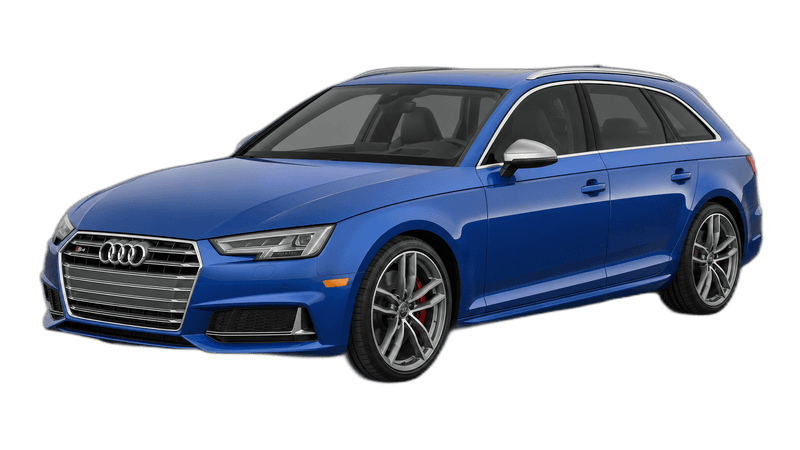
Audi S4 Avant (B9)
£35,000
usedIndicative market price, updated periodically.
349bhp
Power
4.9s
0-100 km/h
250km/h
Top Speed
£35,000
Price Used
How hard it pulls.
Peak g-force the instant you bury the throttle, estimated from the car's 0–100 time and drivetrain.
Audi S4 Avant (B9)Estimated peak launch g from the 0–100 time and drivetrain: an honest approximation, not a measured figure.
The Audi S4 Avant (B9) is a 5-door avant (estate/wagon) by Audi, with 349 bhp, 500 Nm of torque, a 0-100 km/h time of 4.9 seconds and a top speed of 250 km/h. Indicative used value: approximately £35,000. Actual values vary with specification, condition and history.
Dream Car Garage Editorial · Last updated 2 November 2026
Overview
We have not driven this car. This review is based on published specifications and the sources listed below.
The quick estate with a turbocharged V6
The Audi S4 Avant is the fast, understated estate version of the B9 generation A4, with a turbocharged six-cylinder petrol engine and quattro all-wheel drive. This guide is scoped to the 3.0 TFSI petrol S4 Avant sold in Europe from 2016 to 2019. In 2019 the facelifted S4 in Europe swapped the petrol V6 for a 3.0 TDI diesel with a mild-hybrid system, so that car is a different engine with different figures and is not covered here. The saloon shares the engine but is a separate body with its own weight and acceleration time, and the RS4 Avant is a different, more powerful car. Our catalogue lists a 3.0L turbocharged V6 TFSI petrol engine of 2,995 cc producing 349 bhp and 500 Nm, with 0 to 100 km/h in 4.9 seconds, a limited top speed of 250 km/h, an eight-speed tiptronic automatic and quattro all-wheel drive. We have not driven this model for this article. This is a desk-researched ownership guide built from Audi AG's February 2016 press information, a PistonHeads long-term review published in February 2017 and the government recall check, with a few clearly named secondary reads where those three are silent. The PistonHeads piece is a six-month driving report and not a used buying guide, because we could not find a PistonHeads used buying guide for the S4 Avant, so treat its ownership points as one reviewer's observations and not as a fault history.
Checking the figures
Audi's press information gives the engine as 260 kW (354 hp) and 500 Nm of torque. That is the metric horsepower figure, 354 PS, and it converts to the 349 bhp in our catalogue. evo, reviewing the B9 S4 Avant range, also quotes 349 bhp for the petrol car, and PistonHeads prints 354 hp, so an advert that says 354 PS, 354 hp, 260 kW or 349 bhp describes one engine. The Avant is slower than the saloon: Audi's at-a-glance table gives 4.7 seconds for the S4 saloon and 4.9 seconds for the Avant, which matches PistonHeads' 0 to 62 mph time of 4.9 seconds. Both cars have an electronically governed top speed of 250 km/h, which PistonHeads prints as 155 mph.
A few details differ between sources. Audi's February 2016 document starts the 500 Nm plateau at 1,370 rpm and holds it to 4,500 rpm, while a reprint of the September 2015 launch release says 1,300 rpm, so we use the later Audi document. The same document also gives the lb-ft conversion as 368.8 in some places and 516.3 in one place, and 500 Nm is 368.8 lb-ft, so the larger number looks like a typing error. PistonHeads prints 369 lb ft in its text and 368 lb ft in its spec table. For weight, Audi lists 1,675 kg for the Avant, 75 kg less than the previous model, and PistonHeads lists 1,750 kg on the EU basis with a 75 kg driver, which appears to be the same car with the driver added. Do not confuse the petrol car with the facelifted diesel: Audi's media page for the S4 Avant TDI gives 700 Nm and 4.7 seconds, and gives power as both 255 kW (347 hp) and 251 kW (341 hp) in different places, while evo calls the diesel 342 bhp. The previous B8 S4 had a supercharged 3.0 V6 with 245 kW (333 hp) and 440 Nm, so it is also a different car.
Engine and gearbox
Audi describes the 3.0 TFSI as redeveloped from the ground up, sharing only its bore and stroke with the previous engine. It replaced the mechanical supercharger with a twin-scroll turbocharger mounted inside the V of the cylinder banks, and Audi says the engine weighs 172 kg, 14 kg less than before. It has direct petrol injection, four adjustable camshafts, a variable-lift valve system on the inlet side, a switchable water pump and an exhaust manifold integrated into the cylinder head, with coolant circulating around it. We found no engine fault history for this unit in the sources we read, so the checks below are general ones. Look for a smooth cold start and even idle, ask for evidence of regular oil changes, check the coolant level and look for seepage around the engine and the cooling system, and have the car scanned for stored fault codes.
The gearbox is an eight-speed tiptronic torque-converter automatic, not the dual-clutch S tronic of the earlier S4. Audi says it has short lower gears, long upper gears and a freewheeling mode between 55 and 160 km/h when you lift off, and that start-stop works from 3 km/h. There are D, S and E modes and shift paddles. PistonHeads called it slick in auto mode but frustratingly ponderous in manual, and said it could spontaneously downshift several ratios. That is one reviewer's experience, but it is worth a long test drive in each mode to see whether the shifts suit you.
Chassis, brakes and wheels
Audi's quattro system uses a self-locking centre differential that normally sends 60 percent of torque to the rear axle and 40 percent to the front, and can send up to 85 percent forward or 70 percent rearward when one axle slips. Torque vectoring brakes the inside wheels in fast corners, and an optional sport differential distributes torque between the rear wheels. PistonHeads rated the sport differential highly on its test car. Both axles use five-link suspension with electromechanical power steering, and dynamic steering was an option. The standard S sport chassis sits 23 mm lower than the base A4, and the optional damper-control chassis has the same ride height and adds continuous damping control to the Audi drive select modes. PistonHeads' car had the adaptive suspension and said it rode rather nicely, but called the steering flaccid, gloopy and inert, so spend time on the steering before you commit. Because options differ, confirm which chassis and which differential the car you are viewing actually has.
Audi lists front brakes with perforated, internally vented 350 mm discs and black or optional red six-piston fixed calipers with S lettering. We did not find a rear brake specification in the sources we read. Standard wheels are 18-inch with 245/40 tyres, and Audi Sport offered 19-inch wheels, which PistonHeads' test car had in a diamond-cut finish. Check each tyre for matching make and wear, look at the wheels for kerb damage, and inspect disc surfaces for lipping and the pads for wear. A test drive should include firm braking from speed to check pedal feel and straight-line stability.
Body, interior and electronics
Audi gives the Avant 505 litres of boot space with the seats up and 1,510 litres with the 40:20:40 split backrests folded and loaded to the roof. A power tailgate and luggage cover are standard, with optional foot-sensor opening. Audi quotes a drag coefficient of 0.31 for the Avant. Standard equipment included LED headlights with dynamic rear indicators and 18-inch wheels, and optional extras included Matrix LED headlights, a head-up display and the Audi virtual cockpit, a 12.3-inch digital instrument display. PistonHeads' RS4 Avant used buying guide, which covers a different car, mentions leaking headlight covers, a tailgate that can need a firm prod and various infotainment glitches. We have no S4-specific evidence for any of these, but they are sensible things to test on any B9 Avant.
Audi's press document is not consistent about the standard seats: one passage says standard upholstery is fine Nappa leather and another says front sport seats in an Alcantara and leather combination, while the S sport seats with pneumatic massage are an option. Check the actual specification on the car, and test the seat functions. The top infotainment option was MMI navigation plus with MMI touch and an 8.3-inch screen on the second-generation modular infotainment platform, with Audi connect, LTE and a Wi-Fi hotspot, a smartphone interface for Apple CarPlay and Android Auto, an optional Qi phone box and an optional Bang and Olufsen 3D sound system. Whichever version you view, test every screen function, the cameras and parking sensors, the driver assistance systems and any connected services, and ask what is active on the account and whether the previous owner has been removed.
Recalls and history
We did not find a recall list for this model from Audi or DVSA that we could read, so we cannot say whether any campaign applies. Enter the registration in the DVSA vehicle recall service, ask an Audi dealer to check the VIN for open campaigns and ask the seller for paperwork showing any work done. Ask for the full service history, evidence of accident repair and a list of modifications, especially software remaps, which can change the power and torque and the paperwork figures. Also check which of the options above the car really has, because the build sheet shapes the car far more than the badge does.
Buying decision
PistonHeads' verdict is that the S4 is a strong, well-balanced fast Audi with little to alienate its fans, but that it comes a dropped ball or two short of converting sceptics because of the steering and the gearbox's manual behaviour. Its economy complaint is worth noting: on the long-term car a steady motorway cruise barely returned the 30s in mpg, spirited driving gave high 20s at best, and the tank holds 58 litres, against a claimed NEDC figure of 37.7 mpg. PistonHeads compared the S4 Avant with the BMW 340i Touring, which has 326 hp and rear-wheel drive, the Mercedes-AMG C43 and the Volvo V60 Polestar, so that is the competitive set to drive it against. The 2019 facelift brought a diesel in Europe, so the petrol cars in this guide are the ones to look at if you want a petrol S4 Avant, but check the year and engine on the paperwork. Both petrol and diesel cars appear in used adverts, so compare current adverts and do not rely on a price quoted here. Prefer a car with a documented service history, matching tyres in good condition, a clear recall record and the chassis and seat options you actually want.
Specifications
Engine
3.0L turbocharged V6 TFSI petrol
Displacement
3.0L
Power
349 bhp
Torque
500 Nm
0-100 km/h
4.9s
Top Speed
250 km/h
Drivetrain
AWD
Country
Germany
Body Style
5-door Avant (estate/wagon)
Years
2016–2019
Price Used
£35,000
Specifications are manufacturer-published figures.
More from Audi
Frequently Asked Questions
What are the specifications of the Audi S4 Avant (B9)?
The Audi S4 Avant (B9) is a 5-door avant (estate/wagon) by Audi, with 349 bhp, 500 Nm of torque, a 0-100 km/h time of 4.9 seconds and a top speed of 250 km/h. Indicative used value: approximately £35,000. Actual values vary with specification, condition and history.
How much does a Audi S4 Avant (B9) cost?
Indicative used value: approximately £35,000. Actual values vary with specification, condition and history.
What drivetrain does the Audi S4 Avant (B9) use?
The Audi S4 Avant (B9) is configured with all-wheel drive.
What type of car is the Audi S4 Avant (B9)?
The Audi S4 Avant (B9) is a super saloons manufactured by Audi in Germany. Production ran from 2016 to 2019.