
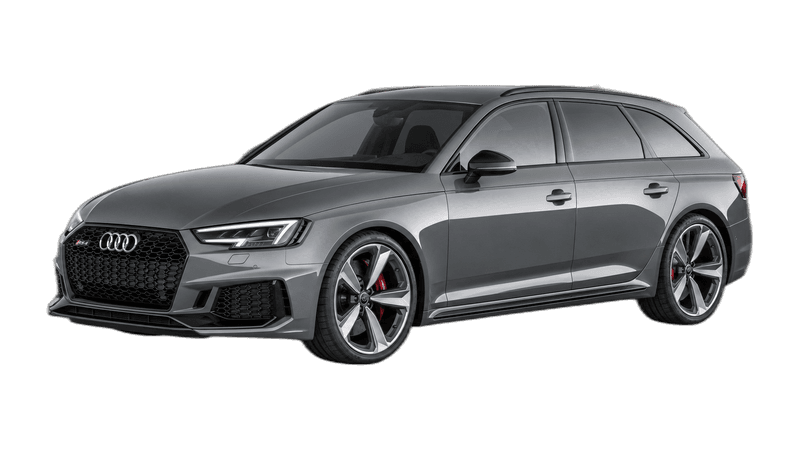
Audi RS4 Avant (B9)
£52,000
usedIndicative market price, updated periodically.
450bhp
Power
4.1s
0-100 km/h
280km/h
Top Speed
£52,000
Price Used
How hard it pulls.
Peak g-force the instant you bury the throttle, estimated from the car's 0–100 time and drivetrain.
Audi RS4 Avant (B9)Estimated peak launch g from the 0–100 time and drivetrain: an honest approximation, not a measured figure.
The Audi RS4 Avant (B9) is a 5-door avant (estate/wagon) by Audi, with 450 bhp, 600 Nm of torque, a 0-100 km/h time of 4.1 seconds and a top speed of 280 km/h. Indicative used value: approximately £52,000. Actual values vary with specification, condition and history.
Dream Car Garage Editorial · Last updated 31 October 2026
Overview
We have not driven this car. This review is based on published specifications and the sources listed below.
The Porsche-assisted V6 changes the character
The Audi RS4 Avant B9 replaced a high-revving naturally aspirated V8 with a twin-turbo V6, and the result is a very different kind of fast estate. Our catalogue covers the 2018 onward car with a 2.9L twin-turbo V6, 450 bhp, 600 Nm, 0 to 100 km/h in 4.1 seconds and a 280 km/h maximum, driving all four wheels. We have not driven this model for this article. This is a desk-researched ownership guide using Audi's own RS4 Avant model page, the PistonHeads RS4 Avant B9 used buying guide and the DVSA recall service. The engine was co-developed with Porsche, and its broad torque band makes the car feel quicker in everyday use than the old V8.
Audi's model page quotes 331 kW, or 450 PS, and 600 Nm available from 1,900 to 5,000 rpm. Note the units: 450 PS is approximately 444 bhp, not the catalogue's 450 bhp. That catalogue discrepancy is unresolved, and the 280 km/h limiter also depends on the fitted option rather than being universal. The standard gearbox is an eight-speed ZF automatic, and the car uses permanent quattro drive with a self-locking centre differential. The broad torque band distinguishes this generation from the earlier V8, but it should not distract a buyer from checking the cooling system, transmission and service file.
Thermostats, cam sensors and cold-start behaviour
PistonHeads reports stuck thermostats and faulty cam sensors, including one reported case of engine damage associated with a sensor fault. That isolated report does not establish how frequently such damage occurs. Ask about any thermostat or sensor diagnosis and request the repair invoice rather than assuming every B9 needs replacement parts. A cold start should be observed for warnings, hesitation or unusual noise, with a specialist scan used to investigate anything unexplained. The reason for an inspection is to establish this car's condition, not to infer a failure rate from one account.
The engine uses direct injection only, so carbon build-up on the intake valves is a long-term consideration rather than an immediate fault. Some owners report a rough idle or a slight stumble when cold, which can be carbon, a sensor or a software issue. A diagnostic scan with live data is more useful than guesswork. Also check the plastic engine covers, which can come adrift and rattle, and look for oil residue around the cam covers and turbocharger pipes. A clean, dry engine bay on a car with a documented file is the target.
ZF8 service and driveline checks
The eight-speed ZF automatic is generally strong, but it is not immune to neglect. PistonHeads notes jerky behaviour in the longer gears and occasional oil leaks that were fixed under warranty on some cars. A test drive should include a cold start, a gentle crawl, a steady motorway cruise and a few firm acceleration runs. The gearbox should shift smoothly and select gears without hesitation. A thump into gear or a long pause when selecting reverse is a reason to investigate further.
Ask when the gearbox oil and filter were last changed. Audi's schedule is long, but a performance estate that tows or is driven hard will benefit from more frequent servicing. The quattro system and sport differential also need clean oil. PistonHeads notes that the sport differential was standard in the UK, which is good for traction but adds another system to maintain. Listen for whines from the rear axle and check for oil misting around the differential and driveshaft seals.
DRC and the standard chassis
The B9 was offered with Dynamic Ride Control, a hydraulic damper system that links the corners diagonally. It improves body control, but the actuators can fail and produce a knocking noise over bumps. PistonHeads reports that replacements are expensive, and that the system was an option rather than standard on every car. A car with DRC should be inspected by someone who understands it, and a car without it is not necessarily a lesser purchase. The standard steel suspension is simpler and cheaper to maintain.
Check the ride height, look for leaking dampers and listen for knocks from each corner. The front control arms and bushes can wear, especially on a heavy estate, and the rear subframe should be inspected for corrosion. A geometry check after purchase is sensible. The B9 rides well for a car with this much grip, but that composure depends on the dampers and bushes being in good order. Do not accept a vague or noisy chassis as normal.
Brakes, wheels and tyres
The B9 uses large steel brakes as standard, with carbon ceramics available as an option. PistonHeads notes that the standard brakes can squeal, particularly at low speed, and that the ceramic setup is expensive to replace if it is worn or damaged. Measure the discs, check the pad thickness and inspect the calipers for corrosion. A car that has been used on track may have cracked discs or boiled fluid, even if the pads look healthy. Fresh fluid is cheap insurance.
The B9 runs large wheels and wide tyres, so check for kerb damage, buckled rims and uneven wear. Matching, correctly rated tyres are a better sign than a mixed set, and their age should be checked independently of the odometer. Confirm the fitted tyre-pressure monitoring system and investigate any warning instead of assuming a sensor replacement is needed. A set of winter wheels can be useful for an all-year estate, but inspect both sets for cracks or repairs and confirm the approved sizes. Extra wheels do not compensate for worn tyres or damaged rims on the car itself.
Body, cabin and provenance
The Avant body is practical and complex, so inspect the tailgate, the load area and the roof rails for damage. Look for water in the spare-wheel well, misted lights and corrosion around the tailgate aperture. The B9's cabin is well built, but the sports seats can wear on the bolsters, the piano-black trim scratches easily and the screens can develop dead pixels. Test every camera, sensor and driver-assistance function, including the adaptive cruise and lane-keeping systems.
Service history is the deciding factor. Look for annual servicing, a record of thermostat and cam-sensor work, and evidence that the gearbox and differential oils have been changed. Use the DVSA recall service to check outstanding campaigns and confirm the VIN. The best RS4 Avant B9 is a well-documented car with a smooth cold start, a clean scan, a healthy chassis and matching tyres. It is a fast, comfortable and genuinely useful estate, but the complex engine and electronics reward a careful, specialist-led inspection.
Specifications
Engine
2.9L twin-turbo V6 petrol
Displacement
2.9L
Power
450 bhp
Torque
600 Nm
0-100 km/h
4.1s
Top Speed
280 km/h
Drivetrain
AWD
Country
Germany
Body Style
5-door Avant (estate/wagon)
Years
2018–present
Price Used
£52,000
Specifications are manufacturer-published figures.
More from Audi
Frequently Asked Questions
What are the specifications of the Audi RS4 Avant (B9)?
The Audi RS4 Avant (B9) is a 5-door avant (estate/wagon) by Audi, with 450 bhp, 600 Nm of torque, a 0-100 km/h time of 4.1 seconds and a top speed of 280 km/h. Indicative used value: approximately £52,000. Actual values vary with specification, condition and history.
How much does a Audi RS4 Avant (B9) cost?
Indicative used value: approximately £52,000. Actual values vary with specification, condition and history.
What drivetrain does the Audi RS4 Avant (B9) use?
The Audi RS4 Avant (B9) is configured with all-wheel drive.
What type of car is the Audi RS4 Avant (B9)?
The Audi RS4 Avant (B9) is a super saloons manufactured by Audi in Germany. Production started in 2018.