
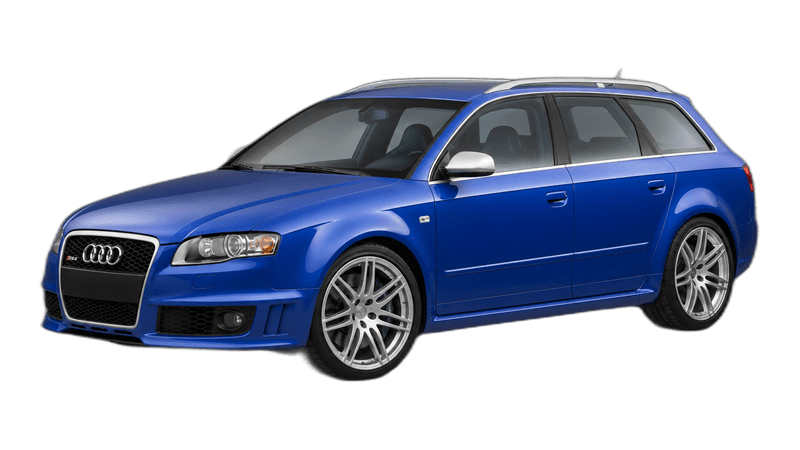
Audi RS4 Avant (B7)
£28,000
usedIndicative market price, updated periodically.
420bhp
Power
4.9s
0-100 km/h
250km/h
Top Speed
£28,000
Price Used
How hard it pulls.
Peak g-force the instant you bury the throttle, estimated from the car's 0–100 time and drivetrain.
Audi RS4 Avant (B7)Estimated peak launch g from the 0–100 time and drivetrain: an honest approximation, not a measured figure.
The Audi RS4 Avant (B7) is a 5-door avant (estate/wagon) by Audi, with 420 bhp, 430 Nm of torque, a 0-100 km/h time of 4.9 seconds and a top speed of 250 km/h. Indicative used value: approximately £28,000. Actual values vary with specification, condition and history.
Dream Car Garage Editorial · Last updated 31 October 2026
Overview
We have not driven this car. This review is based on published specifications and the sources listed below.
A manual V8 Avant with a specific brief
The Audi RS4 Avant B7 is one of the last great analogue performance estates: a high-revving naturally aspirated V8, a six-speed manual gearbox and a body that can carry a family and a dog. Our catalogue covers the 2006 to 2008 car with a 4.2L naturally aspirated V8, 420 bhp, 430 Nm, 0 to 100 km/h in 4.9 seconds and a 250 km/h maximum, driving all four wheels. We have not driven this model for this article. This is a desk-researched ownership guide using Audi's own B7 model page, the PistonHeads RS4 B7 buying guide and the DVSA recall service. The figures are impressive, but the buying decision is really about the cost of keeping a complex, aging V8 estate in good order.
Audi's own model history describes the B7 as the 420 PS, 4.2-litre V8 evolution of the A4, sitting 30 mm lower than a standard car with wider front and rear tracks and permanent quattro drive. Its 420 PS is approximately 414 bhp, not the catalogue's 420 bhp; that unit discrepancy remains unresolved in the catalogue. PistonHeads describes an all-aluminium 4,163 cc engine and an 8,250 rpm redline. The only gearbox offered was a six-speed manual, and the quattro system split torque 40/60 front to rear. The engine and chassis inspection should guide the budget, not just the asking price.
Carbon build-up and the decoke question
The B7's V8 uses direct injection, so carbon deposits can accumulate on the intake valves over time. PistonHeads reports rough idling and a general loss of smoothness among the symptoms. Ask a specialist for a current decoke quotation after diagnosis rather than budgeting from historical repair prices. Some early cars also received an ECU update to improve a lumpy idle. A seller unfamiliar with the issue is not necessarily hiding anything, but a documented inspection and a smooth cold start are better evidence than an exhaust note alone.
Do not confuse a rough idle with a misfire. A proper scan, a compression test and a look at the intake ports will separate worn ignition components from carbon build-up. Ask whether the spark plugs and coils have been changed, and whether the throttle body has been cleaned. A decoke is not a routine service item on every car, but on a high-mileage B7 it is a reasonable negotiating point. The same inspection can reveal vacuum leaks and failing sensors that would otherwise be blamed on the engine's character.
Cooling, oil pipes and the front-end inspection
The B7 has a complex cooling package, and age has not been kind to it. PistonHeads highlights the auxiliary radiators behind the front bumper, which can clog with leaves and corrode, leading to leaks. Replacement is not cheap, and a neglected pair can cause overheating in traffic. Look through the grille for debris, check the coolant level and condition, and inspect the radiator faces for damp patches or missing fins. A front-end removal is the proper way to assess them, so a specialist inspection is worthwhile.
The oil-cooler pipes are another known weak point. The original steel and aluminium pipes corrode, and a failure can dump oil quickly. Ask whether they have been replaced with improved parts, and look for oil residue around the front of the engine and under the car. Oil consumption is also worth discussing: PistonHeads notes that some cars use two to three litres per 1,000 miles, which is high even by performance-car standards. A compression and leak-down test, plus a careful look at the exhaust tips, will help separate a thirsty engine from a worn one.
DRC, control arms and chassis wear
The B7 was fitted with Audi's Dynamic Ride Control, a hydraulic system that links the dampers diagonally to control body movement. Its seals can fail, producing knocks and a loss of composure. PistonHeads describes specialists who can repressurise the system rather than replace every component, but the appropriate repair depends on the fault. Obtain a current quotation covering diagnosis and the necessary parts. A car that feels unsettled over bumps or clunks from one corner should be inspected before purchase.
Front control arms are another wear item, often needing attention around 40,000 miles. Listen for knocks over low-speed bumps and feel for vague steering or uneven tyre wear. The rear suspension and subframe should be checked for corrosion, and the driveshafts and differential for leaks. A geometry check after purchase is sensible, but it will not fix worn bushes or a bent arm. The B7 rewards a thorough chassis inspection because its best quality, a supple and controlled ride, depends on everything working together.
Brakes, wheels and tyres
The B7 uses large steel brakes, with 365 mm discs at the front and 324 mm at the rear. PistonHeads notes that judder can result from pad deposits rather than warped discs, so diagnose the cause before ordering replacement parts. A track-used car may have heat damage that needs more than fresh pads. Measure the discs, check pad thickness and inspect the calipers for corrosion and sticking pistons. Obtain a current quotation for the fitted brake specification and check the fluid-change record. Do not assume an aftermarket hose or pad is an improvement without knowing its intended use.
The original wheels are prone to kerb damage and corrosion, and the tyre choice matters. These cars need a stiff, correctly rated tyre to handle the weight and the quattro system. Check for matching brands, even wear and a date code consistent with the mileage. The TPMS valve batteries have a limited life, and replacement can be fiddly. A set of winter tyres is a bonus if the car has been used all year, but it should not be treated as a substitute for a proper inspection.
Body, boot and provenance
The Avant body adds a large tailgate and a load area, so check the tailgate seals and beneath the boot carpet for water. PistonHeads reports a recall concerning rust around the boot-mounted battery; it does not establish a battery-cable defect. Ask Audi to confirm the campaign's applicability and completion against the VIN. Inspect the battery area, rear lights and tailgate aperture for moisture or corrosion. Check the front wings and arches under good light, and ask for photographs or invoices explaining any fresh underseal rather than assuming it proves sound metal underneath.
Service history is central to a B7 purchase. Look for invoices explaining any decoke, cooling work, DRC repairs and oil-pipe replacement, alongside a consistent mileage trail. Use the DVSA recall service to check outstanding campaigns, and confirm the car's identity with the VIN. Prioritise an Avant with a documented engine and chassis file, a dry boot and sound bodywork. Compare the price with the specialist's written list of immediate work. That provides a defensible ownership budget without assuming that every car needs every repair mentioned in a buying guide.
Specifications
Engine
4.2L naturally aspirated V8 petrol
Displacement
4.2L
Power
420 bhp
Torque
430 Nm
0-100 km/h
4.9s
Top Speed
250 km/h
Drivetrain
AWD
Country
Germany
Body Style
5-door Avant (estate/wagon)
Years
2006–2008
Price Used
£28,000
Specifications are manufacturer-published figures.
More from Audi
Frequently Asked Questions
What are the specifications of the Audi RS4 Avant (B7)?
The Audi RS4 Avant (B7) is a 5-door avant (estate/wagon) by Audi, with 420 bhp, 430 Nm of torque, a 0-100 km/h time of 4.9 seconds and a top speed of 250 km/h. Indicative used value: approximately £28,000. Actual values vary with specification, condition and history.
How much does a Audi RS4 Avant (B7) cost?
Indicative used value: approximately £28,000. Actual values vary with specification, condition and history.
What drivetrain does the Audi RS4 Avant (B7) use?
The Audi RS4 Avant (B7) is configured with all-wheel drive.
What type of car is the Audi RS4 Avant (B7)?
The Audi RS4 Avant (B7) is a super saloons manufactured by Audi in Germany. Production ran from 2006 to 2008.