
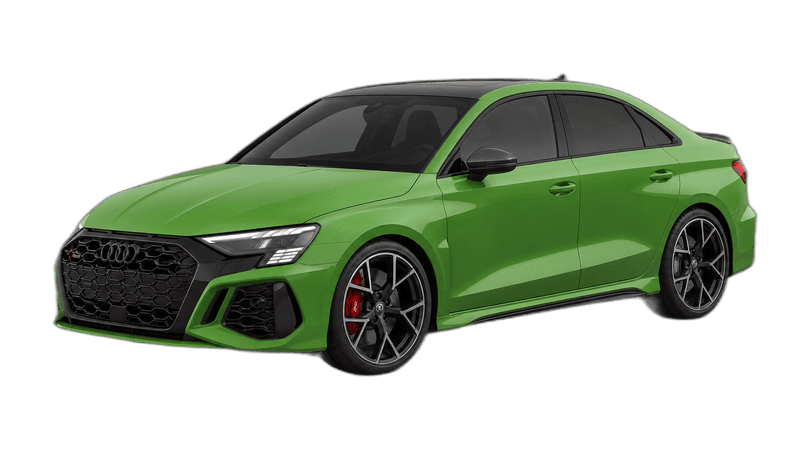
Audi RS3 Saloon (8Y)
£48,000
usedIndicative market price, updated periodically.
401bhp
Power
3.6s
0-100 km/h
290km/h
Top Speed
£48,000
Price Used
How hard it pulls.
Peak g-force the instant you bury the throttle, estimated from the car's 0–100 time and drivetrain.
Audi RS3 Saloon (8Y)Estimated peak launch g from the 0–100 time and drivetrain: an honest approximation, not a measured figure.
The Audi RS3 Saloon (8Y) is a 4/5 seater sedan/saloon by Audi, with 401 bhp, 500 Nm of torque, a 0-100 km/h time of 3.6 seconds and a top speed of 290 km/h. Indicative used value: approximately £48,000. Actual values vary with specification, condition and history.
Dream Car Garage Editorial · Last updated 31 October 2026
Overview
We have not driven this car. This review is based on published specifications and the sources listed below.
A new platform with the same five-cylinder heart
The Audi RS3 Saloon 8Y continued the five-cylinder formula with a new rear-axle torque splitter. Our catalogue covers the 2021 onward car with a 2.5L turbocharged inline-5, 401 bhp, 500 Nm, 0 to 100 km/h in 3.6 seconds and a 290 km/h maximum, driving all four wheels. We have not driven this model for this article. This is a desk-researched ownership guide using Audi's own five-cylinder press material, the PistonHeads RS3 8Y used buying guide and the DVSA recall service. Audi quotes 400 PS, approximately 395 bhp, and 3.8 seconds. The catalogue's 401 bhp and 3.6 seconds remain unresolved discrepancies; we have no evidence explaining the difference. Audi describes 250 km/h as the standard limiter, with 280 or 290 km/h dependent on options, so verify the individual car rather than treating 290 km/h as universal.
The 8Y is roughly 40 kg heavier than the car it replaced, so the engineers relied on chassis hardware rather than a dramatic power increase. The engine itself is an evolution of the familiar 2.5 TFSI, with dual injection, a switchable coolant pump and an aluminium crankcase. Those details matter to a buyer because they address some of the carbon and warm-up complaints that affected earlier generations. They do not make the car maintenance-free, and the first question should still be how it has been used rather than what the brochure promised.
The torque splitter changes the cornering recipe
The headline chassis feature is the torque splitter, which uses two clutches on the rear axle to send drive to the left or right wheel. In its most aggressive mode it can produce the rear-led behaviour Audi markets as a drift setting. On a used car, the system needs to be checked for noises, warning lights and evidence of abuse. A car that has spent its life doing launches and donuts may still look tidy, but the clutches, tyres and brakes will tell a different story.
Ask for a diagnostic scan that covers the all-wheel-drive and stability systems, not just the engine. Listen for clunks from the rear axle on tight, low-speed turns and feel for shudder under light throttle. The torque splitter is covered by warranty on younger cars, but a modified or track-used example may have had its software altered. Confirm any coding with the seller and check that the drive modes still change the car's behaviour. A standard car with a clean scan is the safer buy.
Battery management and electrical small print
PistonHeads describes a battery-management technical service bulletin and a software change intended to maintain charge at or above roughly 85 percent. This is a description of the reported software remedy, not an instruction for owners to maintain a particular charge reading themselves. Ask an Audi workshop whether the bulletin applies to the VIN and whether the relevant update was completed. A car that has sat on a forecourt still needs a battery-health check, and low-voltage fault codes should be explained before a test drive rather than simply cleared.
Small electrical items are worth checking on any modern performance car. The key fob battery can fail within about a year, the infotainment can freeze, and the digital instrument cluster can develop dead pixels. None of these is a deal-breaker, but they are expensive to ignore on a car with dense electronics. Test every screen, camera, sensor and driver-assistance function on a cold start. A car that needs a jump start at the viewing is not ready to be judged on its paintwork.
DCT behaviour and the daily drive
The 8Y uses a seven-speed dual-clutch transmission. It is quick when pressed, but it can be jerky when creeping, hold gears longer than expected when cold and deliver a firm low-speed shift. Some of that is characteristic, and some of it is a sign that the gearbox oil or software has been neglected. A long test drive should include a cold start, stop-start traffic, a steady cruise and a few full-throttle upshifts. The gearbox should not bang, slip or refuse to select a gear.
Launch control is standard, and repeated use puts stress on the clutch packs and driveline. There is no simple way to count launches, but the condition of the tyres, brakes and transmission fluid can hint at it. Ask when the gearbox was last serviced and whether the filter was changed with the oil. If the car has been tuned, the torque limit of the gearbox becomes a real question. A reputable tuner will have a supporting file; an anonymous flash will not.
Brakes, wheels and the facelift
Steel brakes are standard and can squeal in normal use, particularly after a wash or a spell of gentle driving. Ask a workshop to confirm the correct rear-brake service procedure for the VIN rather than assuming all pad changes are identical. Carbon ceramics were optional and need a specialist condition assessment. The 8Y runs large wheels and low-profile tyres, so check for kerb damage, buckled rims and uneven wear. A set of matching, correctly rated tyres is a better sign than four different brands. Obtain a current parts-and-labour quotation if the brakes are near their service limit.
The 2024 facelift brought chassis recalibration and visual changes, so establish which car is being sold. An early 8Y and a facelifted car have different calibrations, and the later car may have updated software. Adaptive damping was available; do not confuse that system with the earlier RS3's magnetic ride. Confirm the installed suspension from the build specification. Listen for knocks over low-speed bumps, check the ride heights and look for leaking dampers. A geometry check is worthwhile after purchase, especially on a car with wide tyres and a rear-axle torque splitter.
Body, cabin and buying checks
The saloon body is more complex than the hatchback around the rear quarters and boot, so inspect the panel gaps and the boot floor carefully. Look for fresh paint, sanding marks and overspray around the arches. The cabin should be checked for bolster wear on the sports seats, scuffs on the sill trims and water in the footwells. The 8Y's screens and touch controls are a fingerprint magnet, but they also show whether the car has been cared for.
Service history is the core of the purchase. Look for annual servicing, a record of the battery bulletin and any software updates. Use the DVSA recall service to check outstanding campaigns and confirm the car's identity against the VIN. The best RS3 Saloon 8Y is a standard, well-documented car with a healthy battery, a clean diagnostic scan, a smooth gearbox and evidence that the torque splitter has not been abused. It is a fast, usable saloon, but the electronics and driveline deserve more attention than the badge suggests.
Specifications
Engine
2.5L turbocharged inline-5 petrol (TFSI)
Displacement
2.5L
Power
401 bhp
Torque
500 Nm
0-100 km/h
3.6s
Top Speed
290 km/h
Drivetrain
AWD
Country
Germany
Body Style
4/5 seater sedan/saloon
Years
2021–present
Price Used
£48,000
Specifications are manufacturer-published figures.
More from Audi
Frequently Asked Questions
What are the specifications of the Audi RS3 Saloon (8Y)?
The Audi RS3 Saloon (8Y) is a 4/5 seater sedan/saloon by Audi, with 401 bhp, 500 Nm of torque, a 0-100 km/h time of 3.6 seconds and a top speed of 290 km/h. Indicative used value: approximately £48,000. Actual values vary with specification, condition and history.
How much does a Audi RS3 Saloon (8Y) cost?
Indicative used value: approximately £48,000. Actual values vary with specification, condition and history.
What drivetrain does the Audi RS3 Saloon (8Y) use?
The Audi RS3 Saloon (8Y) is configured with all-wheel drive.
What type of car is the Audi RS3 Saloon (8Y)?
The Audi RS3 Saloon (8Y) is a super saloons manufactured by Audi in Germany. Production started in 2021.