
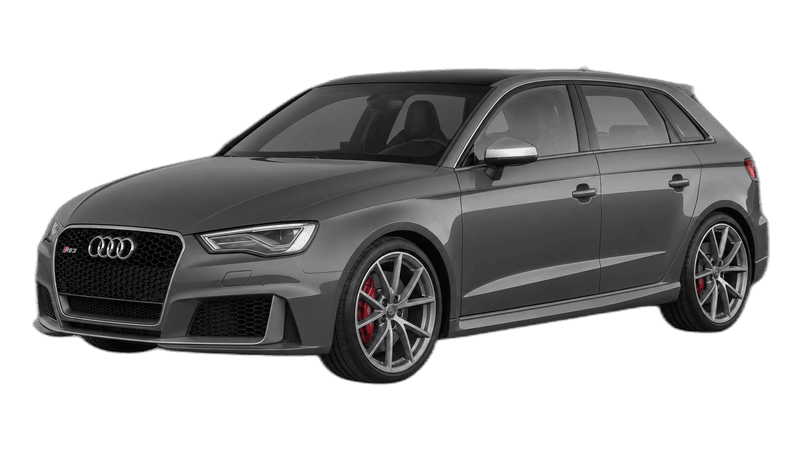
Audi RS3 (8V)
£35,000
usedIndicative market price, updated periodically.
401bhp
Power
4.1s
0-100 km/h
280km/h
Top Speed
£35,000
Price Used
How hard it pulls.
Peak g-force the instant you bury the throttle, estimated from the car's 0–100 time and drivetrain.
Audi RS3 (8V)Estimated peak launch g from the 0–100 time and drivetrain: an honest approximation, not a measured figure.
The Audi RS3 (8V) is a 4/5 seater sedan/saloon by Audi, with 401 bhp, 480 Nm of torque, a 0-100 km/h time of 4.1 seconds and a top speed of 280 km/h. Indicative used value: approximately £35,000. Actual values vary with specification, condition and history.
Dream Car Garage Editorial · Last updated 31 October 2026
Overview
We have not driven this car. This review is based on published specifications and the sources listed below.
Five cylinders in a compact shell
The Audi RS3 8V brought the company's celebrated five-cylinder engine back to a compact hatchback and saloon package. Our catalogue covers the 2015 to 2020 phase with a 2.5L turbocharged inline-5, 401 bhp, 480 Nm, 0 to 100 km/h in 4.1 seconds and a 280 km/h maximum, all through quattro all-wheel drive. We have not driven this model for this article. This is a desk-researched ownership guide using Audi's own RS3 press material, the PistonHeads RS3 8V used buying guide and the DVSA recall service. The headline figures describe the facelifted car; early examples left the factory with less power, so the first job is to establish exactly which version is for sale.
Audi's press release records that the 2.5 TFSI began with 367 PS and moved to 400 PS after the 2017 product upgrade. PistonHeads puts the launch car at 362 hp and 343 lb ft, and the facelift at 395 hp and 354 lb ft. The catalogue's 401 bhp is not a conversion of Audi's 400 PS, which is approximately 395 bhp. Treat that catalogue value as an unresolved discrepancy, not a verified factory specification. An early 8V and a late 8V are different purchases. Ask for the build date, engine code and invoice trail, then match them to the seller's claimed output. The higher speed limit also depends on the car's factory specification.
The 2.5 TFSI needs a misfire file
The five-cylinder is robust when serviced, but it has known irritations. PistonHeads reports misfires and engine-management lights under heavy throttle that often trace to spark plugs rather than something catastrophic. That is cheap to fix, but it can mask a coil or injector problem, so the fault history matters. A car that has repeatedly thrown a light and been cleared without diagnosis deserves a compression check and a proper scan before money changes hands.
The more serious known item is the fuel lift pump module. A recall covered cars that could cut out or jerk because of low fuel pressure, and PistonHeads treats proof of that campaign as essential. Check the registration against the DVSA service and ask for the recall paperwork. Also listen for a rattling exhaust flap and inspect the tailpipes for pitting. Neither is a reason to walk away, but both are useful negotiating evidence on a car presented as perfect.
DQ500 and Haldex care matter more than launch times
The 8V RS3 uses the DQ500 seven-speed wet-clutch transmission. It is not always smooth at low speed, and a jerky crawl in traffic is not automatically a failure. What matters is whether servicing matches the exact gearbox and the way the car has been used. Check the dated oil and filter invoices against the applicable schedule, then discuss any additional maintenance with a specialist. PistonHeads discusses shorter servicing intervals for carefully maintained examples, but that is buying advice rather than a replacement for the factory schedule.
The Haldex all-wheel-drive system needs clean fluid and a working pump. Ask when its oil was last changed and whether the pump screen was inspected where appropriate; do not assume every generation has a separately replaceable filter. Unexplained rear-axle noise or poor traction deserves diagnosis rather than a guess that the pump needs replacing. PistonHeads also reports bevel-box leaks. Look for oil misting underneath and ask whether any warranty replacement has been recorded. A clean inspection and an itemised service invoice are more useful than a seller's assurance that quattro needs no maintenance.
Carbon, cooling and the pre-facelift question
Pre-facelift cars use direct injection only, so carbon can build up on the intake valves. The symptom is a rough idle, hesitation or a slight loss of response rather than a dramatic failure. A walnut-blast decoke is the usual remedy, and the invoice should be part of the file if it has been done. Facelift cars gained dual injection, which reduces the problem but does not eliminate it. Either way, a borescope inspection or a specialist opinion is more useful than a bottle of additive.
Cooling system health deserves attention on any tuned car. Check the coolant level and condition, look for dried residue around the thermostat housing and water pump, and ask whether the car has been mapped. A modified car can be reliable, but it needs a supporting file: uprated intercooler, appropriate plugs, logs and a reputable tuner. An anonymous software flash with no paperwork is a risk, not a feature. Standard cars are not immune, so a cold-start check and a long test drive are both worthwhile.
Brakes, wheels and suspension
The RS3 8V was offered with steel brakes and, on some cars, carbon ceramics. Steel discs can squeal, especially after a wash or a period of light use, and that is not necessarily a defect. What matters is disc thickness, pad life, fluid history and whether the car stops straight without vibration. Carbon ceramics are expensive to replace, so inspect them carefully and confirm their condition with a specialist. PistonHeads notes that 19-inch wheels were standard and that magnetic ride was optional, which affects both ride quality and replacement cost.
Check the tyres for matching brands, even wear and a date code consistent with the mileage. These cars are heavy for their size and can wear the outer edge of the front tyres if the alignment is out. Listen for knocks from the suspension over low-speed bumps, and feel for free play in the steering. A car with tired dampers, worn bushes or a bent wheel can feel vague without obviously failing a road test. A geometry check after purchase is a sensible baseline.
Body, cabin and provenance
The 8V is a mature platform, so corrosion is less of a concern than accident repair and paintwork. Look along the panel gaps, check the paint under bright light and inspect the boot floor and inner wings for signs of structural repair. The saloon and hatchback have different rear shapes, so confirm the body style matches the listing. Inside, check the sports seats for bolster wear, the flat-bottom wheel for scuffs and the infotainment for dead pixels or failing buttons. Water in the footwells or misted lamps can indicate blocked drains or poor previous repairs.
Service history is the deciding factor. A full book with invoices, consistent mileage and a record of recall work is worth more than a low odometer reading. Use the DVSA recall service to check outstanding campaigns, and confirm any tuning or retrofit with the insurer. The best RS3 8V is a facelifted car with a documented fuel-pump recall, fresh plugs, evidence of DQ500 and Haldex servicing, and a straight body. It is a fast, practical compact car, but only when its maintenance file supports the way it has been used.
Specifications
Engine
2.5L turbocharged inline-5 petrol (TFSI)
Displacement
2.5L
Power
401 bhp
Torque
480 Nm
0-100 km/h
4.1s
Top Speed
280 km/h
Drivetrain
AWD
Country
Germany
Body Style
4/5 seater sedan/saloon
Years
2015–2020
Price Used
£35,000
Specifications are manufacturer-published figures.
More from Audi
Frequently Asked Questions
What are the specifications of the Audi RS3 (8V)?
The Audi RS3 (8V) is a 4/5 seater sedan/saloon by Audi, with 401 bhp, 480 Nm of torque, a 0-100 km/h time of 4.1 seconds and a top speed of 280 km/h. Indicative used value: approximately £35,000. Actual values vary with specification, condition and history.
How much does a Audi RS3 (8V) cost?
Indicative used value: approximately £35,000. Actual values vary with specification, condition and history.
What drivetrain does the Audi RS3 (8V) use?
The Audi RS3 (8V) is configured with all-wheel drive.
What type of car is the Audi RS3 (8V)?
The Audi RS3 (8V) is a super saloons manufactured by Audi in Germany. Production ran from 2015 to 2020.