
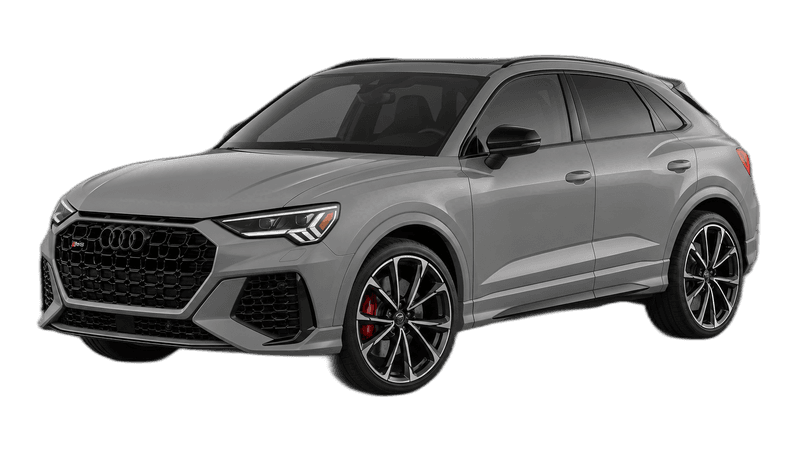
Audi RS Q3 Sportback
£48,000
usedIndicative market price, updated periodically.
395bhp
Power
4.5s
0-100 km/h
250km/h
Top Speed
£48,000
Price Used
How hard it pulls.
Peak g-force the instant you bury the throttle, estimated from the car's 0–100 time and drivetrain.
Audi RS Q3 SportbackEstimated peak launch g from the 0–100 time and drivetrain: an honest approximation, not a measured figure.
The Audi RS Q3 Sportback is a suv coupe (sportback) by Audi, with 395 bhp, 480 Nm of torque, a 0-100 km/h time of 4.5 seconds and a top speed of 250 km/h. Indicative used value: approximately £48,000. Actual values vary with specification, condition and history.
Dream Car Garage Editorial · Last updated 2 November 2026
Overview
We have not driven this car. This review is based on published specifications and the sources listed below.
A 395 bhp five-cylinder compact SUV coupe
The Audi RS Q3 Sportback is the coupe-roofed version of the second-generation RS Q3, built around a 2.5L turbocharged inline-5 petrol (TFSI) engine, a seven-speed S tronic dual-clutch gearbox and quattro all-wheel drive. Audi introduced it alongside a new regular RS Q3. Our catalogue lists the Sportback with 395 bhp, 480 Nm, 0 to 100 km/h in 4.5 seconds and a 250 km/h limited top speed. We have not driven this model for this article. This is a desk-researched ownership guide built from two sources: the Audi Media Center press release for the new RS Q3 and RS Q3 Sportback (titled 2020), and the PistonHeads used buying guide to the Audi RS Q3 (F3), published on 20 June 2026. We did not consult the government recall check for this article, and you should use it yourself.
Scope matters here. This guide covers the 2019 to 2025 second-generation RS Q3 and RS Q3 Sportback with the 2.5 TFSI engine. It does not cover the first-generation RS Q3 or the ordinary Q3 range. The PistonHeads guide covers both body styles of the second generation, but its specification table is headed Audi RS Q3 Sportback, so we treat the Sportback as the main subject and say where a point applies to both.
Checking the figures
Power is where the units differ. Audi's press release gives 294 kW (400 PS). PistonHeads gives 395 hp at 5,850 to 7,000 rpm. PS is metric horsepower, and multiplying 400 PS by 0.9863 gives about 394.5 bhp, which rounds to the 395 bhp in our catalogue. So the two sources describe the same output in different units, and we converted 400 PS to bhp ourselves. A British advert that says 400 bhp or 400 hp is probably quoting the metric figure loosely.
Torque is 480 Nm in Audi's press release, and PistonHeads gives 354 lb ft, which is the same figure in other units. Both sources place the torque at 1,950 to 5,850 rpm, so there is no disagreement to resolve there.
Acceleration is consistent: Audi says 4.5 seconds from 0 to 100 km/h, and PistonHeads lists 4.5 seconds for 0 to 62 mph, which Audi equates to 62.1 mph at 100 km/h. Top speed is also consistent once you read it carefully. Audi says it is regulated at 250 km/h (155.3 mph) or, with an option, 280 km/h (174.0 mph), and PistonHeads says 155 mph limited and unlockable to 174 mph. We use 250 km/h as the standard limited figure. Do not assume a particular car has the higher limit unless the paperwork says so.
Weight is not settled. PistonHeads prints 1,715 kg in a table headed Sportback, although its guide covers both body styles. It also warns that its power and weight data are hard to pin down and should be treated as relative rather than definitive. We would not quote a weight for a specific car without checking its plate or handbook.
Economy and emissions agree between the sources, with caveats. Audi's press release gives combined consumption of 8.9 to 8.8 l/100 km and 204 to 202 g/km CO2, and these figures cover both RS Q3 body styles and refer to the German market on the WLTP cycle. PistonHeads gives 32.1 mpg official combined, which is roughly 8.8 l/100 km, and labels the CO2 of 204 to 202 g/km as WLTP. The lesson is that the lower brochure numbers are not what a hard-driven car will show.
Dates also need care. PistonHeads gives an on-sale range of 2019 to 2025. Audi's press release says the cars were on sale in Germany and other European countries from the end of 2019, and The press release page shows a date written 06/04/2025, which we cannot read reliably as day-month or month-day, and it may be an archive date, so we do not give an original publication date.
Engine and gearbox
Audi describes the 2.5 TFSI as a five-cylinder engine with a 1-2-4-5-3 firing order. PistonHeads adds that it is 26 kg lighter than the engine in the previous model, with an aluminium crankcase accounting for 18 kg of that saving, plasma-coated cylinder barrels and a hollow-bored crankshaft, and that the warm-up strategy stops coolant circulating in the cylinder head after a cold start. It says the engine won the International Engine of the Year award nine years in a row and names it as the EA855 DNWA Evo.
PistonHeads rates long-term reliability as good, but it lists a number of faults and possible faults, most of them hedged, and they make a checklist for your inspection:
- Ticking noises when cold, which owners have been told are nothing to worry about.
- Reports of excessive oil consumption, which PistonHeads says can ease with mileage. Ask the seller how often the oil is topped up.
- Wastegate rattle on a cold start or part throttle, which PistonHeads says Audi called normal.
- A tinny rattle from the exhaust flaps, which Audi acknowledged and answered with an updated exhaust system. Ask whether the car has had it.
- Faulty sensors that trigger false warning lights, and coolant system solenoids that can stick slightly open, changing engine temperature and lengthening warm-up.
- Timing chain stretch from tensioner failure, which PistonHeads says could be a thing on cars run on cheap or infrequently changed oil. It warns that, left alone, it can lead to valves hitting pistons and a very large repair bill.
- Turbo bearings that can fail, especially on cars used mainly for short trips, and water pump housings that may crack and lose coolant.
- At least one owner's engine failed because of a displaced needle roller bearing in a cam follower, usually flagged by oil venting from the filler cap and often ending in a damaged camshaft lobe.
- Problems with the fuel vapour return valve and with seals on the high-pressure fuel pump.
PistonHeads says the seven-speed DQ500 S tronic usually works smoothly, but the pairing with this engine is not perfect. It describes a sense of the powertrain gathering its breath when you accelerate hard from low speed, and some hesitation in gearshifts, though it is unsure the gearbox is to blame. It adds that hard use eventually wears the Mechatronic unit and clutch packs, and that a new official Mechatronic unit is an expensive item. We omit its dated price.
PistonHeads adds two maintenance points. The Haldex all-wheel-drive system needs its fluid changed on a 40,000 km schedule, or the pre-charge pump can clog with sludge. PistonHeads also says a software update was issued for battery drain caused by the emergency call control unit staying switched on, applying to cars with the relevant fault codes, so ask whether the car has had it, particularly if it sits unused for days.
On tuning, PistonHeads says an ABT control unit can lift output to nearly 440 hp and cut the 0 to 62 mph time to 4.3 seconds, and that bigger packages demand stronger internal parts. Treat a tuned car as a car without the manufacturer's engineering margin, and ask for evidence and invoices.
Chassis, brakes and wheels
Audi says the standard RS sport suspension lowers the body by 10 mm compared with the Q3 family. Dynamic Chassis Control adaptive dampers were an option. PistonHeads says that on the Vorsprung they were included, and on other trims they cost extra, so check from the build sheet or by testing whether the car has them. PistonHeads calls the standard passive set-up a decent blend of grip and predictability, backed by a torque-trimming failsafe of nose tuck-in, and says the car is not as sporty as a proper hot hatch because it is a tall SUV.
Audi drive select offers five or six modes, and the RS1 and RS2 modes can be saved and reached with a steering wheel button. They alter steering, engine sound, S tronic and quattro behaviour. Try them all on a test drive and make sure the button and the saved settings work.
Audi lists 20-inch wheels as standard and 21-inch as an option, with six-piston steel brakes with 375 mm perforated front discs and 310 mm rear discs, and black calipers as standard or red as an option. Audi also offers ceramic brakes with 380 mm front discs. PistonHeads gives tyre sizes of 255/40 or 255/35 and says the car goes through discs and pads quickly compared with an ordinary small car. It adds that suspension bushes take a beating and springs have been known to corrode, so look under the car. PistonHeads also notes that Audi's press information and what launch journalists were told disagreed on whether tyre pressure monitoring was standard. Check what the car you are looking at actually has.
Body, interior and electronics
Audi says the Sportback is 45 mm lower than the regular RS Q3, with wheel arches flared by 10 mm. Both cars have a gloss black Singleframe grille and the Sportback has a roof edge spoiler. PistonHeads says the flat slit on the bonnet edge is fake, as is the rear diffuser. Most UK cars were ordered in sober colours, according to PistonHeads, though brighter ones were offered.
PistonHeads reports several faults around the body and glass. Some panoramic sunroofs have needed warranty work, sometimes complete replacement, to stop water running into the footwell from the headliner. Fogging of the front camera has upset systems such as Matrix LED high beam, traffic sign recognition, Pre Sense and adaptive cruise control, and the fix was a new windscreen with a camera heater. Check for damp carpets, test the roof, and look for camera warnings on a cold, damp morning.
On space, Audi gives a 530 litre boot, 1,525 litres with the seats folded in the regular car and 1,400 litres in the Sportback, with a rear bench that slides by 150 mm in the regular car and 130 mm in the Sportback. PistonHeads agrees on the boot figures (530 litres, 1,525 litres and 1,400 litres), and says the Sportback's sloping roof costs practicality and rear-seat comfort. It says realistically this is a four-seater, and that used Sportbacks outnumber regular cars in the UK by about three to two.
The sources disagree on some interior equipment. Audi says the standard seats are leather and Alcantara sport seats with RS embossing, and that nappa RS sport seats are optional. PistonHeads says nappa sports seats were standard and that Alcantara was on the steering wheel, door cards and parts of the dash. Audi describes an RS sport leather steering wheel flattened at the bottom. Audi refers to a virtual cockpit plus and PistonHeads to a 12-inch display, but we cannot tell from them which trims have which screen. PistonHeads praises the physical knobs for the dual temperature zones and says Android Auto and Apple CarPlay are standard. Because the sources conflict, confirm the specification of each car from its own documents.
PistonHeads says electronic imperfections have extended into the sat-nav and infotainment, producing dealer bookings and potentially long delays depending on how busy and well staffed the dealer is. It also says Vorsprung cars with three-zone climate control disappointed some owners, because the third zone is only a thumbwheel for the rear.
Recalls and history
Neither source gives a recall list or recall numbers for this model, so we state none. What PistonHeads describes are fixes that Audi has acknowledged: an updated exhaust system for the exhaust flap rattle, a software update for the emergency call battery drain, and a windscreen with a camera heater for fogging cameras. These are not described as recalls, and the sources do not say which cars were covered. Enter the registration into the government recall check, ask an Audi dealer to check open campaigns and software updates, and ask the seller for invoices showing what was done.
Ask for a full service history showing regular oil changes, because PistonHeads ties the timing chain and turbo risks to poor oil and short-trip use. It also advises finding out what kind of driving a car has done, and says high-load stop-start city use is worst for it. Ask for the Haldex fluid service record and for evidence of any tune or exhaust change. A used RS Q3 is likely to carry expensive options, PistonHeads says, so check that every option listed in the advert is actually fitted and working.
Buying decision
PistonHeads' verdict is that the RS Q3 is smooth, quick and useful, with an extra layer of character from its five-cylinder engine, and that driven normally it gets you there faster than expected while using less fuel than expected. It describes the handling as more about keeping you out of trouble than entertaining you, and notes that sceptics find it less entertaining than a sporty hatch and less SUV-ish than some other SUVs. Its view of the faults is that they are well known in the community, that Audi has been fair in acknowledging them, and that most can be avoided by following a proper maintenance schedule, although getting timely dealer action can be hit or miss.
PistonHeads quotes asking prices from June 2026, which we have left out because they are dated. Compare current adverts instead. Prefer a car with a clean government recall check, a documented oil and Haldex service history, the exhaust and software fixes confirmed in writing, a dry sunroof and headliner, working cameras and driver assistance on a cold start, and clear confirmation of the body style, the options and the top speed limiter.
Specifications
Engine
2.5L turbocharged inline-5 petrol (TFSI)
Displacement
2.5L
Power
395 bhp
Torque
480 Nm
0-100 km/h
4.5s
Top Speed
250 km/h
Drivetrain
AWD
Country
Germany
Body Style
SUV coupe (Sportback)
Years
2019–2025
Price Used
£48,000
Specifications are manufacturer-published figures.
More from Audi
Frequently Asked Questions
What are the specifications of the Audi RS Q3 Sportback?
The Audi RS Q3 Sportback is a suv coupe (sportback) by Audi, with 395 bhp, 480 Nm of torque, a 0-100 km/h time of 4.5 seconds and a top speed of 250 km/h. Indicative used value: approximately £48,000. Actual values vary with specification, condition and history.
How much does a Audi RS Q3 Sportback cost?
Indicative used value: approximately £48,000. Actual values vary with specification, condition and history.
What drivetrain does the Audi RS Q3 Sportback use?
The Audi RS Q3 Sportback is configured with all-wheel drive.
What type of car is the Audi RS Q3 Sportback?
The Audi RS Q3 Sportback is a suvs manufactured by Audi in Germany. Production ran from 2019 to 2025.