Shelby Cobra 260
260cv
Potenza
The Shelby Cobra 260 produces 260 bhp.
Dream Car Garage Editorial · Edited by José Teo Lorente Vallecillos · Last updated 3 November 2026
Panoramica
We have not driven this car. This review is based on published specifications and the sources listed below.
Scope of this guide
This guide is scoped to the Shelby Cobra 260, the first Cobra that Carroll Shelby sold, built in 1962 with a Ford 260 cubic inch V8 in a lightweight AC Ace chassis. It is a two-seat roadster, front-engine and rear-wheel drive, with a four-speed manual gearbox. The Cobra 260 is one of two engine versions of the Mark I. The other is the Mark I with the larger 289 cubic inch engine, which replaced it, and that car is outside this page. The later Mark II and the 427 cars are also outside it.
We have not driven this model for this article. We are an editorial desk that reads sources, and everything below comes from pages we opened: two Wikipedia articles, two Ultimate Car Page pages and a third page on one chassis, Sportscar2, Classic Pony Cars, Conceptcarz, the RM Sotheby's lot page for the prototype, two Sports Car Market pages, the Cobra Authority page for the prototype and a Spanish language Motor1 article. We have not inspected, owned or tested a car. Cars like this almost never come to market, so this page is for research, not a buying recommendation, and a guide cannot replace an inspection by a specialist who knows the original Cobra chassis series.
The figures at a glance
- Engine: 4.3L naturally aspirated V8, a Ford 260 cubic inch small-block (4,261 cc on the Ultimate Car Page specification), with a single four-barrel carburettor, mounted front-engine.
- Drivetrain: rear-wheel drive, four-speed manual. Ultimate Car Page names a Borg Warner T-10 gearbox.
- Power: 260 bhp at 5800 rpm.
- Torque: 365 Nm. Two pages print 269 lb ft at 4800 rpm, and 269 multiplied by 1.35582 gives 364.7 Nm, which rounds to 365 Nm.
- 0-100 km/h: no figure shown. The pages we read give 0-60 mph times only, and we have not relabelled any of them as a 0-100 km/h time.
- Top speed: no figure shown that we can tie to a standard 260 bhp car. The pages give 135 mph, 152 mph, 153 mph and 240 km/h, and we explain the spread below.
- Weight: 916 kg on Wikipedia, 962 kg on Ultimate Car Page and 2,170 lb (about 984 kg) on Sportscar2. The sources disagree.
- Years: 1962.
- Production: 75 cars with the 260 engine, including the prototype.
History and how the Cobra started
The Cobra was built on the AC Ace, a two-seat roadster that AC Cars had made since 1953. Wikipedia says the Ace used three straight-six engines over its life, ending with a 2.6 litre Ford Zephyr six. According to Wikipedia, Ford gave Shelby two 221 cubic inch (3.6 litre) small-block V8s in September 1961, and one was shipped to AC in England. AC mechanics at Thames Ditton finished the prototype, called the AC Ace 3.6 with chassis number CSX2000, in January 1962. The RM Sotheby's lot page adds that Shelby pitched the concept to Charles Hurlock at AC in September 1961.
On 2 February 1962 the chassis was air-freighted to Los Angeles without an engine. Wikipedia says Shelby's team installed the engine and gearbox at Dean Moon's shop in Santa Fe Springs, California, in under eight hours, and RM Sotheby's tells the same story, adding Moon's remark that they drove it around afterwards. By then the engine had grown from the 221 cubic inch size to 260 cubic inches, which Wikipedia gives as 4.3 litres. The Cobra Authority page confirms that CSX2000 was originally fitted with a Ford 260 cubic inch small-block V8 and says the car was completed in February 1962.
AC also fitted a stronger Salisbury 4HU rear differential with inboard disc brakes, the same unit used on the Jaguar E-Type, according to Wikipedia. Wikipedia says the only front-end change on the prototype was moving the steering box outward to clear the wider V8. The Cobra still used the earlier transverse leaf spring suspension of the Ace, which Sports Car Market notes for both 260 and 289 cars.
Sources disagree about when production really began. Motor1 says production started in March 1962. The Classic Pony Cars page says the first three production Cobras were completed and shipped to the United States complete with 260 engines in July 1962, and the Ultimate Car Page chassis page for CSX2021 says that car's specification was set in July 1962, invoiced to Shelby American in October 1962 and delivered to its first private owner in December 1962. We read those as different milestones (first cars, first shipments, first deliveries to customers) rather than a hard conflict, but none of the pages lines them up for us.
Ultimate Car Page says the car was introduced at the 1962 New York Auto Show, and RM Sotheby's agrees that the prototype appeared there in yellow. The Cobra made its racing debut at the 1962 Riverside three hour race, where, according to Ultimate Car Page, Bill Krause led by over 30 seconds before a wheel came off. The same page says Shelby won the first US manufacturers' championship in 1963 with 111 points to Ferrari's 28, and that the Cobra gained full FIA homologation that year.
Variants and what changed over the run
The 260 is a short chapter. Wikipedia says the first 75 Mark I cars, including the prototype, used the 260, and the next 51 used the 289. The Classic Pony Cars page says the 260 was used up to chassis CSX2074 and that the first 289 car was CSX2075, completed in January 1963. Counting chassis numbers from CSX2000 to CSX2074 gives 75, which fits the 75 that three other pages print, though that arithmetic is ours and not a quoted statement.
Wikipedia says production cars are listed as CSX or CS 2001 to 2602 across the whole Mark I and Mark II run, and that CSX2001 was the first production car, finished by Ed Hugus in Pennsylvania. Sports Car Market says CSX2003 was invoiced for the chassis, drivetrain and assembly kit at 4,995 dollars to Ed Hugus's European Cars in Pittsburgh, in a profile published on 22 September 2025. That is a dealer invoice for a kit, not a retail price, and no page we read gives an original list price for a finished car.
Wikipedia lists two running changes: the inboard rear brakes were moved outboard to cut cost, and the fuel filler moved from the fender to the middle of the trunk. After the 289 arrived, Shelby offered an upgrade to earlier cars, and Wikipedia says most owners accepted it, so cars that still have the 260 engine are rare today. That matters for anyone judging originality, because a 260 chassis with a 289 may be correct history rather than a fault.
Which figures we chose, and why
Power
We use 260 bhp at 5800 rpm. Sportscar2 prints 260 bhp at 5800 rpm, Classic Pony Cars prints the same, and the RM Sotheby's lot page prints 260 bhp for the 260 cubic inch engine. Sports Car Market says the 260 produced roughly 260 horsepower and that exact output depended on tuning and specification. Motor1 prints about 268 CV, which at 0.98632 is about 264 bhp, and the Carfolio citation title in the Wikipedia article reads 263.6 PS, which is 260 bhp divided by 0.98632. So the metric figures are just the same output in other units. None of the pages we read says whether 260 bhp is a gross or a net rating, so we cannot say which basis it uses.
Two competition figures are easy to mix up with this. Ultimate Car Page prints 335 bhp at 8,500 rpm on its 260 specification page, and Sportscar2 prints the same 335 bhp for a competition version. Those are race-tuned numbers and not the road car rating.
Torque
Sportscar2 and Classic Pony Cars both print 269 lb ft at 4800 rpm. We convert at 1.35582 and get 365 Nm. No page we read prints the torque directly in newton metres, so the metric figure is a conversion.
Acceleration
No page gives 0-100 km/h, so we show no figure. For 0-60 mph, the Conceptcarz and RM Sotheby's pages quote Car Life in June 1962 at 4.2 seconds, and the Cobra Authority and Sports Car Market prototype pages say the same. Sportscar2 prints 5.5 seconds for the standard 260 and 4.2 seconds only for the competition version. So the famous 4.2 second time may belong to a tuned or special car and not an ordinary customer car, and the pages we read do not settle which. A 0-60 mph time is not a 0-100 km/h time, and we have not converted one into the other.
Top speed
This is the widest disagreement. Conceptcarz, RM Sotheby's and Cobra Authority credit Road & Track in September 1962 with 153 mph, which is about 246 km/h at 1.60934. Ultimate Car Page prints 245 km/h (152 mph) next to its 335 bhp figure. Motor1 prints 240 km/h. Sportscar2 prints 135 mph for the 260 bhp car, about 217 km/h. The test pages concern the prototype, and none of them says it was in standard customer tune, so we give no single top speed in the summary figures and set out the range here: no figure shown.
Years and production
Ultimate Car Page says 1962, and the 289 car CSX2075 was finished in January 1963, so we show 1962 for the 260. Wikipedia and Sportscar2 give 1962 to 1963 for the whole Mark I, which includes the 289 cars, so we did not use it for the 260 alone. For numbers, Wikipedia, Sportscar2 and Ultimate Car Page agree on 75 cars with the 260 engine, and we use that. The Motor1 article says about two hundred cars were sold in just over a year, but that appears to cover Cobras in general and it conflicts with the other three pages, so we did not use it. The RM Sotheby's page says CSX2000 was the only Cobra in existence for its first five months.
What to check before buying
Only Sports Car Market gave us specifics, so this list is short and no inspection scheme. Its advice, in summary:
- Chassis numbers: original Shelby chassis numbers generally fall within the documented CSX series, but a chassis number alone is not sufficient. Documentation, physical chassis characteristics and ownership history should all agree.
- Replicas: it calls the Cobra probably one of the most replicated cars ever built, and says a replica is fundamentally different from an original in value and historical significance, even if it drives well.
- Suspension: original 260 and 289 cars use the earlier transverse leaf spring layout, and the springs, links, hubs and uprights need careful inspection because correct parts can be hard to source.
- Chassis: the tubular chassis should be inspected for corrosion, fatigue and old accident repairs.
- Engines: many Cobras lost their original engines to racing or hard use, and a period-correct replacement can be acceptable if documented accurately. This is where the 289 upgrade history above matters.
- Brakes and fuel: the car is very fast for its weight, so brakes need careful checking, and old fuel lines near a hot V8 are a serious fire risk.
Market and value notes
We found few prices that apply to a 260 and we do not invent any. The prototype CSX2000 sold at RM Sotheby's Monterey auction on 19 August 2016 for 13,750,000 dollars including buyer's premium, according to the Sports Car Market profile. Cobra Authority and RM Sotheby's repeat the 13,750,000 dollar figure. That is a one-off car with unique history and tells a buyer nothing about an ordinary 260.
The Ultimate Car Page 260 specification page lists past auction results of 1,545,000 dollars (Broad Arrow Auctions, Monterey Jet Center, 2025) and 577,000 dollars (RM Sotheby's Arizona, 2020). It does not say which chassis those were, so we cannot say whether they were original 260 cars, and we would not treat them as a price guide.
What we could not find
- No agreed top speed for a standard 260 bhp car, and no 0-100 km/h time, so there is no figure shown for either.
- No page we read says whether 260 bhp is gross or net.
- No original list price for a finished 260. The only early price is the 4,995 dollar kit invoice above.
- No direct torque figure in newton metres, only lb ft.
- We could not open the Classic.com 260 page (access refused) or the FastestLaps page (access refused), and we did not work around either. A Roarington page we tried contained nothing about the Cobra.
- No maker page. Pages from Ford, AC Cars or Shelby's own company were not among the sources we read.
About the photograph
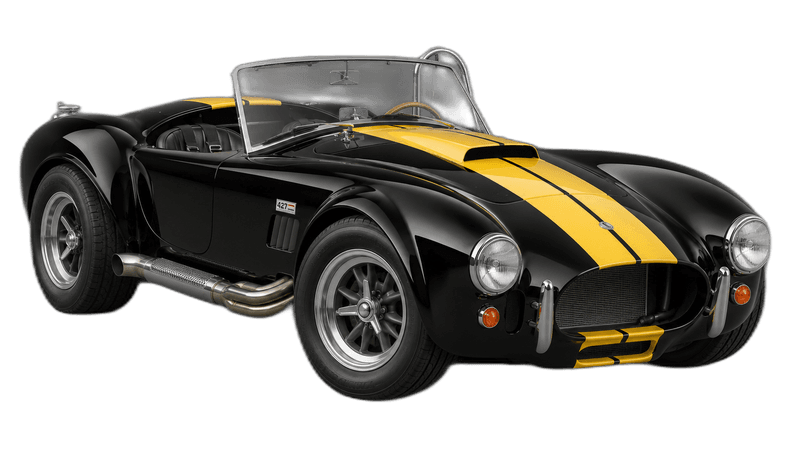
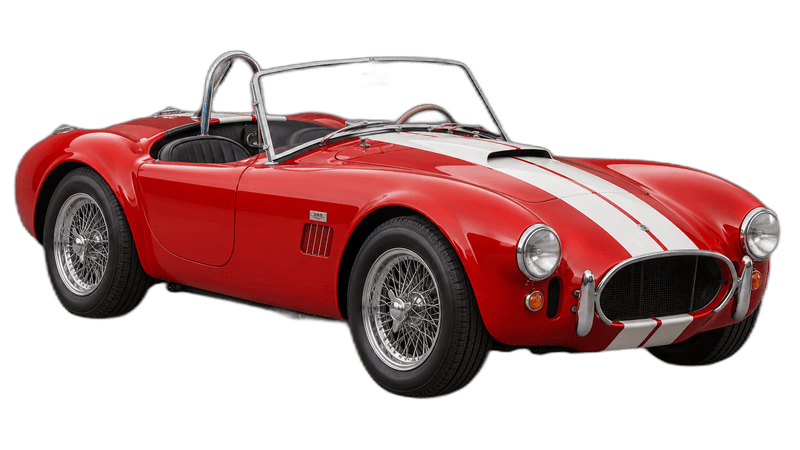
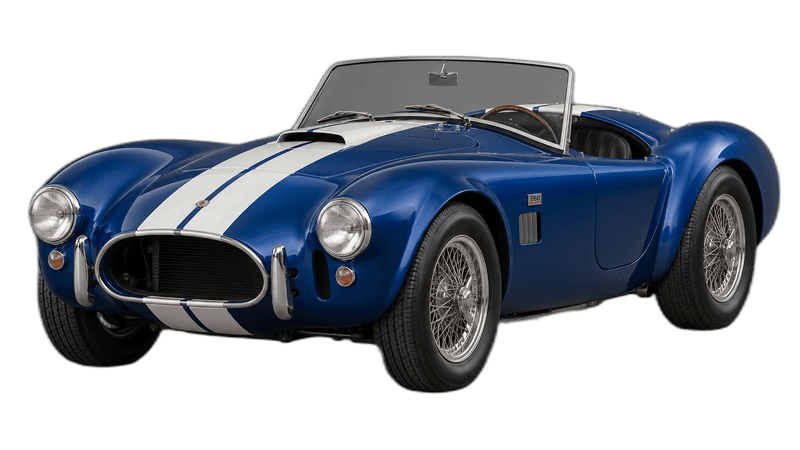
The page uses the catalogue photograph for this model, and its credit is listed on the credits page.
Verdict
The Shelby Cobra 260 is the short first chapter of the Cobra story: a light AC Ace chassis, a 4.3L naturally aspirated V8 with 260 bhp, 365 Nm by our conversion, and only 75 cars with that engine, including the prototype. The sources agree on the engine and the count and disagree on almost everything about performance, so there is no figure shown for 0-100 km/h or top speed, and we would treat any quoted road test number as belonging to a particular car. If you are researching one, the useful questions are which chassis it is, whether it still has its 260 engine or was upgraded to a 289, and whether the paperwork and the car agree. This page is for research, not a buying recommendation, and a specialist inspection is the only way to answer those.
Sources
- Wikipedia: AC Cobra
- Wikipedia: Shelby Cobra
- Ultimate Car Page: AC Shelby Cobra Mk I 260 specification
- Ultimate Car Page: AC Shelby Cobra Mk I 260 history
- Ultimate Car Page: AC Shelby Cobra 260 CSX2021
- Sportscar2: The AC Cobra 260 sports car
- Classic Pony Cars: Carroll Shelby's AC Cobras
- Sports Car Market: Shelby Cobra knowledge base
- Sports Car Market: 1962 Shelby Cobra CSX2000
- RM Sotheby's: 1962 Shelby 260 Cobra CSX 2000
- Conceptcarz: Shelby Cobra 289 (includes 260 notes)
- Cobra Authority: 1962 Shelby Cobra 260 CSX2000
- Motor1 Espana: Shelby Cobra 260 de 1962
Specifiche
| Motore | 4.3L naturally aspirated V8 |
|---|---|
| Cilindrata | 4.3L |
| Potenza | 260 cv |
| Coppia | 365 Nm |
| Trazione | RWD |
| Paese | United States |
| Carrozzeria | 2-door roadster |
| Anni | 1962 |
| Produzione | 75 |
Specifications are manufacturer-published figures.
Domande Frequenti
How much power does the Shelby Cobra 260 have?
The Shelby Cobra 260 produces 260 bhp and 365 Nm of torque.
What engine does the Shelby Cobra 260 have?
The Shelby Cobra 260 uses a 4.3L naturally aspirated V8.
How many Shelby Cobra 260 were made?
Shelby produced 75 units of the Shelby Cobra 260.
When was the Shelby Cobra 260 built?
The Shelby Cobra 260 was built from 1962 to 1962.
Is the Shelby Cobra 260 all-wheel drive?
No. The Shelby Cobra 260 is configured with rear-wheel drive.