
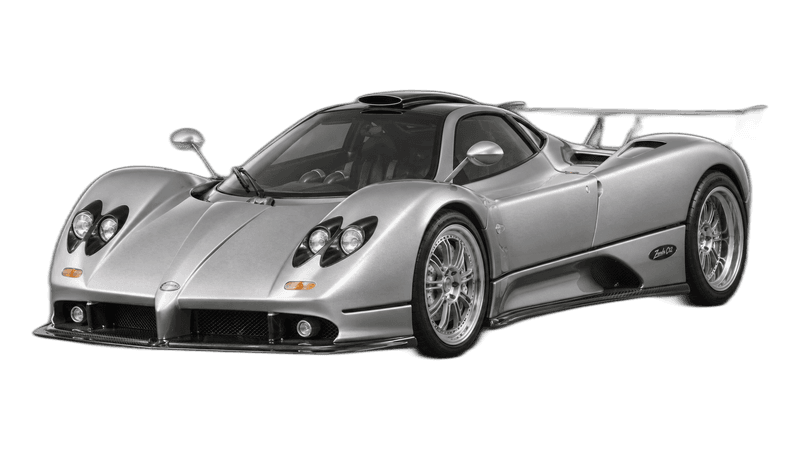
Pagani Zonda C12
394cv
Potenza
4.2s
0-100 km/h
298km/h
Velocita Massima
Quanto spinge.
La forza g di picco nell'istante in cui affondi l'acceleratore, stimata dal tempo 0–100 e dalla trazione.
Pagani Zonda C12G di partenza stimata dal tempo 0–100 e dalla trazione: un'approssimazione onesta, non un dato misurato.
The Pagani Zonda C12 is a 2-door coupé by Pagani, with 394 bhp, 570 Nm of torque, a 0-100 km/h time of 4.2 seconds and a top speed of 298 km/h.
Dream Car Garage Editorial · Edited by José Teo Lorente Vallecillos · Last updated 3 November 2026
Panoramica
We have not driven this car. This review is based on published specifications and the sources listed below.
Scope of this guide
This guide is scoped to the Pagani Zonda C12, the first production car from Horacio Pagani's company, shown at the Geneva Motor Show in March 1999. It is a two-door coupé with a carbon fibre structure, a 6.0 litre Mercedes-Benz V12 mounted behind the seats, and power sent to the rear axle. In plain words it is a mid-engine, rear-wheel drive car. It is not a guide to the C12 S that replaced it from 2000 with a 7.0 litre engine, to the 7.3 litre cars, to the Zonda F, or to any of the later one-off and limited Zondas.
We have not driven this model for this article. We are an editorial desk that reads sources, and everything below comes from pages we opened: Wikipedia, the Pagani Automobili Zonda page, two pages on supercars.net, an English and a German feature on Motor1, a French Motor1 news piece, an RM Sotheby's feature on the Zonda, the conceptcarz page for the C12, an Italpassion model page and an Ultimatespecs listing. We have not inspected, owned or tested a car. The C12 is a very rare car that almost never comes to market, so please treat this page as research, not as a buying recommendation, and do not use it in place of an inspection by a Pagani specialist.
The figures at a glance
- Engine: 6.0L naturally aspirated V12, a Mercedes-Benz M120 unit of 5,987 cc, set in a central position behind the cabin with the cylinders at 60 degrees.
- Layout: mid-engine, rear-wheel drive, with a manual gearbox. Most sources say five speeds, a few list six (see the transmission note below).
- Power: 394 bhp at 5200 rpm. This is the figure on most of the pages we read, and the section below explains why we use it.
- Torque: 570 Nm. Converting the 420 lb ft printed by supercars.net and Motor1 at 1.35582 gives 569.4 Nm, which agrees.
- 0-100 km/h: 4.2 seconds. This is a metric figure printed by the German Motor1 feature, by Italpassion and in the Wikipedia specification table. Several English pages give 4.2 seconds to 60 mph instead, which is a different benchmark that happens to carry the same number.
- Top speed: 298 km/h. The German Motor1 feature and the Wikipedia table both print 298 km/h. Converting the 185 mph on supercars.net, Motor1 and RM Sotheby's at 1.60934 gives 297.7 km/h, which rounds to the same figure.
- Weight: about 1,250 kg (2,755 or 2,756 lb), usually described as dry or empty weight.
- Years: 1999 to 2002.
- Production: five cars with the 6.0 litre V12, according to Wikipedia, Motor1, conceptcarz, RM Sotheby's and the French Motor1 piece.
Which power figure we use, and why
Power is the figure that varies most between pages, so it is worth being open about it. Here is what we read.
- 394 bhp or 394 hp: supercars.net (394 bhp, 293.8 kW, at 5200 rpm), the English Motor1 feature (394 hp, 293 kW), RM Sotheby's (394 brake horsepower), the body text on the Pagani Automobili Zonda page (as much as 394 hp), and Italpassion (394 hp).
- 394 PS: the German Motor1 feature prints 394 PS, with no kilowatt figure. Ultimatespecs prints 399 PS, 394 HP and 293 kW together, which shows how loosely the units are mixed. Converting 399 PS at 0.98632 gives 393.5 bhp, and converting 293.8 kW at 1.34102 gives 394.0 bhp, so these cluster tightly around the same number.
- 408 PS: the running text on Wikipedia and the conceptcarz page. Converting 408 PS at 0.98632 gives 402.4 bhp, and Wikipedia itself prints 402 hp for it.
- 450 PS: the Wikipedia specification table (450 PS, 331 kW, 444 hp, at 5200 rpm) and the specification table on the Pagani Automobili Zonda page (331 kW, 450 cv). Converting 450 PS at 0.98632 gives 443.8 bhp. The French Motor1 piece prints 454 hp.
We use 394 bhp everywhere in this guide because it is the figure on the largest number of pages, it is printed in bhp by several English sources, and it is consistent with the 293 kW value that two independent pages give. We cannot tell from the pages we read why the 408 PS and 450 PS numbers exist. None of them says whether they describe a later state of tune, an uprated customer car, or simply a different way of measuring. The Pagani Automobili page is itself inconsistent, because its body text says 394 hp while its table says 450 cv. If you are looking at a specific car, ask for the figure on that car's paperwork rather than trusting any page, ours included.
Torque shows a smaller spread. Most pages say 570 Nm (supercars.net, both Motor1 features, Italpassion, Ultimatespecs and the Pagani text). The French Motor1 piece prints 571 Nm and conceptcarz prints 421 lb ft, which converts to 570.8 Nm. Wikipedia gives a range of 570 to 640 Nm in its text and 590 Nm in its table, and the Pagani Automobili table also says 590 Nm. We use 570 Nm to stay consistent with the 394 bhp figure.
Performance claims
We found no magazine road test of the 6.0 litre car, so every number below is a figure that a page prints, not a result anyone measured for us.
- 0-100 km/h: 4.2 seconds (German Motor1, Italpassion, Wikipedia table). The French Motor1 piece says about 4 seconds, against 5.3 seconds for the Ferrari 360 Modena. One listing, on idoneos.com, prints 4.8 seconds, but the same page lists a 7,010 cc engine that belongs to the C12 S, so we do not rely on that page.
- 0-60 mph: 4.2 seconds (supercars.net, English Motor1, conceptcarz). RM Sotheby's gives 4.2 seconds to 62 mph. The Wikipedia text gives 4.0 seconds for 60 mph. We do not relabel any of these as a 0-100 km/h time.
- 100 mph: 8.2 seconds on conceptcarz, and 9.2 seconds to 161 km/h (100 mph) in the Wikipedia text. These two disagree by a full second.
- Top speed: 298 km/h on the German Motor1 feature and the Wikipedia table, about 297 or 298 km/h converted from 185 mph on several others. Italpassion prints 295 km/h and idoneos.com prints 320 km/h. The conceptcarz page prints 210 mph, which at 1.60934 would be about 338 km/h and is far above everything else we read, so we treat it as an error or a claim about a different car.
History and name
The sources tell the same broad story. Horacio Pagani moved from Argentina to Italy in 1983 and worked at Lamborghini, including on the Countach Evoluzione, before founding Pagani Composite Research in 1988 and Modena Design in 1992, according to RM Sotheby's. Work on the car began in 1993 and the project was known internally as the C8 Project. In 1994 Mercedes-Benz agreed to supply engines, and the German Motor1 feature says the plan was to put an AMG-built V12 in every Pagani.
The car was first planned as the Fangio F1, after the five-time Formula 1 champion Juan Manuel Fangio, who was also Argentine. Wikipedia, both Motor1 features and conceptcarz say it was renamed after Fangio died in 1995, and Wikipedia says the name Zonda comes from a hot air current above Argentina. The car was presented at Geneva in 1999, and the Wikipedia heading puts the C12 at 1999 to 2002. RM Sotheby's, however, says the C12 S superseded the original car in 2000, and conceptcarz says the C12 was built until 2002. Because the sources disagree, we use 1999 to 2002 for the span and treat the end year as soft.
Construction and equipment
The Pagani Automobili page describes a carbon fibre monocoque, and RM Sotheby's adds extruded aluminium sub-frames and says test driver and engineer Loris Bicocchi handled dynamic development. It says the first cars had ABS and what it calls a rather primitive kind of traction control, which is worth remembering when you read modern comparisons. Supercars.net lists Brembo ventilated discs of 355 mm at the front and 335 mm at the rear, tyres of 255/40/18 at the front and 345/35/18 at the rear, a wheelbase of 2,730 mm, a length of 4,345 mm and a width of 1,933 mm. It also describes a curved windscreen and an interior modelled on a fighter jet cockpit.
Transmission note
Wikipedia, both Motor1 features and the supercars.net text say five-speed manual. The supercars.net specification table, Ultimatespecs and idoneos.com list six speeds. We use five speeds because more of the narrative text agrees on it, but we have no maker document to settle the point.
How many were built
This is the part that makes the C12 unusual. The count is small and the sources largely agree on it.
- Wikipedia says only five cars were built with the 6.0 litre engine. One was used for crash testing and homologation, one was a demonstrator and show car, and the rest went to customers over about three years.
- The German Motor1 feature says five in total, with three delivered to customers, which matches the arithmetic above.
- RM Sotheby's says five coupés and a single roadster before the C12 S took over, so a roadster may exist on top of the five coupés. No other page we read mentions it.
- Conceptcarz says only five of the initial 6.0 litre cars were built, and adds 15 units of the 7.0 litre C12 S and 17 of the 7.3 litre C12 S. RM Sotheby's says 16 coupés of the C12 S were built before capacity rose again. Italpassion says fewer than 140 examples of all Zonda versions, while conceptcarz mentions 60 cars of all types by January 2006 and then a different later count, so any statement about total Zonda numbers needs care.
We use five as the count for the C12, and the roadster as a footnote.
Chassis 001
Motor1 says chassis 001 was the homologation and crash test car, and that Pagani still owns it. The company restored it under its Pagani Rinascimento programme and showed it at the 2019 Geneva Motor Show for the Zonda's twentieth anniversary. The French Motor1 piece says it kept its original metallic grey colour. Conceptcarz also describes chassis 001 as used for approval and crash tests. This means one of the five cars is not available to buyers at all, and that the number of customer cars was very small.
What the rarity means
We found no buying guide, no list of common faults, no recall notice and no ownership cost data for the 6.0 litre C12 in any source we read, so we are not going to invent a checklist. What the sources do support is a short list of things a researcher can say with confidence:
- Only about three cars reached customers, so any car described as a C12 should have a clear chain of documents back to the factory.
- The 6.0 litre car is easy to confuse with the C12 S, because pages mix their figures (the idoneos.com page is an example). Check the engine size in any listing.
- Specification details such as power and gearbox are not settled in public sources, so ask for factory paperwork.
- A guide like this one cannot replace a specialist inspection, and no source we read describes an inspection routine for these cars.
Prices and market notes
We found no recorded auction sale of a 6.0 litre C12 on any page we opened. The prices we did find are these:
- New price: supercars.net gives 280,000 dollars for the C12, while conceptcarz gives 320,000 dollars for the C12 and 350,000 dollars for the C12 S. Neither page dates the figure.
- Market comment: RM Sotheby's says that in 2012 earlier Zondas would typically fetch maybe 450,000 to 550,000 dollars at auction. The article is general and does not name a specific car. The much higher price it links to belongs to a 2006 Zonda Riviera, which is a different car.
Given only five cars and no sales on record in our sources, we give no value for a C12. Anyone needing a figure should ask a specialist dealer or an auction house.
What we could not find
- No road test of the 6.0 litre car, so the performance figures come from summary pages only.
- No maker document that gives power, torque or gearbox type. The Pagani Automobili page conflicts with itself.
- No source that says when the fifth C12 was finished, so the 1999 to 2002 span is the best we can offer.
- No buying checklist, known faults, recall or running cost data.
- The Encycarpedia page for the C12 returned a 403 refusal when we tried to open it, so we did not use it and did not work around the block.
- Hagerty, Bonhams and other auction pages for Zondas turned up only as search results for later C12 S cars, not for the 6.0 litre car, so we did not cite them.
About the photograph
The page uses the catalogue photograph for this model, and its credit is listed on the credits page.
Verdict
The Zonda C12 matters because it was the first Pagani, not because of a place in any ranking. A carbon fibre car of about 1,250 kg with a Mercedes V12 making 394 bhp and 570 Nm was a bold start for a small Italian maker, and the sources that print a metric sprint time agree on 4.2 seconds to 100 km/h and about 298 km/h, although we could not find a road test to confirm them. The strongest takeaway is how few were built: five with the 6.0 litre engine, and possibly one roadster, with one chassis kept by the factory. Sources disagree on power labels (394, 408 or 450), on the gearbox and on the end of production, so any single number you see should be checked. This page is a research aid built from published pages and not a buying recommendation, and it cannot replace a specialist inspection of a specific car.
Sources
- Wikipedia: Pagani Zonda
- Pagani Automobili: Zonda
- Supercars.net: 1999 Pagani Zonda C12
- Supercars.net: Car of the Day, 1999 Pagani Zonda C12
- Motor1: 1999 Pagani Zonda C12, Supercar Sunday
- Motor1 Germany: Pagani Zonda C12 (1999), Supercar Sonntag
- Motor1 France: La toute premiere Pagani Zonda C12 restauree pour Geneve
- RM Sotheby's: The rise of the Zonda
- Conceptcarz: Pagani Zonda C12
- Italpassion: Pagani Zonda
- Ultimatespecs: Pagani Zonda C12
- Idoneos: Pagani Zonda C12
Specifiche
Motore
6.0L naturally aspirated V12
Cilindrata
6.0L
Potenza
394 cv
Coppia
570 Nm
0-100 km/h
4.2s
Velocita Massima
298 km/h
Trazione
RWD
Paese
Italy
Carrozzeria
2-door coupé
Anni
1999–2002
Produzione
5
Specifications are manufacturer-published figures.
Altre di Pagani
Domande Frequenti
What are the specifications of the Pagani Zonda C12?
The Pagani Zonda C12 is a 2-door coupé by Pagani, with 394 bhp, 570 Nm of torque, a 0-100 km/h time of 4.2 seconds and a top speed of 298 km/h.
How many Pagani Zonda C12 were made?
Pagani produced 5 units of the Pagani Zonda C12.
What drivetrain does the Pagani Zonda C12 use?
The Pagani Zonda C12 is configured with rear-wheel drive.
What type of car is the Pagani Zonda C12?
The Pagani Zonda C12 is a hypercars manufactured by Pagani in Italy. Production ran from 1999 to 2002.