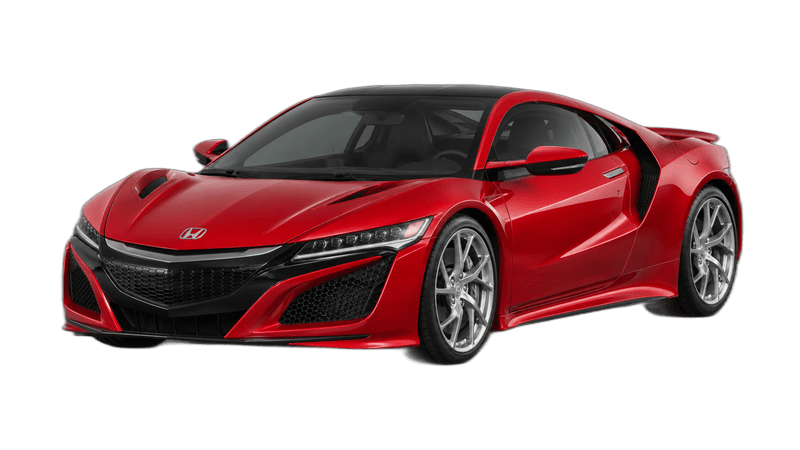
Honda NSX NC1
573cv
Potenza
2.9s
0-100 km/h
307km/h
Velocita Massima
The Honda NSX NC1 produces 573 bhp, reaches 100 km/h in 2.9 seconds and has a top speed of 307 km/h.
Quanto spinge.
La forza g di picco nell'istante in cui affondi l'acceleratore, stimata dal tempo 0–100 e dalla trazione.
Honda NSX NC1G di partenza stimata dal tempo 0–100 e dalla trazione: un'approssimazione onesta, non un dato misurato.
Dream Car Garage Editorial · Edited by José Teo Lorente Vallecillos · Last updated 3 November 2026
Panoramica
We have not driven this car. This review is based on published specifications and the sources listed below.
Scope of this guide
This guide is scoped to the Honda NSX NC1, the second-generation NSX, a two-door coupe built by Honda from May 2016 until the final Type S in late 2022. It is a mid-engine car with all-wheel drive, delivered by a Sport Hybrid SH-AWD system: a twin-turbocharged V6 sits behind the cabin and drives the rear wheels through a nine-speed dual-clutch gearbox, and electric motors add drive at the front and the rear. It is not a guide to the first-generation NSX, which is a different car with a naturally aspirated engine. Outside North America the car was sold as a Honda, and in North America as an Acura, but it is the same car.
We have not driven this model for this article. We are an editorial desk that reads sources, and everything below comes from pages we opened: two Honda Global press releases, Auto Express, evo, Driving Electric, Autoblog, a recall summary on CarComplaints, a data sheet on more-cars.net, and Wikipedia. We are not a dealer, a workshop or a registry, and nothing here replaces an inspection of a particular car by a specialist who knows it. This is research, not a buying recommendation.
The figures at a glance
- Engine: 3.5L twin-turbocharged V6 hybrid. Wikipedia describes a 3,493 cc twin-turbocharged 75 degree DOHC V6 mounted longitudinally behind the cabin, and more-cars.net also gives 3,493 cc. Honda's 2016 release says only "3.5-liter V6 DOHC Twin-turbo".
- Power: 573 bhp, combined system output. Wikipedia prints 573 hp, 581 PS and 427 kW. Auto Express and evo both print 573 bhp, and evo says this is Honda's stated combined output. The V6 alone is 500 bhp according to Auto Express. We discuss the units in the next section.
- Torque: 645 Nm combined, which is 476 lb ft. Wikipedia and Auto Express both print 645 Nm, and evo prints 476 lb ft. The engine alone makes 550 Nm per Auto Express.
- 0-100 km/h: 2.9 seconds. This is the 0-62 mph time printed by Auto Express and evo, and 62 mph is within a fraction of a km/h of 100 km/h. We explain how firm that figure is below.
- Top speed: 307 km/h, which is 191 mph. Wikipedia calls it electronically limited. Auto Express prints 191 mph.
- Drive: all-wheel drive through a nine-speed dual-clutch gearbox. Honda lists it as 4WD (Sport Hybrid SH-AWD).
- Weight: sources disagree, from 1,725 kg to 1,796 kg. See below.
- Body: two-door coupe.
- Production: May 2016 to 2022, in Marysville, Ohio.
Where the sources disagree
Power is where a quick look goes wrong, so we spell it out. Honda's own pages that we opened do not print a combined power figure: the 2016 press release lists the engine, the motors and the Japanese price, and says nothing about output. The figure comes from the press and from Wikipedia. Wikipedia gives 573 hp as the same output as 581 PS, and the conversion checks out: 581 PS multiplied by 0.98632 is about 573 bhp. So 573 is a bhp or horsepower figure, not PS misread as bhp. If you see 581 anywhere, it is the same output in metric horsepower. Driving Electric, in the same review, prints 581 bhp in its data panel and 573 bhp in its text, so that page contradicts itself, and we chose 573 because two other sources and the conversion support it.
We looked for the idea that the 2019 update raised output to about 600 PS. We did not find it. The evo review of the updated car still quotes 573 bhp as Honda's combined output, and describes the update as new dampers, thicker anti-roll bars, tyres, hubs, recalibrated steering, hybrid system and stability control. Wikipedia gives no new power or torque for the update. The 602 hp and 610 PS figures belong to the 2022 Type S, which we cover below.
Torque has a small spread: 645 Nm in Wikipedia and Auto Express, 646 Nm in more-cars.net. The 476 lb ft figure converts to about 645 Nm, so we use 645.
Acceleration is the loosest figure. Wikipedia reports a manufacturer 0-60 mph time of 2.9 seconds and a Car and Driver measured 3.1 seconds. Auto Express and evo both print 2.9 seconds for 0-62 mph. Driving Electric prints 3.3 seconds to 62 mph. more-cars.net lists 2.9 for 0-100 without a unit. Because 62 mph is 99.8 km/h, we treat the 2.9 seconds to 62 mph as the 0-100 km/h time, but we did not find Honda's own page stating a 0-100 km/h time, so this is a press and reference figure, and a car in the real world will vary with tyres, surface and temperature. We do not use a round 3.0 seconds, because no source we read gives it.
Top speed is 307 km/h in Wikipedia and 308 km/h in more-cars.net, a rounding difference on the same 191 mph. We use 307.
Weight: Auto Express prints both 1,776 kg and 1,725 kg on the same page, evo prints 1,776 kg, and Wikipedia gives a range of 1,725 to 1,796 kg. Weight depends on specification, so use these as a range.
History and how the car came about
This NSX is a clean-sheet successor, not a facelift. Wikipedia notes that the article is inconsistent about the start, with one section saying production began in 2015, but that the first car rolled off the line on 24 May 2016. Honda's Japanese release opened custom orders on 25 August 2016, with customer deliveries from 27 February 2017 and a first-year Japanese sales plan of 100 cars. Wikipedia reports that a North American price of 156,000 US dollars was announced in December 2015.
Cars were assembled at Honda's Performance Manufacturing Center, next to Honda's Marysville plant in Ohio. Honda says body construction, painting and final assembly are all done in house by about 100 associates. Wikipedia adds that the engines were assembled separately at Honda's Anna, Ohio engine plant. The nine-speed gearbox is fitted behind the V6, and evo says an electric motor sits between engine and gearbox.
Wikipedia says production ended in Japan, Australia and Europe in 2020 because of weak sales. We read that as the end of sales in those markets, and the article does not say more. We did not find a source that explains why.
How the Sport Hybrid SH-AWD layout works
Calling this car simply all-wheel drive hides how it works, so we describe it as the sources do. The V6 drives the rear wheels through the dual-clutch gearbox. A rear motor sits between the engine and the gearbox, and Honda's release calls it a high-output rear direct drive motor. At the front a Twin Motor Unit has two motors that power the left and right front wheels separately. Honda says this gives electrically controlled torque vectoring across all four wheels. Wikipedia says the engine alone drives the rear wheels, and evo says the two front motors share one drive assembly but can work independently.
There is no mechanical shaft to the front axle in these descriptions, so the front wheels are driven electrically. evo adds that the battery is relatively small, so electric-only running is limited. Auto Express says the three motors give four-wheel drive, with power through the nine-speed automatic to the rear wheels. evo splits the 573 bhp as 47 bhp from the rear motor and 36 bhp from each front motor, and Auto Express notes the individual outputs do not simply add up to the total. We pass that on as a caution, not as a fault in either source.
Variants and what changed over the run
- 2016 to 2018: the original car. Wikipedia gives a length of 4,470 mm for these years.
- 2019 to 2021: the updated car. evo lists softer comfort damping that still firms up in Sport Plus and Track modes, thicker anti-roll bars, Continental SportContact 6 tyres, upgraded hubs, a recalibrated steering, hybrid system and stability control, plus a body-coloured front grille garnish in place of chrome, a gloss black grille and a new orange paint. Wikipedia gives a length of 4,490 mm. evo says it drives much as it did before.
- 2022 Type S: Wikipedia and Autoblog give 602 hp. Wikipedia gives 610 PS, 449 kW and 667 Nm combined, with 522 hp from the engine alone, a manufacturer 0-60 mph under 3 seconds, a Car and Driver measured 2.9 seconds, and an unchanged 191 mph top speed. Honda's 2021 release says 350 units worldwide, 30 in Japan and 320 outside Japan. Autoblog says the final car was completed on 16 November 2022 and was a matte Gotham Gray car reserved for a customer, while Honda's release said production would conclude in December 2022. We read these as a plan and then a result, though we cannot say which was exact.
Wikipedia says a total of 2,908 cars were produced including 350 Type S. We found no second source for that total, so we treat it as unconfirmed and do not use it as a firm figure.
Running costs and known issues
Our running-cost evidence is thin and comes from one review. Auto Express gives official fuel consumption of 28.3 mpg and 228 g/km of CO2, and says the NSX has a thirst to match its performance, a high Benefit in Kind tax bill and fairly hefty servicing bills. The standard Honda warranty it quotes is three years or 60,000 miles. It says Honda's reputation for reliability is solid but that the car ranks poorly in its Driver Power survey. It expects the car to retain around 59 per cent of its value after three years, and the NSX had not been tested by Euro NCAP. We found no servicing schedule, no brake or battery replacement costs, and no failure rate, so we give none.
Honda Global notes that carbon ceramic discs were a manufacturer option, and that cars with iron brake rotors were due to begin delivery in May 2017. If you are weighing an example, that means brake fit is something to confirm from the paperwork.
Recalls and safety
We opened one recall page. CarComplaints, describing NHTSA campaign 18V599000, reports that road vibration can loosen the screws holding the circuit board of the centre high-mounted brake light on 2017 NSX cars, which can blow the brake light fuse and disable the brake lights. It covers 793 vehicles, was announced on 7 September 2018 and began on 2 November 2018, and the remedy is a free replacement of the light. Our search also turned up other NSX campaigns, including one on fuel tank couplers and one on a fuel pump, but we could not read those pages and we do not rely on them. Check any specific car against the NHTSA recall lookup, or your national equivalent, by VIN.
What to check before buying
- Recall status by VIN: whether every open campaign was completed, with a dealer record.
- Which brakes are fitted: iron or carbon ceramic, per the Honda Global note, and the cost of replacing whatever is fitted, which we could not find.
- The year: the 2019 update changed the damping, tyres and calibrations, so work out which version you are looking at.
- Hybrid system health: we found no source on battery life, and a specialist should read the system.
- Service history from a dealer with NSX experience. evo says only two UK dealers sold the car, both in London, so ask where it was serviced.
- Whether it is a Type S, which is a distinct limited car of 350 units.
Market and value notes
New prices we read were: 23,700,000 yen in Japan including 8 per cent consumption tax in 2016 (Honda Global), 156,000 US dollars announced for North America in December 2015 (Wikipedia), and about 145,000 pounds in the UK (Auto Express; evo prints 144,765 pounds in its text and 147,425 pounds in its header). These are launch prices from different years. We found no used price or auction result, so we offer no current value, and we do not forecast one.
What we could not find
We found no combined power, torque, acceleration or top-speed figure on a Honda page that we opened, so every figure above is from the press and reference sources named. We found no Honda page that states a 0-100 km/h time. We found no used pricing, no service interval and no battery-life data.
About the photograph
The page uses the catalogue photograph, and its credit is listed on the credits page.
Verdict
The NC1 NSX is a well-documented car with a confusing powertrain label. Its headline numbers are consistent across the sources we read: 573 bhp, 645 Nm, about 2.9 seconds to 100 km/h or 62 mph, and 307 km/h. The things that differ are the weight, the power units and the tester's acceleration claims. Its all-wheel drive is electric at the front and mechanical at the rear, and the 2019 update changed the chassis and software, not the power we found in print. It was a low-volume car from a single plant in Ohio, and the Type S is rarer still. Use this page to understand the car, then rely on a specialist and the recall record for any particular example.
Sources
- Wikipedia, Honda NSX (second generation)
- Honda Global, new NSX sales announcement (2016)
- Honda Global, NSX Type S first information (2021)
- Auto Express, Honda NSX review
- evo, Honda NSX review
- Driving Electric, Honda NSX performance
- Autoblog, Acura NSX Type S ends production
- CarComplaints, 2017 Acura NSX brake light recall 18V599000
- more-cars.net, Honda NSX fact sheet
Specifiche
| Motore | 3.5L twin-turbocharged V6 hybrid |
|---|---|
| Cilindrata | 3.5L |
| Potenza | 573 cv |
| Coppia | 645 Nm |
| 0-100 km/h | 2.9s |
| Velocita Massima | 307 km/h |
| Trazione | AWD |
| Paese | Japan |
| Carrozzeria | 2-door coupé |
| Anni | 2016–2022 |
Specifications are manufacturer-published figures.
Domande Frequenti
How much power does the Honda NSX NC1 have?
The Honda NSX NC1 produces 573 bhp and 645 Nm of torque.
How fast is the Honda NSX NC1 from 0 to 100 km/h?
The Honda NSX NC1 accelerates from 0 to 100 km/h in 2.9 seconds.
What is the top speed of the Honda NSX NC1?
The Honda NSX NC1 has a top speed of 307 km/h.
What engine does the Honda NSX NC1 have?
The Honda NSX NC1 uses a 3.5L twin-turbocharged V6 hybrid.
When was the Honda NSX NC1 built?
The Honda NSX NC1 was built from 2016 to 2022.
Is the Honda NSX NC1 all-wheel drive?
Yes. The Honda NSX NC1 is configured with all-wheel drive.