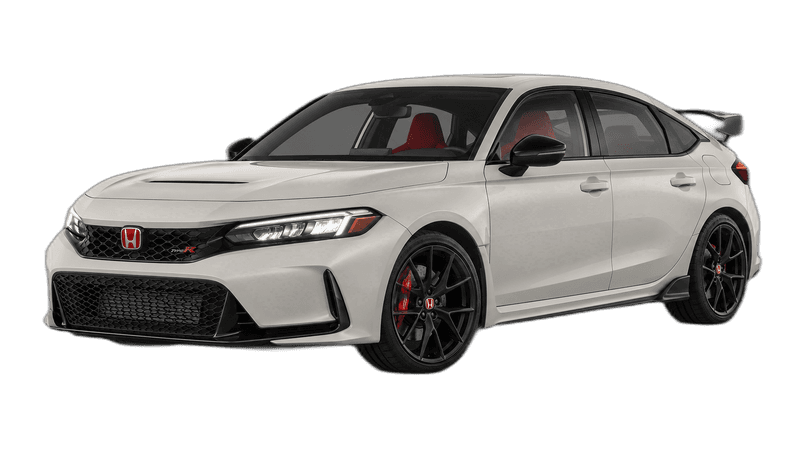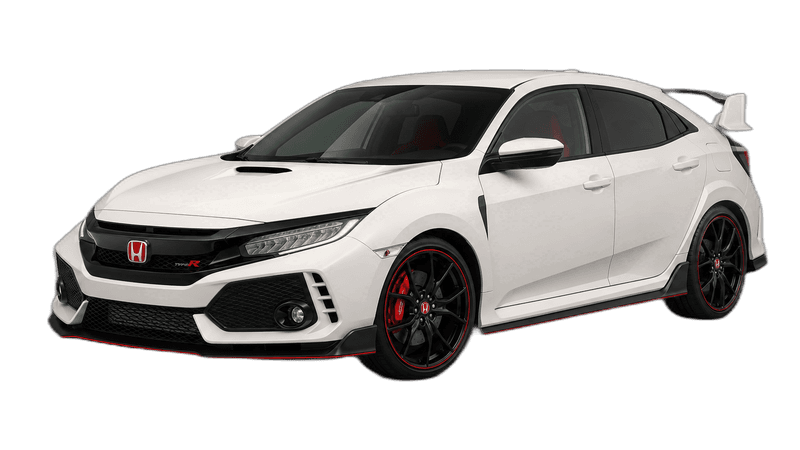
Honda Civic Type R (FK8)
£35,000
usedIndicative market price, updated periodically.
316bhp
Power
5.8s
0-100 km/h
272km/h
Top Speed
£35,000
Price Used
The Honda Civic Type R (FK8) produces 316 bhp, reaches 100 km/h in 5.8 seconds and has a top speed of 272 km/h. A representative example is worth about £35,000.
How hard it pulls.
Peak g-force the instant you bury the throttle, estimated from the car's 0–100 time and drivetrain.
Honda Civic Type R (FK8)Estimated peak launch g from the 0–100 time and drivetrain: an honest approximation, not a measured figure.
Dream Car Garage Editorial · Edited by José Teo Lorente Vallecillos · Last updated 30 October 2026
Overview
We have not driven this car. This review is based on published specifications and the sources listed below.
The FK8 widened the Type R audience
The FK8 took the turbocharged Civic Type R to the United States while keeping the manual gearbox and front-wheel-drive layout that define the model. Honda dates the generation to 2017–2021 and records 316 hp for Europe and Japan, with 306 hp in the United States. It also lists 295 lb-ft of torque, a helical limited-slip differential, dual-axis front suspension, multi-link rear suspension and adaptive dampers. We have not driven this model for this article. This is a desk-researched ownership guide using Honda's Type R history, the PistonHeads FK8 used buying guide and the DVSA recall service. Their findings are inspection evidence, not a substitute for a specialist assessment.
Our catalogue uses the European specification: a 1996 cc turbocharged inline-four petrol engine, 316 bhp, 400 Nm, 0 to 100 km/h in 5.8 seconds and a 272 km/h maximum, with front-wheel drive. That output should not be applied uncritically to every market. Honda is clear that US cars used a different rating, and PistonHeads also describes the European car. If you are comparing an import with a UK or European car, verify the market and specification before treating the figures as interchangeable.
Cooling, engine management and modifications
The FK8 uses the same basic K20C1 engine family as the FK2, with revisions that Honda and PistonHeads both describe. The PistonHeads guide notes a distinct intake and exhaust character as the engine approaches higher engine speeds. It also records first-to-second shift graunch, clutch master-cylinder replacements and some gearbox replacements. Those reports do not amount to a universal defect rate. They do mean the clutch hydraulics, shift quality and transmission noise should be checked methodically.
Cooling confidence is still part of the ownership case, particularly if the car has seen track use. Ask about coolant service, radiator condition, hose and clamp condition, oil temperature management and whether any protective modifications were made after hard sessions. A remap or intake can improve response, but only when the calibration and surrounding hardware are appropriate. Honda's 2020 update changed the grille and airflow balance, while the PistonHeads guide records the broader facelift as including revised dampers, rear subframe bushes, ball joints, two-piece brake rotors and pad material. A pre-update car and a post-update car should therefore be inspected against the equipment actually fitted.
Brakes, wheels and suspension carry the performance load
The FK8's standard 20-inch wheels and 245/30 tyres look dramatic but make wheel damage and tyre cost part of ordinary ownership. PistonHeads identifies the debate over moving to smaller wheels for comfort and pothole resistance. Whatever size is fitted, check for distorted rims, mismatched tyres, uneven wear and repeated kerb strikes. The adaptive dampers should change the car's behaviour between modes. If the car feels floaty, crashes over broken surfaces or shows a persistent suspension warning, the dampers and their control system need diagnosis rather than guesswork.
The Brembo front brakes are high-performance components, not generic wear items. PistonHeads says squeal can be normal on the FK8, but cracks around drilled holes mean replacement. Measure pad thickness, inspect disc surfaces and ask for temperature-related judder history. A car that has been tracked should have brake-fluid evidence and possibly uprated pads; a road car with tired brakes will feel disappointing even if the engine is strong. Check the lower front air dam and underbody panels for damage, because aerodynamic and cooling parts are expensive when casually repaired.
Cabin, practicality and the 2020 update
The FK8 is only a five-door, and its boot is not simply the same as every regular Civic. PistonHeads describes the seating position as lower than the FK2, which many drivers prefer. The dashboard includes a digital instrument cluster and a central screen; the 2020 update brought Honda Sensing and revised infotainment, including a return to a physical volume control. Test every switch, camera, sensor and driver-assistance function. A warning light on a highly equipped performance car can become a parts bill, not a minor irritation.
PistonHeads also mentions dashboard vibration reports. Listen at idle and over rough roads, but distinguish a loose trim buzz from a real suspension or structural issue. Inspect seat bolsters, pedal wear, steering-wheel condition and the security system. The DVSA recall service and Honda's own campaign records should be used against the registration or VIN. Do not assume that a facelift car has every update merely because it is late; confirm software, dampers, brakes and safety equipment against the build record.
How to weigh facelift and modification history
Decide whether you want the sharper 2017–2019 chassis or the revised 2020-on car before viewing examples in person. The later car can bring the equipment and cooling updates that matter to you, but the earlier car may have the cleaner service file. Do not pay a premium for a facelift based only on the grille or screen. Confirm the damper specification, brake hardware, software, safety equipment and wheel size against the VIN.
Modification history should be judged by integration. A intake, remap or wheel change from a recognised specialist with invoices is easier to assess than a chain of undocumented parts. Ask what has been removed from the car and whether the original exhaust, intake, wheels and suspension are available. On the road, the car should feel cohesive rather than nervous. If the engine is strong but the brakes, geometry and tyres disagree with each other, the ownership cost has moved from purchase price to correction.
Value comes from coherent use, not one heroic claim
The FK8's value depends on how coherently the engine, gearbox, cooling, brakes, suspension and electronics have been used. A car with a clean service record, sensible tyres, no unexplained warning lights and evidence of careful warm-up and cool-down habits is easier to own than a heavily modified example with missing invoices. Honda's history gives the generation its dates, market outputs and 2020 refresh; PistonHeads supplies the buyer-level checks. Use the DVSA recall service before purchase and price any outstanding work separately from the car.
The strongest FK8 is not the one with the loudest exhaust or the most aggressive map. It is the one whose specification, maintenance and use all point in the same direction. This guide combines Honda's historical specifications and the sources listed below. It assigns no exact production count to the European derivative.
Specifications
| Engine | 2.0L K20C1 inline-4 turbocharged petrol |
|---|---|
| Displacement | 2.0L |
| Power | 316 bhp |
| Torque | 400 Nm |
| 0-100 km/h | 5.8s |
| Top Speed | 272 km/h |
| Drivetrain | FWD |
| Country | Japan |
| Body Style | 5-door hatchback |
| Years | 2017–2021 |
| Price Used | £35,000 |
Specifications are manufacturer-published figures.
Compare with
Frequently Asked Questions
What is a Honda Civic Type R (FK8) worth?
A representative example is worth about £35,000. Actual values vary with specification, condition and history.
How much power does the Honda Civic Type R (FK8) have?
The Honda Civic Type R (FK8) produces 316 bhp and 400 Nm of torque.
How fast is the Honda Civic Type R (FK8) from 0 to 100 km/h?
The Honda Civic Type R (FK8) accelerates from 0 to 100 km/h in 5.8 seconds.
What is the top speed of the Honda Civic Type R (FK8)?
The Honda Civic Type R (FK8) has a top speed of 272 km/h.
What engine does the Honda Civic Type R (FK8) have?
The Honda Civic Type R (FK8) uses a 2.0L K20C1 inline-4 turbocharged petrol.
When was the Honda Civic Type R (FK8) built?
The Honda Civic Type R (FK8) was built from 2017 to 2021.
Is the Honda Civic Type R (FK8) all-wheel drive?
No. The Honda Civic Type R (FK8) is configured with front-wheel drive.