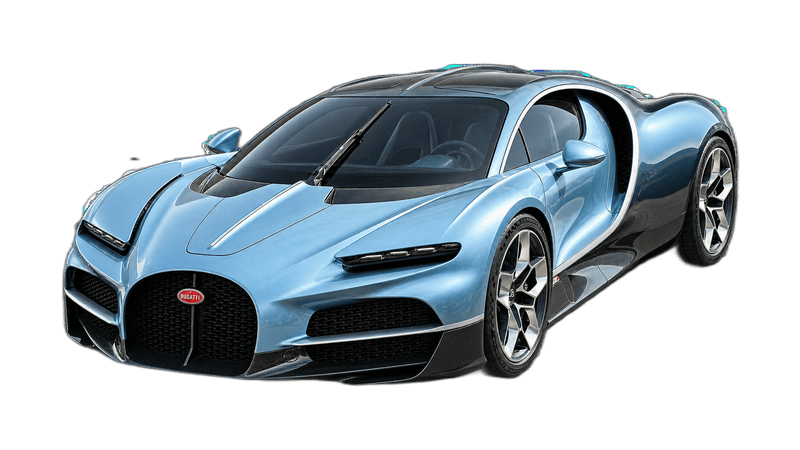
Bugatti Tourbillon
1775cv
Potenza
2s
0-100 km/h
380km/h
Velocita Massima
The Bugatti Tourbillon produces 1775 bhp, reaches 100 km/h in 2 seconds and has a top speed of 380 km/h.
Quanto spinge.
La forza g di picco nell'istante in cui affondi l'acceleratore, stimata dal tempo 0–100 e dalla trazione.
Bugatti TourbillonG di partenza stimata dal tempo 0–100 e dalla trazione: un'approssimazione onesta, non un dato misurato.
Dream Car Garage Editorial · Edited by José Teo Lorente Vallecillos · Last updated 28 October 2026
Panoramica
We have not driven this car. This review is based on published specifications and the sources listed below.
Bugatti's 250-car V16 hybrid
The Tourbillon is Bugatti's successor to the Chiron, and it changes the formula substantially. The engine is an 8.3-litre naturally aspirated V16 with a 90-degree bank angle, producing 1000 PS and 900 Nm up to 9000 rpm. Three electric motors add power, two at the front and one at the rear, for a combined output of 1800 PS, about 1775 bhp. Bugatti plans 250 cars.
This is a desk-researched ownership guide. We have not driven this model for this article. Bugatti's 2024 launch material stated that type approval had not yet been granted, so this guide is prospective rather than a report on an established used market. Confirm the current approval and delivery status for your market before ordering, and confirm final specification, warranty terms and servicing arrangements with Bugatti before any commitment.
The V16 and the hybrid system
The V16 is naturally aspirated, which is unusual in a modern hypercar. Bugatti quotes 1000 PS, 900 Nm and a 9000 rpm limit. The engine is paired with an eight-speed dual-clutch transmission and a 24.8 kWh gross battery pack. The electric system runs at 800 volts and provides more than 60 km of WLTP electric range.
The front electric motors produce 250 kW each, and the rear motor produces 250 kW. The battery limits the combined electrical output, so those per-motor ratings are not additive at all times. Torque vectoring is part of the chassis package. The battery, inverters, motors and cooling circuits are all factory-controlled systems. A buyer should ask for the delivery inspection record, the battery health report and the software configuration.
Because the car is new, there is no meaningful independent wear pattern to quote. The sensible approach is to treat the hybrid system like any other high-voltage component: verify the diagnostic history, confirm the correct charging equipment and ask how the battery has been maintained during storage. Do not accept a dashboard with no warnings as proof that the systems are healthy.
Performance and the Speed Key
Bugatti quotes 0 to 100 km/h in 2.0 seconds, 0 to 200 km/h under 5.0 seconds, 0 to 300 km/h under 10.0 seconds and 0 to 400 km/h under 25.0 seconds. Top speed is limited to 380 km/h, or 445 km/h with the Speed Key. These are manufacturer figures and should not be treated as a target for a road test.
The Speed Key is part of the car's identity and should be documented. Ask how it is stored, whether it has been used and whether the associated configuration and safety checks have been completed. The tyres, brakes and aero settings for a high-speed run are not the same as those for normal road use.
Chassis, aerodynamics and brakes
The Tourbillon uses a carbon-fibre monocoque and a sophisticated aerodynamic package. Bugatti has published details of the car's underbody, diffuser and active surfaces. Inspect the front splitter, floor, diffuser and rear wing for damage. A car that has been transported incorrectly can suffer hidden damage underneath.
The brakes are carbon-ceramic units, and the tyres are model-specific. Ask for disc and pad measurements, fluid history and tyre date codes. Check the wheels for kerb damage and the centre-lock or bolt arrangement for correct torque. A high-speed car needs brakes and tyres that are not just legal but correct.
Tyre age is particularly important on a low-mileage car. A set that was fitted at the factory may look new but be unsuitable for high-speed use. Ask when the tyres were replaced and how the car has been stored.
The suspension uses adaptive dampers and a ride-height system. Check for leaks, warning messages and uneven tyre wear. A four-wheel alignment report is useful evidence, particularly if the car has covered delivery mileage or been moved between countries.
The watchmaker cabin
The Tourbillon's instrument cluster is a mechanical assembly with more than 600 parts, made from titanium, sapphire and ruby, and weighing around 700 grams. It is a piece of engineering in its own right. Check that every function works, that the display is legible and that the controls move smoothly. Do not assume that a complex mechanical cluster will be inexpensive to repair.
The dihedral doors need careful inspection. Check the hinges, latches, struts and alignment, and look for paint damage around the openings. The cabin should be checked for trim fit, seat operation, climate control, cameras and charging points. Any personalisation should be documented in the build record.
Delivery specification and factory support
Because the Tourbillon is a new model, the most important document may be the factory order and delivery specification. Confirm the VIN, the exterior and interior finishes, the optional packages and the market specification. Ask whether the car has been registered, used for demonstration purposes or stored as a display vehicle.
Warranty and servicing should be arranged through Bugatti's official network. Ask for the service intervals, the approved fluids, the battery maintenance procedure and the policy for extended storage. Confirm whether the car can be serviced locally or must be shipped to a factory-approved centre.
The 250-car production plan is a useful context, not a valuation guarantee. A Tourbillon should be bought on specification, condition and support, not on a prediction about scarcity.
Inspection and ownership planning
Use a Bugatti-approved specialist or the factory itself. The inspection should cover the V16, the hybrid system, the battery, the transmission, the brakes, the tyres, the aero, the structure and the electrical functions. Ask for a cold start, a diagnostic scan and a written report.
Confirm the type-approval status for the market where the car will be registered. Insurance, transport and storage should be in place before delivery. This is not a car to move on a general-purpose trailer or leave in an unheated garage without a battery plan.
Sources and limitations
Bugatti's launch press release, model page and technical specification document supply the powertrain, performance and production information, while the Doha launch release confirms the 250-car plan. The guide makes no claim about transaction prices, future values or reliability. Final specification and type approval should be confirmed with Bugatti.
Specifiche
| Motore | 8.3 L naturally aspirated V16 plug-in hybrid |
|---|---|
| Potenza | 1775 cv |
| 0-100 km/h | 2s |
| Velocita Massima | 380 km/h |
| Trazione | AWD |
| Paese | France |
| Carrozzeria | 2-door coupé |
| Anni | 2026–present |
| Produzione | 250 |
Specifications are manufacturer-published figures.
Domande Frequenti
How much power does the Bugatti Tourbillon have?
The Bugatti Tourbillon produces 1775 bhp.
How fast is the Bugatti Tourbillon from 0 to 100 km/h?
The Bugatti Tourbillon accelerates from 0 to 100 km/h in 2 seconds.
What is the top speed of the Bugatti Tourbillon?
The Bugatti Tourbillon has a top speed of 380 km/h.
What engine does the Bugatti Tourbillon have?
The Bugatti Tourbillon uses a 8.3 L naturally aspirated V16 plug-in hybrid.
How many Bugatti Tourbillon were made?
Bugatti produced 250 units of the Bugatti Tourbillon.
When was the Bugatti Tourbillon built?
Production of the Bugatti Tourbillon began in 2026.
Is the Bugatti Tourbillon all-wheel drive?
Yes. The Bugatti Tourbillon is configured with all-wheel drive.