
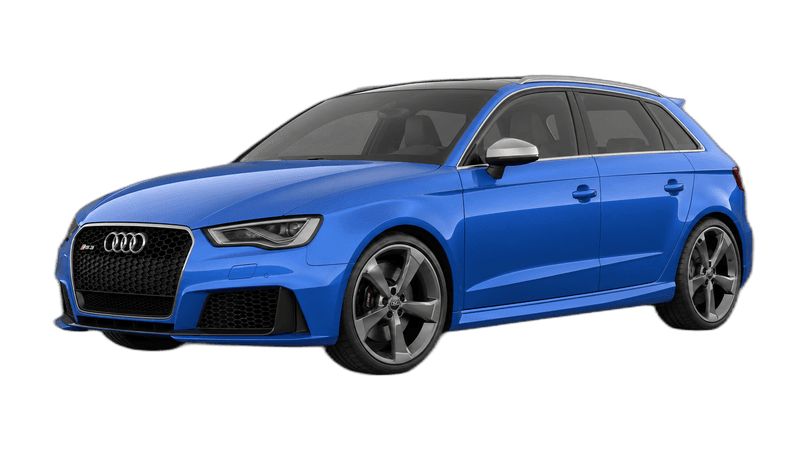
Audi RS3 Sportback (8V)
£35,000
usatoIndicative market price, updated periodically.
395cv
Potenza
4.1s
0-100 km/h
280km/h
Velocita Massima
£35,000
Prezzo Usato
Quanto spinge.
La forza g di picco nell'istante in cui affondi l'acceleratore, stimata dal tempo 0–100 e dalla trazione.
Audi RS3 Sportback (8V)G di partenza stimata dal tempo 0–100 e dalla trazione: un'approssimazione onesta, non un dato misurato.
The Audi RS3 Sportback (8V) is a hatchback by Audi, with 395 bhp, 480 Nm of torque, a 0-100 km/h time of 4.1 seconds and a top speed of 280 km/h. Indicative used value: approximately £35,000. Actual values vary with specification, condition and history.
Dream Car Garage Editorial · Edited by José Teo Lorente Vallecillos · Last updated 2 November 2026
Panoramica
We have not driven this car. This review is based on published specifications and the sources listed below.
The five-cylinder RS3 in five-door form
The Audi RS3 Sportback of the 8V generation is a five-door, all-wheel-drive hot hatch with a seven-speed S tronic dual-clutch gearbox and Audi's five-cylinder turbo engine. Our catalogue lists a 2.5L turbocharged inline-5 petrol engine producing 395 bhp and 480 Nm, with 0 to 100 km/h in 4.1 seconds and a top speed of 280 km/h. This guide is scoped to the 400 PS facelift RS3 Sportback, the version Audi showed in February 2017 and put on sale from August 2017. It is not about the earlier car, the RS3 saloon, or the later 8Y generation, and we explain below how the earlier car differs so that you do not mix up an advert.
We have not driven this model for this article. This is a desk-researched ownership guide built from sources we could read in full: Audi's own MediaInfo release of 10 February 2017 (the Belgian edition, in French), the PistonHeads RS3 (8V) used buying guide by Tony Middlehurst published on 26 September 2021, and the government recall check. Where PistonHeads covers both the early and the facelift car, we say which one it is describing.
Checking the figures
Audi's release gives the facelift engine as 294 kW, which it expresses as 400 PS, and says that is 33 PS more than its predecessor. That implies the launch car made 367 PS. PistonHeads prints the two outputs in horsepower, 362 hp for the early car and 395 hp for the facelift, with torque of 343 lb ft and 354 lb ft. So 362 is the early car in bhp, not a PS figure, and 395 bhp is simply 400 PS converted. A figure of 401 bhp is not a conversion of anything Audi published, which is why our catalogue now shows 395. An advert quoting 400 PS, 395 hp and 294 kW describes one engine.
Audi states 480 Nm of torque, available from 1,700 rpm and constant to 5,850 rpm, and a 0 to 100 km/h time of 4.1 seconds. PistonHeads gives 4.1 seconds to 62 mph for the facelift and 4.3 seconds for the early car. Top speed needs care. Audi says the electronic limiter is set at 250 km/h and that it can be raised to 280 km/h on request, and PistonHeads says a dealer could lift a facelift car from 155 mph to 174 mph, which is the same pair of numbers. The 280 km/h in our catalogue is therefore the raised limit, and a car without that change will stop at 250 km/h. Ask what the car was built and set up with, and do not assume the limiter has been changed.
Engine and gearbox
Audi's release says the 2.5 TFSI is 26 kg lighter than before, thanks largely to an aluminium crankcase, and that it uses dual injection, into the intake manifold and into the combustion chambers, along with the Audi valvelift system on the exhaust side. PistonHeads adds an aluminium oil pump and a magnesium sump, and says dual injection was introduced to limit carbon build-up on the intake valves. That is the main mechanical split between the two cars, so check which one you are looking at before you read any carbon-cleaning advice that was written for the early car.
PistonHeads lists misfires and an engine warning light under heavy throttle as a known fault, usually cured by new spark plugs, so look for dated plug invoices. It also reports a low-speed cutting out, hesitation and cold-start problem linked to the fuel lift pump module, confirmed by a low fuel pressure code, and says the recall fix involved removing the rear seat and fitting a new module. The guide gives no recall year, so use the DVSA service rather than guessing. A light metallic tapping under acceleration can be an oxygen sensor or a catalyst problem, according to the same guide. Some sports exhausts had rattling flaps, and PistonHeads says Audi would replace the rear section if lubricating the pivots did not stop it. Corrosion can affect the black tips of facelift cars and the chrome pipes of early cars, and the guide says Audi was less accommodating about that.
Tuning is common. The guide mentions remaps, intercoolers, high-pressure fuel pumps and exhaust deletions, and a stage-two car said to make about 450 hp. A modified car can be sound, but it needs a tuner, a dyno or log record and the parts list. A seller who cannot say what is on the car is asking you to buy an unknown.
The gearbox is a seven-speed S tronic. PistonHeads says the facelift car has the wet-clutch DQ500 with new coding for quicker shifts, and that the facelift's quattro clutch sits on the rear axle for better weight distribution. It also warns that the box can be reluctant to change gear at low rpm and confused by three-gear downshifts, and that some owners had selector problems. Audi's factory interval of 10,000 miles or one year for oil, gearbox and Haldex fluid is described as much too wide by careful owners, who often halve it. Ask for the dated invoices, not a verbal assurance. PistonHeads also says bevel box leaks were reported and generally sorted under warranty, so look for oil on the underside.
Chassis, brakes and wheels
Audi's release describes a multi-plate electrohydraulic clutch that varies the torque split between the axles, so the more sporting the drive, the more goes to the rear wheels. PistonHeads says up to 100 per cent can go rearward. The car has progressive steering, a four-link rear axle and a ride height 25 mm below the A3, with a front track 20 mm wider. Standard wheels are 19-inch with 235/35 tyres, which Audi says sit over 310 mm brake discs, and carbon ceramic front discs were an option. The RS sport suspension with adaptive damping was also optional, so confirm what a given car has.
PistonHeads calls the steering the weakest part of the car, less communicative than a Golf R, and says some early cars had the wrong rear top mounts that knocked or made road noise, with no recall but a technical note allowing warranty replacement. Steel discs can squeal, and the guide suggests uprated pads and discs as common fixes. Carbon ceramics are lighter and resist fade, but check their condition and the replacement cost before you pay for the option. The factory tyre is a Pirelli P Zero in 235/35 R19, and the guide says Michelin Pilot Super Sport is a common alternative. Look for uneven wear, a date code that fits the mileage and kerbed wheels.
Body, interior and electronics
Audi lists a gloss black honeycomb Singleframe grille, a roof spoiler, a diffuser insert, wide oval exhaust tips and LED headlights as standard, with Matrix LED headlights as an option. PistonHeads says the Matrix lights come with sequential indicators. The body is mature, so look for accident repair rather than rust: panel gaps, paint under bright light, the bumpers and the boot floor.
Inside, Audi fits Nappa leather sport seats as standard, with more shaped RS sport seats as an option, plus a flat-bottomed RS wheel. The instrument pack has a boost gauge, and the Virtual Cockpit was optional with a dedicated RS display. Audi connect with an LTE module, Apple CarPlay and Android Auto, a phone box, a 705-watt Bang and Olufsen system and driver assistance such as Traffic Jam Assist were on the options list. PistonHeads says the volume control sits by the gear selector where a knee can catch it, especially in right-hand-drive cars, and that cabin rattles were reported around the driver's door card, the glovebox and the rear bench catch. It adds that the sunroof can creak when cracked open. Test every screen, camera and assistance function, and ask which options the car actually has.
The Sportback was not the only body. PistonHeads says the 8V first came only as a Sportback, and that the saloon arrived with the facelift and was not offered on early cars. Check that the listing, the registration and the car in front of you agree on the body.
Recalls and history
The only recall-linked item PistonHeads names is the fuel lift pump module. It does not give a recall list, and neither source supplies one for a specific car, so enter the registration in the DVSA recall service and ask for dealer paperwork showing that any open work was completed. PistonHeads warns that a car of this age and performance has very likely had a tough life, with many examples past 100,000 miles, so ask for a full service history, accident and repair evidence, and a clear list of modifications.
Buying decision
PistonHeads compares the RS3 with the Golf R, M140i and Focus RS, and says it is a little too digital for some buyers and well behind a Cayman S for pure driving pleasure, although it is as quick across country and more practical as a Sportback. Prefer a facelift car with a documented fuel pump recall, dated plug and fluid invoices for the engine, gearbox and Haldex, no unexplained tuning and a body that matches its paperwork. Because adverts mix the 362 hp early car and the 395 hp facelift, confirm the output and the build date before you negotiate. We do not repeat dated prices here; compare current adverts for cars with the same specification.
Specifiche
Motore
2.5L turbocharged inline-5 petrol
Cilindrata
2.5L
Potenza
395 cv
Coppia
480 Nm
0-100 km/h
4.1s
Velocita Massima
280 km/h
Trazione
AWD
Paese
Germany
Carrozzeria
hatchback
Anni
2017–2020
Prezzo Usato
£35,000
Specifications are manufacturer-published figures.
Altre di Audi
In evidenza su Carpedia
Domande Frequenti
What are the specifications of the Audi RS3 Sportback (8V)?
The Audi RS3 Sportback (8V) is a hatchback by Audi, with 395 bhp, 480 Nm of torque, a 0-100 km/h time of 4.1 seconds and a top speed of 280 km/h. Indicative used value: approximately £35,000. Actual values vary with specification, condition and history.
How much does a Audi RS3 Sportback (8V) cost?
Indicative used value: approximately £35,000. Actual values vary with specification, condition and history.
What drivetrain does the Audi RS3 Sportback (8V) use?
The Audi RS3 Sportback (8V) is configured with all-wheel drive.
What type of car is the Audi RS3 Sportback (8V)?
The Audi RS3 Sportback (8V) is a hot hatches manufactured by Audi in Germany. Production ran from 2017 to 2020.