
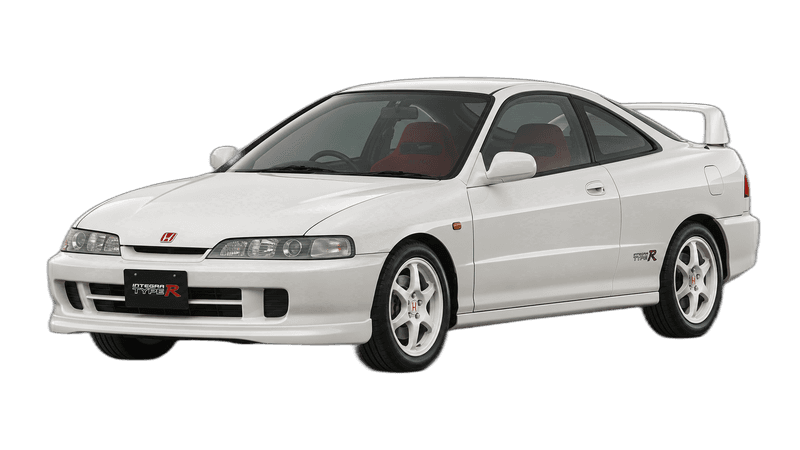
Honda Integra Type R (DC2, Japan)
197ch
Puissance
6.3s
0-100 km/h
234km/h
Vitesse Maximale
Comment ça pousse.
La force g maximale à l'instant où vous enfoncez l'accélérateur, estimée d'après le 0–100 et la transmission.
Honda Integra Type R (DC2, Japan)G de départ estimée d'après le 0–100 et la transmission: une approximation honnête, pas une mesure.
The Honda Integra Type R (DC2, Japan) is a 3-door coupé by Honda, with 197 bhp, 181 Nm of torque, a 0-100 km/h time of 6.3 seconds and a top speed of 234 km/h.
Dream Car Garage Editorial · Last updated 2 November 2026
Vue d'ensemble
We have not driven this car. This review is based on published specifications and the sources listed below.
Scope of this guide
This guide is scoped to the Japanese-market Honda Integra Type R coupe, chassis code DC2, built from 1995 to 2001: the 3-door fastback with the 1.8 L VTEC inline-four (1797 cc) engine and front-wheel drive. It is not a guide to the UK-market Type R sold from 1998 to 2001 at about 187 bhp (190 PS), to the US Acura Integra Type R at 195 hp, or to the 4-door DB8 Type R sold in Japan. We say below where each of those differs so you can tell which car an advert is really describing.
We have not driven this model for this article. Everything here comes from Honda's own Japanese press release of 24 August 1995, a PistonHeads used buying guide written for the DC2 Type R specifically, and the government recall checker. We also read a Japanese catalogue listing, evo, Octane, Wikipedia, a German magazine feature and a JDM import guide for cross-checks, and we flag in the text every point that rests on them. Where sources disagree, or where a figure could not be confirmed word for word, we say so.
The figures at a glance
- Engine: 1.8 L VTEC inline-four (1797 cc), naturally aspirated, 81.0 mm bore by 87.2 mm stroke, compression ratio 11.1:1.
- Power: 200 PS net at 8,000 rpm on Honda's 1995 press release, which is 197 bhp after conversion.
- Torque: 18.5 kgm at 7,500 rpm for the 1995 car, which is about 181 Nm by our conversion. Later cars are rated higher, as explained below.
- Gearbox: five-speed manual only, with a torque-sensing helical limited-slip differential.
- Drive: front-wheel drive.
- 0-100 km/h: 6.3 seconds, a European-spec magazine figure, not a Honda claim for the Japanese car.
- Top speed: 234 km/h, from the same European-spec source, which is about 145 mph by our conversion.
- Weight: 1,060 kg for the 3-door coupe on Honda's 1995 table.
- Years: on sale in Japan from 16 October 1995, with production running to 2001.
- Production: no total we could confirm for the coupe alone.
Why the quoted power and torque vary
Honda's press release states 200 PS net at 8,000 rpm and says it was the highest output per litre of any naturally aspirated production engine at the time, at 111 PS per litre. PS is a metric horsepower. 200 PS multiplied by 0.98632 gives 197.3 bhp, which we round to the 197 bhp we publish. Wikipedia prints the same Japanese rating as 147 kW, 200 PS and 197 hp. That is a conversion made by us, not a figure printed by Honda in bhp.
Other markets used other rating methods and other tuning, so the numbers differ even though the engine family is the same. The UK car is quoted at 187 bhp by evo and Octane, and at 190hp, 131 lb ft and 8,000 rpm by PistonHeads. The US car is listed at 195 hp, a figure Wikipedia and an import guide give on the SAE basis. Do not compare any of these directly with the Japanese net PS rating.
Torque needs care too. Honda's 1995 table gives 18.5 kgm at 7,500 rpm, which is 181 Nm by our conversion (18.5 multiplied by 9.80665). A Japanese catalogue listing for a July 1999 car gives 19.0 kgm, or 186.3 Nm, at 6,200 rpm, and an import guide says the same 19.0 kgm applies to the 98-spec cars from January 1998. The power rating stayed at 200 PS. We therefore use 181 Nm for the original 1995 car, and an owner of a later car should expect the 186 Nm rating on the paperwork. We did not find a Honda document that explains the change.
Performance claims and what they mean
Honda did not publish a 0-100 km/h time or a top speed in the 1995 press release, and we found none in any Honda document for the Japanese car. The catalogue values we use therefore come from outside Honda and belong to a different specification.
The 6.3 seconds and the 234 km/h come from a German auto motor und sport feature, which prints them for the European version (190 PS, 178 Nm, 1,125 kg). evo gives 145 mph as a claimed top speed, which is about 233 km/h, and an official 0-62 mph time of 6.7 seconds, noting that its own test recorded 6.2 seconds to 60 mph. The same page lists 6.2 seconds in its specification box, so evo disagrees with itself. Wikipedia quotes US magazine tests of 6.1, 6.2 and 6.8 seconds to 60 mph for the Acura. A South African archive piece reportedly gives 7.88 seconds and 228 km/h, which looks like an outlier and which we did not read in full.
The honest summary is that the sources span about 6.1 to 6.8 seconds depending on the car, the surface and who timed it. A Japanese-spec car with 200 PS and 1,060 kg should be no slower than the European car, but that is our inference, not a published figure. Treat 6.3 seconds and 234 km/h as indicative claims.
Model years, series and production numbers
Honda announced the Type R on 24 August 1995 and put it on sale at its Bellno dealerships on 16 October 1995. The coupe cost 2,228,000 yen in Tokyo before consumption tax on Honda's table. The Type R was part of a facelift of the whole Integra range, and Honda's monthly sales target of 3,500 cars in the press release covers the whole Integra series, not the Type R alone.
An import guide describes a 98-spec revision from 29 January 1998, with 16-inch wheels carrying 215/45 ZR16 tyres and discharge headlights, against 195/55 R15 tyres on the 1995 car. The same guide lists a Type R X trim from December 1999. PistonHeads says Honda officially imported the car to the UK only from 1998 to 2001, and that only 500 came to Britain. evo also says 500 cars, but its page title says 1996 to 2001, so the UK start date varies between sources.
The DC5 Type R replaced the car in Japan from July 2001, so we use 1995 to 2001 as the span for this guide. The German magazine mentions 36,305 Type R units built from 1995, but that figure is single-source, may include the 4-door and export cars, and we did not confirm it, so we publish no production count.
How the Japanese coupe differs from the UK, US and 4-door cars
- UK car: PistonHeads says UK cars have 282 mm front discs where earlier JDM cars have 262 mm, and a rear fog light built into the bumper, whereas imports typically carry an aftermarket one. Octane adds quad headlights and different bumpers and wheels, and says UK cars rust more than Japanese ones. Pre-98 JDM cars have a single-unit headlight with a slim rectangular shape.
- US car: the Acura Integra Type R was sold as a liftback only, in 1997 to 1998 and 2000 to 2001 according to Wikipedia, at 195 hp.
- 4-door DB8: Honda's table lists a 4-door hardtop Type R at 1,100 kg with the same 200 PS rating, against 1,060 kg for the coupe. It is a Japan-only body style, and the import guide says its catalogue ended in 2000.
- Weight: the 1,060 kg is Honda's 1995 figure for the coupe. We did not find a verified kerb weight for the 98-spec or later cars.
Engine and gearbox
The press release lists the five-speed manual gearbox, the 11.1:1 compression ratio and a torque-sensing helical limited-slip differential. Octane says the engine pulls to just shy of 9,000 rpm, but we found no Honda document that states the rev limiter, so we do not give one.
PistonHeads has useful warnings for the DC2 Type R, though it wrote them for UK cars. It says the engine uses a little oil even with gentle use, so check the level regularly. It advises an oil change every 6,000 miles, or thicker oil changed more often on track cars. It says the cambelt and spark plugs are due at 60,000 miles, or every five years on occasionally used cars, and the coolant every four years or 48,000 miles. It recommends original Honda oil, coolant and fuel filters for the high revs.
On the clutch, PistonHeads says it can be damaged by drivers revving too hard to pull away, that track use adds wear, and that the slave cylinder can weep fluid. It says second and third gear synchros can wear with repeated track use, so listen for graunching, and that shifts should be quick and precise with no slop.
Chassis, steering and brakes
Honda's press release names the torque-sensing differential for traction. Honda's heritage article on the car says the chassis was lightened and stiffened following the approach of the NSX-R, but we did not find a document that lists the full suspension changes, so we do not itemise them here.
PistonHeads says worn bushes spoil the handling and recommends a full set of polyurethane bushes. It also says the dampers are needed by about 60,000 miles and names Bilstein B6 units as a replacement. Brake judder, it says, points to track use. Because UK cars have larger front discs than JDM cars, parts for an imported Japanese coupe may not interchange with those for a UK car, and we could not verify which parts differ beyond the disc size.
Running costs and practicality
PistonHeads quotes 32.5 mpg and 208 g/km for the UK car, which does not apply directly to the Japanese coupe. We found no official Japanese fuel consumption in the sources we read, so we give no economy figure for the car in this guide.
Our sources do not cover insurance, road tax, import duty or specialist labour rates for the Japanese coupe, so we give no figures. If you are buying an import, check how the car is taxed and what it costs to insure before you commit, and confirm that the speedometer and odometer readings are in the units you expect.
What to check before buying
- Confirm it is a genuine Type R and not an ordinary Integra converted with badges or parts, using the registration documents, chassis and engine numbers, and a Honda specialist.
- Find out whether it is a 1995-97 car or a 98-spec car, since the wheels, headlights and torque rating differ.
- Look for rust at the rear arches, which PistonHeads calls common on UK cars, and check the boot for damp because rear light seals can let water in.
- Check for accident repair and overspray, since PistonHeads says plenty have been on track or slid off the road, and note that red cars can fade to pink.
- Inspect the driver's seat bolster, which PistonHeads says wears quickly, and the thin windscreen, which is more prone to cracks.
- Listen for a loose exhaust heat shield and check the electric aerial.
- Make sure the red master key is present, because PistonHeads says replacing a lost ignition key is expensive.
- Ask for proof of the cambelt, plug and coolant work, and test the clutch, the second and third gear synchros and the differential.
- Confirm every recall is closed, using the check below.
Recalls and the DVSA check
We did not find a recall list for the Japanese-market DC2 Type R in the sources we read, and PistonHeads does not mention recalls. That does not mean there are none. If the car is registered in the UK, run it through the DVSA vehicle recall check on GOV.UK using the registration number or VIN. That tool may not hold campaigns for a car first sold in Japan, so also ask a Honda dealer or specialist to check the chassis number against Honda's records.
Verdict
The DC2 Integra Type R is a light, high-revving, front-wheel drive coupe with a well-documented engine, and its Japanese-market rating of 200 PS is the one to anchor on. If you are shopping for one, confirm which market and which series the car is, check the clutch, the gearbox and the bodywork, and treat the 197 bhp, 181 Nm, 6.3 seconds and 234 km/h figures as published or converted ratings with the caveats explained above. We have not driven it, so use the sources and a proper inspection to decide.
Specifications
Moteur
1.8 L VTEC inline-four
Cylindrée
1.8L
Puissance
197 ch
Couple
181 Nm
0-100 km/h
6.3s
Vitesse Maximale
234 km/h
Transmission
FWD
Pays
Japan
Carrosserie
3-door coupé
Années
1995–2001
Specifications are manufacturer-published figures.
Plus de Honda


Questions Fréquentes
What are the specifications of the Honda Integra Type R (DC2, Japan)?
The Honda Integra Type R (DC2, Japan) is a 3-door coupé by Honda, with 197 bhp, 181 Nm of torque, a 0-100 km/h time of 6.3 seconds and a top speed of 234 km/h.
What drivetrain does the Honda Integra Type R (DC2, Japan) use?
The Honda Integra Type R (DC2, Japan) is configured with front-wheel drive.
What type of car is the Honda Integra Type R (DC2, Japan)?
The Honda Integra Type R (DC2, Japan) is a sports cars manufactured by Honda in Japan. Production ran from 1995 to 2001.