
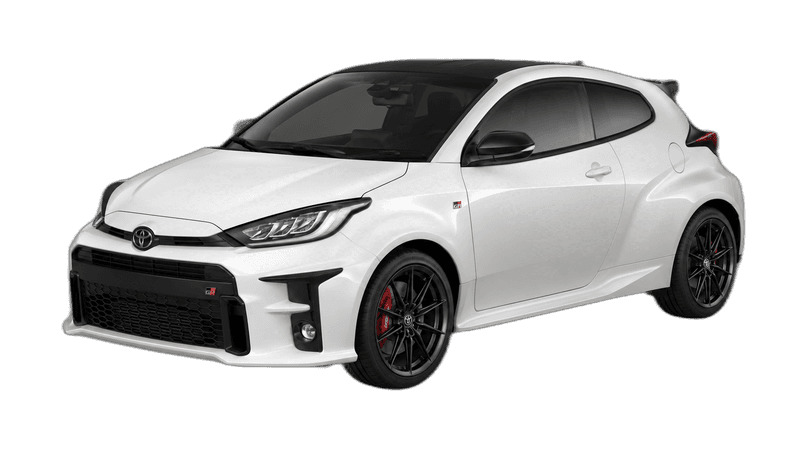
Toyota GR Yaris
£35,000
usadoIndicative market price, updated periodically.
257cv
Potencia
5.5s
0-100 km/h
230km/h
Velocidad Máxima
£35,000
Precio Usado
The Toyota GR Yaris produces 257 bhp, reaches 100 km/h in 5.5 seconds and has a top speed of 230 km/h. A representative example is worth about £35,000.
Cómo empuja.
La fuerza g máxima en el instante en que pisas a fondo, estimada a partir del 0–100 y la tracción del coche.
Toyota GR YarisG de salida estimada a partir del 0–100 y la tracción: una aproximación honesta, no una cifra medida.
Dream Car Garage Editorial · Edited by José Teo Lorente Vallecillos · Last updated 2 November 2026
Visión General
We have not driven this car. This review is based on published specifications and the sources listed below.
A homologation special built on a supermini
The Toyota GR Yaris is a three-door, all-wheel-drive hot hatchback that Toyota built as the road-going basis for its World Rally Championship Yaris. Our catalogue describes the first-generation car, which has a 1.6L turbocharged inline-3 petrol (G16E-GTS) engine producing 257 bhp and 360 Nm, with 0 to 100 km/h in 5.5 seconds and a 230 km/h limited top speed. We have not driven this model for this article. This is a desk-researched ownership guide built from a Toyota press release of January 2020, a PistonHeads used buying guide published in February 2024 and the government recall check. The press release is a pre-launch document in French, from the Belgian edition of Toyota's press material, so treat it as a statement of the intended specification rather than a record of every production car.
Checking the figures
Toyota's release gives the engine capacity as 1,618 cc and quotes 261 PS DIN (192 kW) with 360 Nm of torque. The 261 PS rating is the metric figure, which converts to the 257 bhp in our catalogue, and PistonHeads lists 257 hp, 266 lb ft (the same 360 Nm), 5.5 seconds to 62 mph and a limited top speed of 143 mph, which is the 230 km/h limit. Toyota's wording is 0 to 100 km/h in under 5.5 seconds, so treat the 5.5 seconds as an upper bound. Both sources give a kerb weight of 1,280 kg, and Toyota's release gives a power-to-weight ratio of 4.9 kg per PS.
There is a second generation to keep apart. PistonHeads reports that an updated car shown at the Tokyo show in January 2024 has 276 hp and 288 lb ft from revised injection and ignition software and better cooling, an estimated 5.1 seconds to 62 mph, an optional eight-speed automatic and seats mounted 25 mm lower, with production due to start in April 2024. Those figures are from the guide's pre-production reporting, so confirm the specification of any car sold as an updated model from its own documents, and do not apply this guide's engine and gearbox findings to it without checking.
Engine and gearbox
Toyota describes a new turbocharged three-cylinder with piston cooling jets, large exhaust valves, a partly machined intake port and a single ball-bearing turbocharger, paired with a six-speed manual gearbox, the one transmission our sources describe for the first-generation car. PistonHeads adds that the engine uses direct injection with an intake port shaped to limit carbon build-up, and that the turbo's strong push arrives from about 3,000 rpm, becoming a rush above 4,000 rpm. Some owners wanted more power or sound, and the guide notes that the engines respond well to tuning, with dyno figures quoted well above standard, so ask what has been changed and whether there is a paper trail.
PistonHeads describes problems as few and minor. A small number of owners reported limp mode with many warning lights after leaving a petrol station, and the fix was usually an insufficiently tightened fuel cap, which owners suggest closing with about half a dozen clicks. A few track users reported the central clutch pack in the all-wheel-drive system overheating and disconnecting the rear axle, with a smooth change to front-wheel drive. Some cars jump out of second gear or feel notchy when changing up from first, which PistonHeads says dealers would fix by adjusting the cable linkage under warranty, and oil changes were said to improve shift quality. The guide found no specific transmission weakness. Prices for servicing at a GR Centre and at independents are dated and vary, so we have not repeated them: ask for invoices that show what was done and when. PistonHeads says the earliest cars still had at least two years of factory warranty in February 2024, provided non-approved parts had not invalidated it, so check what cover remains today.
Chassis, drive and brakes
Toyota's GR-FOUR system distributes torque between the axles through a highly responsive coupling and, according to the release, can range from 100:0 front to 0:100 rear. The driver chooses a 60:40 base split in Normal, 30:70 in Sport and 50:50 in Track, and the balance then adjusts automatically. Toyota says the car combines the front of its GA-B platform with the rear of the GA-C platform, uses MacPherson struts at the front and a double-wishbone rear suspension in place of the standard Yaris torsion beam, and has large grooved 356 mm front discs with four-piston calipers.
The optional Circuit Pack adds Torsen limited-slip differentials on both axles, adjustable-performance suspension and forged 18-inch alloy wheels with Michelin Pilot Sport 4S 225/40R18 tyres, and PistonHeads adds stiffened springs and anti-roll bars, recalibrated power steering, an engine undercover and red brake calipers with GR logos, with forged 10-spoke wheels that save 10 kg. The guide says the Convenience Pack, which adds blind-spot monitoring, parking sensors, a head-up display, satellite navigation and a JBL audio system, could not be combined with a Circuit Pack, so check which one the car has. PistonHeads reports that the ride is firm on minor roads and that wheel alignment can be disturbed by regular use on poor surfaces, so look for uneven tyre wear. Some cars may have been lowered, and it is easy to get the set-up wrong, so ask what springs and dampers are fitted.
On the brakes, the guide records some criticism of a slightly dead pedal feel, a faint whistling from the rear usually caused by dirt on the pad corners, and caliper dust boots that can melt during hard use. It calls the radar fix the only recall it is aware of affecting all cars: it corrected patchy initialisation of the radar sensor for the adaptive cruise control.
Body, interior and electronics
Toyota says the body combines a carbon-fibre-reinforced polymer roof with aluminium for the bonnet, doors and tailgate, and lowers the roofline by 91 mm over the standard Yaris. PistonHeads describes a body that is considerably stiffer than the ordinary car, and warns that a minor knock to the corner of the bumper can mean replacing the whole bumper, while the plastic mesh in the lower grille breaks easily when hit by gravel. Inspect both, and for paint repair, since cars are used hard and many have been modified.
Inside, the guide finds the cabin well assembled with practically no squeaks, and a rattle behind your head is usually only a headrest not fully clicked into place. It notes that the rear-view mirror is large and low, the pedals are hard to heel and toe on, the seats are mounted high, and a lane assist system needs a five-second button press to switch off. A Circuit Pack car lacked built-in satellite navigation, although connecting a phone through the USB port gives access to map applications. The battery sits under the boot floor for balance, which cuts boot space to 174 litres, and there is no conventional spare wheel.
Recalls and history
Besides the adaptive cruise radar recall, neither source supplies a full recall list, so enter the registration in the DVSA recall service and ask the seller for dealer paperwork confirming that any open work was completed. Ask for a full service history, evidence of any accident repair, receipts for modifications and whether the car has been used on track, since that stresses the clutch pack, brakes and tyres.
Buying decision
The PistonHeads verdict is that the GR Yaris was and is a special car, which Toyota had to build 25,000 of to meet homologation rules. It says that even an unmodified car delivers a lot, that very little goes wrong and that the earliest cars still had factory warranty remaining in early 2024. The February 2024 prices are not repeated; compare current adverts. The best car has a documented service history, an unmodified or well-documented set-up, even tyre wear, intact bumpers and grille, a gearbox that selects every gear cleanly and every recall closed.
Especificaciones
| Motor | 1.6L turbocharged inline-3 petrol (G16E-GTS) |
|---|---|
| Cilindrada | 1.6L |
| Potencia | 257 cv |
| Par Motor | 360 Nm |
| 0-100 km/h | 5.5s |
| Velocidad Máxima | 230 km/h |
| Tracción | AWD |
| País | Japan |
| Carrocería | 3-door hatchback |
| Años | 2020–present |
| Precio Usado | £35,000 |
Specifications are manufacturer-published figures.
Preguntas Frecuentes
What is a Toyota GR Yaris worth?
A representative example is worth about £35,000. Actual values vary with specification, condition and history.
How much power does the Toyota GR Yaris have?
The Toyota GR Yaris produces 257 bhp and 360 Nm of torque.
How fast is the Toyota GR Yaris from 0 to 100 km/h?
The Toyota GR Yaris accelerates from 0 to 100 km/h in 5.5 seconds.
What is the top speed of the Toyota GR Yaris?
The Toyota GR Yaris has a top speed of 230 km/h.
What engine does the Toyota GR Yaris have?
The Toyota GR Yaris uses a 1.6L turbocharged inline-3 petrol (G16E-GTS).
When was the Toyota GR Yaris built?
Production of the Toyota GR Yaris began in 2020.
Is the Toyota GR Yaris all-wheel drive?
Yes. The Toyota GR Yaris is configured with all-wheel drive.
Más de Toyota
Destacado en Carpedia
Suzuka: The Figure-Eight That Defines Champions
Suzuka Circuit's distinctive figure-eight layout, the only overpass crossing in modern Formula 1, combines technical precision with high-speed commitment across 5.807 km of Japanese engineering philosophy. Here are the production cars that have conquered it most completely.
Dream Car Garage on a Budget: 5-Car Builds Under 500K
Four complete 5-car dream garage builds, each totalling under GBP 500,000. From track-day weapons to Italian thoroughbreds, every build uses real market prices and delivers genuine variety.
The JDM Underground: Why Japan Still Leads
The NSX humbled Ferrari. The GT-R embarrassed Porsche. Thirty years later, Japan's engineering philosophy is still unmatched.
What Your Dream Garage Says About You
The cars you choose when money is no object say everything about who you are, and nothing about what you drive.