
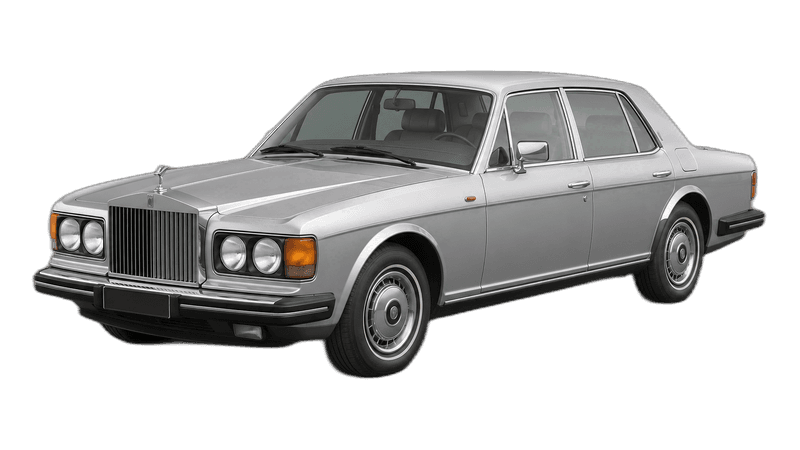
Rolls-Royce Silver Spirit
£25,000
usadoIndicative market price, updated periodically.
200cv
Potencia
11.4s
0-100 km/h
186km/h
Velocidad Máxima
£25,000
Precio Usado
Cómo empuja.
La fuerza g máxima en el instante en que pisas a fondo, estimada a partir del 0–100 y la tracción del coche.
Rolls-Royce Silver SpiritG de salida estimada a partir del 0–100 y la tracción: una aproximación honesta, no una cifra medida.
The Rolls-Royce Silver Spirit is a 4-door saloon by Rolls-Royce, with 200 bhp, 404 Nm of torque, a 0-100 km/h time of 11.4 seconds and a top speed of 186 km/h. Indicative used value: approximately £25,000. Actual values vary with specification, condition and history.
Dream Car Garage Editorial · Edited by José Teo Lorente Vallecillos · Last updated 2 November 2026
Visión General
We have not driven this car. This review is based on published specifications and the sources listed below.
Scope of this guide
This guide is scoped to the Rolls-Royce Silver Spirit Mark I, the standard-wheelbase four-door saloon built at Crewe from 1980 to 1989 with the 6.75L V8 naturally aspirated engine, a three-speed automatic gearbox and rear-wheel drive. It is not a guide to the longer Silver Spur, which BMW Group's classic archive says is ten centimetres longer with ten centimetres more rear legroom. It is not a guide to the Bentley Mulsanne and Eight, which Wikipedia lists as sharing the same basis. It is also not a guide to the Silver Spirit II of 1989 onwards (fuel injection with Bosch Motronic, ABS, adaptive damping and, from winter 1991, a four-speed gearbox), to the Mark III, or to the turbocharged Mark IV. An advert that says only "Silver Spirit" can describe any of them, and the figures differ.
We have not driven this model for this article. Everything here comes from three cited sources: the BMW Group Classic blog's "Inspiration" page on the Silver Spirit (BMW Group owns the Rolls-Royce brand today, and this is archive material rather than a current brochure), PistonHeads' "Rolls-Royce Silver Spirit II | The Brave Pill" by Mike Duff (29 May 2021), and the government recall checker. We also read Wikipedia, the Autocade entry, a Motor Sport report from October 1980, a reprint of Car and Driver's 1981 test, the 0-60specs aggregator, the French site Motorlegend and a Classic & Sports Car buyer's guide as reproduced by Flying Spares. We flag every point that rests on them. Where sources disagree we say so rather than pick a winner quietly.
The figures at a glance
Rolls-Royce never published power or torque for these cars. The BMW archive page says the horsepower figure is withheld in keeping with Rolls-Royce tradition, and the Car and Driver reprint prints no power, torque or acceleration numbers either. So every power, torque and performance figure below is an estimate or an independent road-test number, and we say which.
- Engine: 6.75L V8 naturally aspirated, a light-alloy overhead-valve engine. Autocade and Motorlegend both give 6750 cc, and Motor Sport called it a well-proven six and three-quarter litre light alloy V8 in 1980.
- Power: about 200 bhp. PistonHeads says the launch Spirit "had around 200hp from its carb-fed engine", and the 0-60specs page credits a 1981 Car and Driver test of a Mark I with 200 hp. This is an estimate from named sources, not a Rolls-Royce figure, and both sources say hp, so we treat it as bhp without being able to prove the definition. We found no PS figure for the Mark I. Motorlegend lists 240 ch at 4000 rpm, which looks like a different specification or a later engine, so we do not use it. The 192 bhp we used to store matched none of these sources.
- Torque: 404 Nm. This is our conversion of the 298 lb ft that 0-60specs lists alongside the Car and Driver test (298 x 1.3558 is about 404 Nm). We could not check it against the original magazine. Motorlegend prints 450 Nm at 2000 rpm, so treat torque as the least certain figure in this guide.
- 0-100 km/h: 11.4 seconds, the time that the German magazine auto motor und sport recorded in September 1981 according to the BMW archive page. It is a road-test measurement. For comparison, PistonHeads says about 10.5 seconds to 60 mph at launch and the Car and Driver figure on 0-60specs is 10.8 seconds to 60 mph. 60 mph is slightly less than 100 km/h (62 mph), so a true 0-100 km/h time would be a little longer than those two.
- Top speed: 186 km/h (115 mph), from the same auto motor und sport test. Motorlegend quotes 193 km/h and some auction descriptions quote 120 mph, so published numbers range around that value.
- Drive: rear-wheel drive with the engine at the front. Autocade shows the layout as front engine, rear drive, and Car and Driver describes the semi-trailing-arm independent rear suspension.
- Weight: about 2.2 tonnes according to BMW's archive. Wikipedia gives 4,980 lb (2,259 kg) for the Mark I Spirit and Motorlegend 2,245 kg.
What the Silver Spirit actually was
The Silver Spirit arrived in 1980 as the replacement for the Silver Shadow. Autocade says it used the Shadow floorpan and Wikipedia describes the 6.75 litre V8 as the Rolls-Royce L410. PistonHeads says the engine was "barely altered" from the Shadow's. The new body, according to Motor Sport's 1980 report, was two inches wider and slightly lower, with glass area up by 30 per cent, a redesigned rear suspension with a sub-frame and gas spring units, a foot-operated parking brake and a digital clock and temperature display in the dash. BMW's archive gives the car as 5.27 metres long and 1.89 metres wide.
PistonHeads is blunt about the performance: around 10.5 seconds to 60 mph for a 2.2 tonne car, with fuel economy no better than 15 mpg under gentle use in the 1990 car it describes. The US car in the 1981 Car and Driver reprint scored 10 EPA mpg. Nobody buys one of these for speed, and the figures above explain why. The attraction is the quiet ride, the hydraulic suspension and the sense of occasion.
Years, fuel systems and where the sources disagree
We store 1980 to 1989 because Wikipedia lists the Mark I as 1980 to 1989 and Autocade gives 1980 to 1989 too. Wikipedia says the Silver Spirit II was introduced at the 1989 Frankfurt Motor Show and its Mark I production table ends with chassis KCH27798 and begins the Mark II at 29001.
The fuel system is the messiest part. PistonHeads says the launch car was carburettor-fed. Motorlegend says two single-barrel carburettors. Autocade says Bosch fuel injection from 1986. The Car and Driver reprint says the throttle of the 1981 US car connects to Bosch K-Jetronic injection. Wikipedia says Bosch Motronic injection became standard with the Mark II. These can all be true for different markets and years, and we cannot reconcile them from the sources. Before you buy, ask which fuel system and emissions specification a specific car has, because the Car and Driver 200 hp figure on 0-60specs may belong to an injected American-market car rather than a British carburettor one.
How many were built
Wikipedia's production table shows 8,126 Mark I Silver Spirits and 6,240 Silver Spurs for 1980 to 1989. Autocade gives 8,129 for the Spirit across the same years. The difference is three cars and we do not know which is right, so our catalogue stores no production count. The Italian ACI guide cited in a search result puts all Spirits across four series at 9,657, a figure we did not open. Treat any count as approximate.
Running costs and what tends to go wrong
We found no official service schedule or parts price list for the Mark I, so we make no running-cost claim. The buyer's guide that Flying Spares reproduces from Classic & Sports Car says the all-aluminium V8 can run for about 500,000 miles if properly maintained, but that missed servicing leads to stuck hydraulic tappets and worn cams. It tells you to listen for a rattly top end and to look for emulsion in the oil filler cap or oil in the coolant, both pointing to head gasket trouble. It calls the GM gearbox the one component that is affordable to rebuild, and says air-conditioning repairs are costly and regular regassing matters.
On the hydraulics it advises checking that the two warning lights appear with the ignition on, that both go out within about 30 seconds from cold and 20 seconds when warm, and that after warm-up the brake pedal gives at least 40 pumps. If those tests fail it says to budget for a costly hydraulic overhaul. The two front calipers run on separate circuits, so neglect "means double trouble". Electronic dampers are very costly to replace, although the guide places those on the later cars with adaptive damping, which is the Silver Spirit II of 1989, not the Mark I in this guide. It also warns about corrosion, damp carpets, and damaged or missing trim being hard and expensive to replace. Flying Spares is a parts seller and its pages are partly promotional.
What to check before buying
- Confirm which Silver Spirit it is. Look at the chassis number, because Wikipedia says the last Mark I was KCH27798, and check it is not a Silver Spur or a Mark II.
- Ask whether the engine has carburettors or fuel injection and whether it is a UK or an imported car.
- Ask for the complete service record, especially oil changes, tappet or cam work and any engine replacement. PistonHeads' 1990 example carried a second engine fitted about 2,000 miles before the advert.
- Test the hydraulic warning lights, pedal pumps and the brakes on both circuits as described above.
- Check for corrosion, wet carpets and missing trim, and test every electric and digital function.
- Get a specialist who knows these cars to inspect it. We have not established what parts and labour cost.
Recalls and the DVSA check
The government recall checker is a weak fit for a car of this age. The page says you can use a registration number to see whether a car has been recalled, or the manufacturer, model and year of manufacture if you have no registration, and that the manufacturer notifies owners of non-safety recalls. It does not say what range of dates its safety recall records cover, so we cannot tell you whether a car built between 1980 and 1989 would show up. We did not run it, because we are not looking at a specific car. We found no recall notice for the Silver Spirit in any of the sources we read, and absence from our sources is not a clean bill of health. Ask Rolls-Royce specialists or an owners' club whether any service bulletin applies, and treat an empty checker result as no information rather than reassurance.
About the photograph
The picture at the top of this page shows a brown 1982 Silver Spirit photographed in Greenwich, Connecticut. Its Commons description calls it a US-market model with active seatbelts and a catalytic converter, so some of its details differ from a British car. We use it only to show the shape of the body. We cropped it to the page format, and its licence plate is a blank holder with no characters.
Verdict
The Silver Spirit Mark I in this guide has an estimated 200 bhp from its 6.75L V8 naturally aspirated engine, an estimated 404 Nm, a road-test 11.4 seconds to 100 km/h and a road-test 186 km/h, with rear-wheel drive. It is a large, heavy, slow-by-modern-standards luxury saloon whose condition and paperwork matter far more than any number in this guide, and whose published figures all carry the caveats above. If you are considering one, work out exactly which version it is, insist on a full history, have the hydraulics and engine checked by a specialist and treat every figure here as an estimate. We have not driven it, so rely on the sources and a proper inspection to decide.
Especificaciones
Motor
6.75L V8 naturally aspirated
Cilindrada
6.8L
Potencia
200 cv
Par Motor
404 Nm
0-100 km/h
11.4s
Velocidad Máxima
186 km/h
Tracción
RWD
País
UK
Carrocería
4-door saloon
Años
1980–1989
Precio Usado
£25,000
Specifications are manufacturer-published figures.
Más de Rolls-Royce



Destacado en Carpedia
Preguntas Frecuentes
What are the specifications of the Rolls-Royce Silver Spirit?
The Rolls-Royce Silver Spirit is a 4-door saloon by Rolls-Royce, with 200 bhp, 404 Nm of torque, a 0-100 km/h time of 11.4 seconds and a top speed of 186 km/h. Indicative used value: approximately £25,000. Actual values vary with specification, condition and history.
How much does a Rolls-Royce Silver Spirit cost?
Indicative used value: approximately £25,000. Actual values vary with specification, condition and history.
What drivetrain does the Rolls-Royce Silver Spirit use?
The Rolls-Royce Silver Spirit is configured with rear-wheel drive.
What type of car is the Rolls-Royce Silver Spirit?
The Rolls-Royce Silver Spirit is a luxury manufactured by Rolls-Royce in UK. Production ran from 1980 to 1989.