
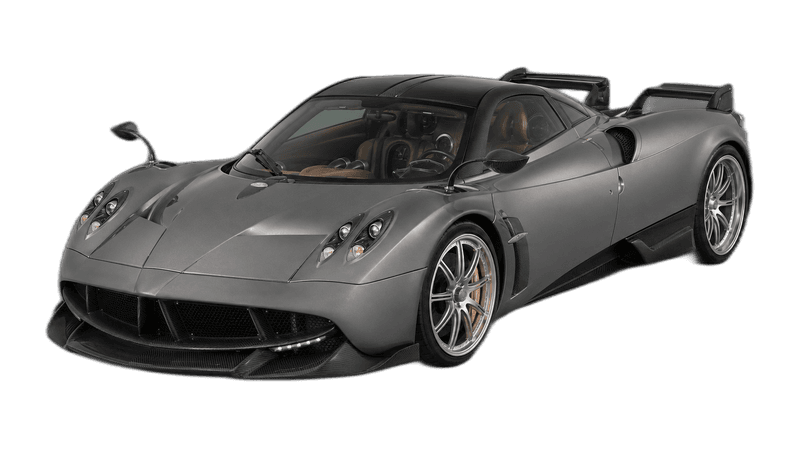
Pagani Huayra
£2,600,000
usadoIndicative market price, updated periodically.
720cv
Potencia
3.3s
0-100 km/h
370km/h
Velocidad Máxima
£2,600,000
Precio Usado
The Pagani Huayra produces 720 bhp, reaches 100 km/h in 3.3 seconds and has a top speed of 370 km/h. A representative example is worth about £2,600,000.
Cómo empuja.
La fuerza g máxima en el instante en que pisas a fondo, estimada a partir del 0–100 y la tracción del coche.
Pagani HuayraG de salida estimada a partir del 0–100 y la tracción: una aproximación honesta, no una cifra medida.
Dream Car Garage Editorial · Edited by José Teo Lorente Vallecillos · Last updated 2 November 2026
Visión General
We have not driven this car. This review is based on published specifications and the sources listed below.
Scope of this guide
This guide is scoped to the standard Pagani Huayra coupe, the two-door, gull-wing, mid-engine, rear-wheel drive car with the Mercedes-AMG-built 6.0L twin-turbo V12 petrol (5980 cc) engine, made by hand in Italy from 2011 to 2018 in a run of 100. It is not a guide to the Huayra BC, the Huayra Roadster, the Huayra Roadster BC or the later special editions and track cars. Those are separate cars with different power, weight and body parts, and we say below where they differ so that you can tell which one an advert really describes.
We have not driven this model for this article. Everything here comes from three cited sources: a Pagani press release for the Middle East launch of the Huayra, PistonHeads' news article on the Huayra Roadster (19 February 2017, by Dan Trent), and the government recall checker. We also read a PistonHeads classified advert for a 2013 coupe, a Wikipedia article and two US safety recall reports, and we flag each point that rests on them. Pagani publishes little, and there is no PistonHeads or manufacturer used buying guide for the coupe that we could find, so a good deal of the advice below is general and labelled as such. Prices are history or ranges, not valuations.
The figures at a glance
- Engine: 6.0L twin-turbo V12 petrol (5980 cc), built by Mercedes-AMG for Pagani, mounted behind the cabin.
- Power: 720 bhp, which is Pagani's 730 PS converted by us (730 x 0.98632 is about 720). Pagani prints PS and kW, not bhp.
- Torque: 1000 Nm, the figure in both the Pagani release (it also gives 737 lb ft) and Wikipedia.
- 0-100 km/h: 3.3 seconds, Pagani's own claim in the same release, where it also gives 0-62 mph.
- Top speed: 370 km/h, Pagani's claim, which the release also gives as 230 mph.
- Drive: rear-wheel drive and mid-engine, through a seven-speed sequential gearbox.
- Weight: 1,350 kg in the Pagani release, which does not say whether that is dry weight. Wikipedia lists it as dry weight.
- Launch price: 1,195,000 euros plus local taxes, as printed in the Pagani release.
What the Huayra coupe is
The Huayra replaced the Zonda and is a carbon-bodied, two-door coupe with gull-wing doors. Pagani's release says it was personally designed by Horacio Pagani and describes it as a car developed from scratch that meets the toughest safety requirements. It also says it is built in Modena, whereas Wikipedia and Pagani's own recall filings give San Cesario sul Panaro as the base, so treat the exact place as unsettled. Wikipedia gives the dimensions as 4,625 mm long, 2,036 mm wide, 1,169 mm high and a 2,795 mm wheelbase.
How many were built
Wikipedia gives the coupe a production run of 2011 to 2018 and 100 units, and says the limit was part of Pagani's agreement with Mercedes-AMG, the engine supplier. A PistonHeads advert for a 2013 car, chassis number 007, also describes it as one of 100 worldwide and says only three right-hand-drive cars were supplied to the UK. That is the seller's wording, not a verified register. The Pagani release does not state a production figure. Wikipedia also says the coupe was reported sold out in February 2015. We have no source for the exact end of production beyond 2018, so the year range is the Wikipedia range.
Why the quoted power and speed vary
Several figures circulate for the same car. Pagani's release says 730 PS, which is about 720 bhp by our conversion. Wikipedia prints 740 PS and 730 hp, and PistonHeads' Roadster article uses plain hp for the Roadster, so PS, hp and bhp are easily mixed up. A figure of 740 bhp for the coupe is therefore not supported by the manufacturer release, and we do not use it. We use the 730 PS Pagani gives.
Performance claims also differ. Pagani says 3.3 seconds to 100 km/h and 370 km/h. Wikipedia says about 383 km/h (238 mph) and 2.8 seconds to 60 mph (97 km/h) on a different basis. We follow the manufacturer for the headline numbers and treat the others as unverified claims. None of these are test results from us or from the sources we cite.
Drivetrain and gearbox
The coupe is rear-wheel drive with a seven-speed sequential gearbox and, according to Wikipedia, a single-disc clutch. Wikipedia says Pagani avoided a dual-clutch design because it would add more than 70 kg, and puts the coupe's transmission weight at 96 kg. PistonHeads' Roadster article makes a similar point for the Roadster: the Xtrac automated manual gearbox in that car weighs 40 per cent less than an equivalent dual-clutch unit. The sources we read for the coupe do not name the gearbox supplier, so we do not state one. A PistonHeads advert lists a smart gas gearbox upgrade and a front suspension lifter as fitted extras on one car; neither is explained, so ask what was changed and who did it.
Engine and cooling
The M158 engine is a 60 degree V12 designed by Mercedes-AMG for Pagani. Wikipedia says it has smaller turbochargers, a different intercooler layout and re-programmed engine management to reduce lag, and that it uses dry sump lubrication. It also lists a titanium exhaust with Inconel silencers made by MHG-Fahrzeugtechnik, weighing under 10 kg. A dry sump engine has more oil hardware to service than a wet sump one, and exhaust parts in exotic metals are costly, so ask for evidence of who serviced the engine and what was replaced. We found no source that gives service intervals or costs for the coupe.
Chassis, brakes and aero
Wikipedia lists Brembo carbon-ceramic brakes with 380 mm discs, six-piston calipers at the front and four-piston calipers at the rear. It also describes active aerodynamics: four flaps that move independently, with a control unit reading speed, yaw rate and steering angle, and a front ride height that can change. The flaps and the ride-height system are moving parts with actuators, so a working check of every mode is sensible. We have no source on their failure rates and make no claim about them.
How the coupe differs from other versions
The Huayra BC is a track-focused version with a stated 764 PS, a lower dry weight of 1,218 kg and a run of 29 or 30 cars (Wikipedia gives both numbers). The Roadster has the same 6.0L V12 with 764 hp quoted by PistonHeads, a dry weight of 1,280 kg, conventional doors instead of gull-wing doors, and a run of 100. PistonHeads says it is about 80 kg lighter than the coupe. The Roadster BC is a further track-oriented derivative. If an advert mentions 764 PS, carbon triax, a roof or a BC badge, it describes a different car from the one in this guide.
Running costs and parts
We have no manufacturer or PistonHeads data on service prices, insurance or parts for the coupe. Any figure for these on the internet should be treated with caution unless the source says how it was obtained. The honest position is that a car of this kind needs specialist work, so whoever services it, whether Pagani or an independent, should be able to show relevant experience and evidence of work done. Ask for written quotes before you commit. Fuel use is high; Wikipedia gives US EPA figures of about 12.0 mpg (imperial) city and 16.8 mpg highway.
Buying notes
One PistonHeads advert that we read was a 2013 coupe with 5,900 miles, a right-hand-drive UK-supplied car, listed at 2.75 million pounds, with an expired MOT, and now marked as no longer available. Pagani's launch price was 1,195,000 euros plus taxes, and Top Gear's review page, published in January 2015, gave a price from 990,000 pounds, so asking prices for used cars have moved a long way since. These are history, not valuations. The advert also lists a service book, handbooks, a car cover and a battery charger as included. These are the seller's claims, not checks.
What to check before buying
This list is our own inference from the sources and general good practice, not a Pagani or PistonHeads checklist.
- Full documented history, with named specialist invoices and a service book that matches the chassis number.
- Evidence that the airbag recall and any other campaign work was done (see the recall section below).
- Specification: confirm it is a standard coupe, not a BC or Roadster, by chassis number and by asking Pagani.
- Gearbox: how it shifts hot and cold, and what the gas gearbox or other upgrades mean on that car.
- Active aero and ride height: ask for a demonstration of all modes and any warning lights.
- Carbon bodywork: check for repairs, resprays, cracks and mismatched paint, and ask whether any panels are replacements.
- Tyres and brakes: ask the age and wear of the tyres and carbon-ceramic discs.
- Battery and electrics: Pagani's BC and Roadster recall concerned battery software, so ask what battery and software the car has.
- Import and registration: for a right-hand-drive car, confirm the car's UK status and registration documents.
Recalls and the DVSA check
We did not run the GOV.UK recall checker, which needs a registration number or a manufacturer, model and year, so the page itself is the place to confirm any UK recall. We found no UK recall for the coupe in our sources. We did read two US NHTSA recall reports. Recall 16V-588 (August 2016) covers 32 Huayra cars built between 21 April 2014 and 29 July 2016, because holes for the driver airbag fasteners on the steering wheel were out of tolerance, and the remedy is new fasteners. Recall 18V-175 (April 2018) covers 16 Huayra BC coupes and Roadsters, not the standard coupe, for a battery software fault. A US report does not prove that a UK car is affected, so ask Pagani whether the work was done on any car you consider.
Verdict
The standard Pagani Huayra coupe is 720 bhp, 1000 Nm, a claimed 3.3 seconds and 370 km/h, rear-wheel drive and mid-engine, in a hand-built carbon coupe made in a run of about 100. The figures are Pagani's claims and the sources disagree on several of them, so do not buy on a number. If you are shopping for one, confirm which version it is, insist on a complete specialist history and recall evidence, and have an expert inspect it. We have not driven it, so use the sources and a proper inspection to decide.
Especificaciones
| Motor | 6.0L twin-turbo V12 petrol (5980 cc) |
|---|---|
| Cilindrada | 6.0L |
| Potencia | 720 cv |
| Par Motor | 1000 Nm |
| 0-100 km/h | 3.3s |
| Velocidad Máxima | 370 km/h |
| Tracción | RWD |
| País | Italy |
| Carrocería | 2-door coupe |
| Años | 2011–2018 |
| Producción | 100 |
| Precio Usado | £2,600,000 |
Specifications are manufacturer-published figures.
Preguntas Frecuentes
What is a Pagani Huayra worth?
A representative example is worth about £2,600,000. Actual values vary with specification, condition and history.
How much power does the Pagani Huayra have?
The Pagani Huayra produces 720 bhp and 1000 Nm of torque.
How fast is the Pagani Huayra from 0 to 100 km/h?
The Pagani Huayra accelerates from 0 to 100 km/h in 3.3 seconds.
What is the top speed of the Pagani Huayra?
The Pagani Huayra has a top speed of 370 km/h.
What engine does the Pagani Huayra have?
The Pagani Huayra uses a 6.0L twin-turbo V12 petrol (5980 cc).
How many Pagani Huayra were made?
Pagani produced 100 units of the Pagani Huayra.
When was the Pagani Huayra built?
The Pagani Huayra was built from 2011 to 2018.
Is the Pagani Huayra all-wheel drive?
No. The Pagani Huayra is configured with rear-wheel drive.
Más de Pagani

Destacado en Carpedia
The 10 Greatest V12 Engines Ever Made
A celebration of the twelve-cylinder engine, the most intoxicating configuration ever devised, and the ten units that defined it.
Monza: The Temple of Speed
Autodromo Nazionale Monza has been defining outright speed since 1922. Its long straights reward horsepower above all else, yet its three chicanes and the Parabolica demand braking precision and mechanical balance. These are the fastest production cars ever recorded on the most storied circuit in motorsport.